


Further data supporting that paclitaxel-associated acute pain syndrome is associated with development of peripheral neuropathy: North Central Cancer Treatment Group trial N08C1
- PMID: 22415454
- PMCID: PMC3376686
- DOI: 10.1002/cncr.27489
Further data supporting that paclitaxel-associated acute pain syndrome is associated with development of peripheral neuropathy: North Central Cancer Treatment Group trial N08C1
Abstract
Background: Paclitaxel causes an acute pain syndrome (P-APS), occurring within days after each dose and usually abating within days. Paclitaxel also causes a more classic peripheral neuropathy, which steadily increases in severity with increasing paclitaxel total doses. Little detail is available regarding the natural history of these 2 syndromes, or any relationship between them, although a recent publication does provide natural history data about weekly paclitaxel, supporting an association between the severity of P-APS and eventual peripheral neuropathy symptoms.
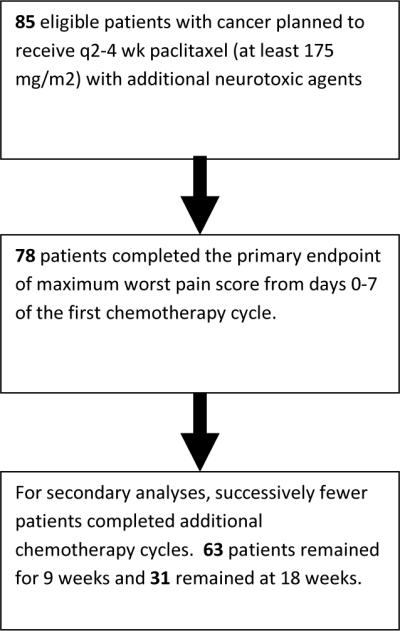
Methods: Patients entering this study were about to receive paclitaxel and carboplatin every 3 weeks. Daily questionnaires were completed for the first week after every chemotherapy dose, and European Organization for Research and Treatment of Cancer, Quality of Life Questionnaire, Chemotherapy-Induced Peripheral Neuropathy 20-item instruments were completed weekly.
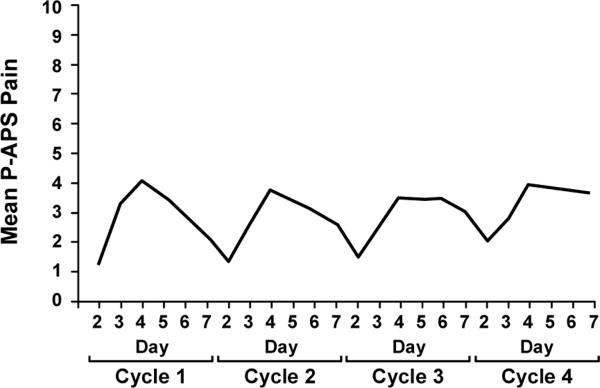
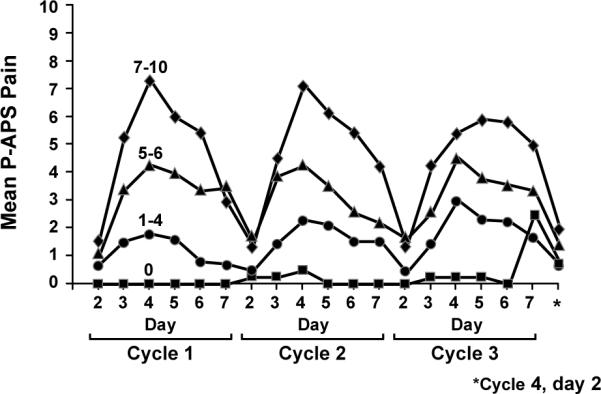
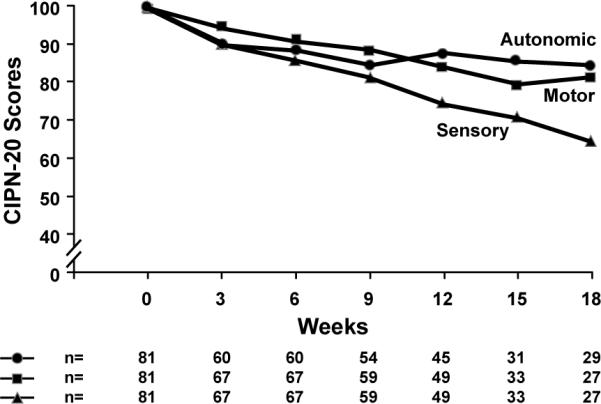
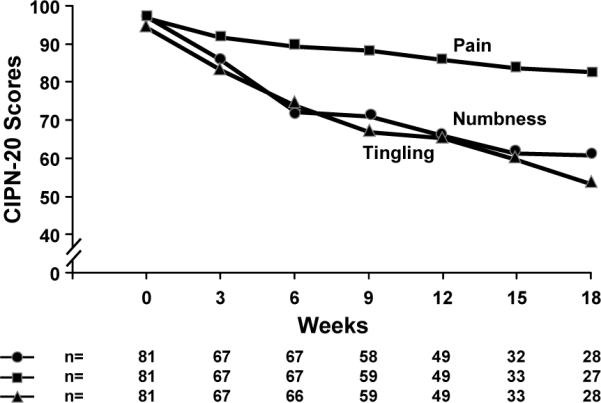
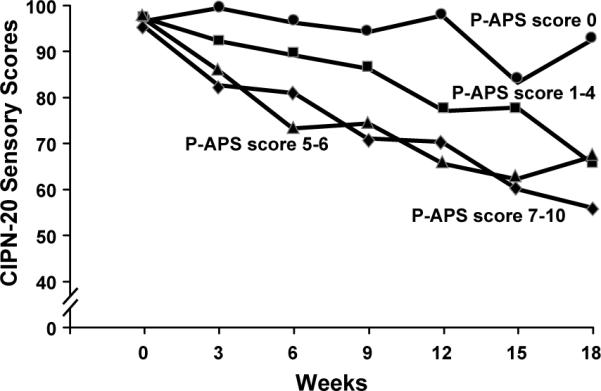
Results: The P-APS severity peaked on day 4 after the initial chemotherapy dose, with 12%, 29%, 23%, and 36% of patients having maximal pain scores of 0, 1 to 4, 5 or 6, or 7 to 10 during the first week after the first dose of therapy, respectively. Patients with P-APS scores of 0 to 4 with the first dose of chemotherapy had less eventual sensory neuropathy than did patients with P-APS scores of 5 to 10 (P = 0.001). With regard to the more peripheral neuropathy, sensory neuropathy was more problematic than was either motor or autonomic neuropathy. Numbness and tingling were more common components of the sensory neuropathy than was pain.
Conclusions: Patients with worse P-APS severities appear to have more eventual chemotherapy-induced peripheral neuropathy. This provides support for the concept that P-APS is a form of nerve pathology.
Copyright © 2012 American Cancer Society.
Figures
References
-
- Rowinsky EK, Eisenhauer EA, Chaudhry V, Arbuck SG, Donehower RC. Clinical toxicities encountered with paclitaxel (Taxol) Semin Oncol. 1993;20(4 Suppl 3):1–15. - PubMed
-
- Garrison JA, McCune JS, Livingston RB, et al. Myalgias and arthralgias associated with paclitaxel. Oncology (Williston Park) 2003;17(2):271–7. discussion 81–2, 86–8. - PubMed
-
- Loprinzi CL, Maddocks-Christianson K, Wolf SL, et al. The Paclitaxel acute pain syndrome: sensitization of nociceptors as the putative mechanism. Cancer J. 2007;13(6):399–403. - PubMed
Publication types
MeSH terms
Substances
Grants and funding
- U10 CA035267/CA/NCI NIH HHS/United States
- U10 CA052352/CA/NCI NIH HHS/United States
- CA-35090/CA/NCI NIH HHS/United States
- K05 CA124477/CA/NCI NIH HHS/United States
- U10 CA037404/CA/NCI NIH HHS/United States
- U10 CA035448/CA/NCI NIH HHS/United States
- CA-25224/CA/NCI NIH HHS/United States
- CA-124477/CA/NCI NIH HHS/United States
- N01 CA063844/CA/NCI NIH HHS/United States
- U10 CA035272/CA/NCI NIH HHS/United States
- U10 CA035113/CA/NCI NIH HHS/United States
- CA-35415/CA/NCI NIH HHS/United States
- U10 CA035431/CA/NCI NIH HHS/United States
- U10 CA035090/CA/NCI NIH HHS/United States
- U10 CA035103/CA/NCI NIH HHS/United States
- U10 CA037417/CA/NCI NIH HHS/United States
- N01 CA035431/CA/NCI NIH HHS/United States
- U10 CA035269/CA/NCI NIH HHS/United States
- CA-37404/CA/NCI NIH HHS/United States
- CA-52352/CA/NCI NIH HHS/United States
- CA-63844/CA/NCI NIH HHS/United States
- U10 CA063848/CA/NCI NIH HHS/United States
- CA-35103/CA/NCI NIH HHS/United States
- CA-35113/CA/NCI NIH HHS/United States
- U10 CA035101/CA/NCI NIH HHS/United States
- CA-63848/CA/NCI NIH HHS/United States
- U10 CA035415/CA/NCI NIH HHS/United States
- CA-37417/CA/NCI NIH HHS/United States
- CA-35272/CA/NCI NIH HHS/United States
- CA-35269/CA/NCI NIH HHS/United States
- CA-35448/CA/NCI NIH HHS/United States
- CA-35101/CA/NCI NIH HHS/United States
- U10 CA025224/CA/NCI NIH HHS/United States
- CA-35267/CA/NCI NIH HHS/United States
- U10 CA063844/CA/NCI NIH HHS/United States
LinkOut - more resources
Full Text Sources
Medical
Miscellaneous
