Multicenter Study
. 2012 May 10;119(19):4467-75.
doi: 10.1182/blood-2011-11-393694. Epub 2012 Mar 13.

Stereotyped B-cell receptors in one-third of chronic lymphocytic leukemia: a molecular classification with implications for targeted therapies

Affiliations
Multicenter Study

Stereotyped B-cell receptors in one-third of chronic lymphocytic leukemia: a molecular classification with implications for targeted therapies

Andreas Agathangelidis et al. Blood. .

Abstract

Mounting evidence indicates that grouping of chronic lymphocytic leukemia (CLL) into distinct subsets with stereotyped BCRs is functionally and prognostically relevant. However, several issues need revisiting, including the criteria for identification of BCR stereotypy and its actual frequency as well as the identification of "CLL-biased" features in BCR Ig stereotypes. To this end, we examined 7596 Ig VH (IGHV-IGHD-IGHJ) sequences from 7424 CLL patients, 3 times the size of the largest published series, with an updated version of our purpose-built clustering algorithm. We document that CLL may be subdivided into 2 distinct categories: one with stereotyped and the other with nonstereotyped BCRs, at an approximate ratio of 1:2, and provide evidence suggesting a different ontogeny for these 2 categories. We also show that subset-defining sequence patterns in CLL differ from those underlying BCR stereotypy in other B-cell malignancies. Notably, 19 major subsets contained from 20 to 213 sequences each, collectively accounting for 943 sequences or one-eighth of the cohort. Hence, this compartmentalized examination of VH sequences may pave the way toward a molecular classification of CLL with implications for targeted therapeutic interventions, applicable to a significant number of patients assigned to the same subset.


Figures
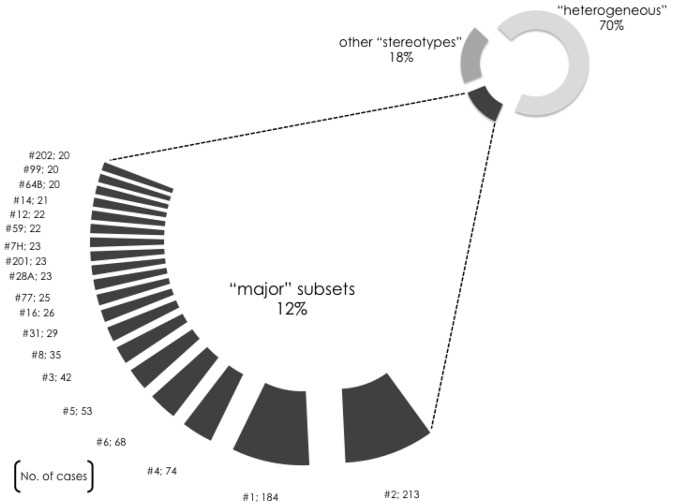
Figure 1
Figure 1
A limited number of major subsets accounts for a sizeable proportion of the CLL Ig repertoire. Nineteen different subsets were identified in the present study containing 20 or more cases and defined as major. The relative size of each major subset (no. 1, 2, etc) is indicated in the graph, while their actual member sequences are listed in supplemental Table 5. Altogether, the 19 major subsets comprised 943 rearrangements in total and accounted for ∼ 41% of the stereotypes and for ∼ 12% of the cohort sequences, hence indicating that an important fraction of CLL cases can be represented by only few VH CDR3 stereotypes.
Figure 2
Figure 2
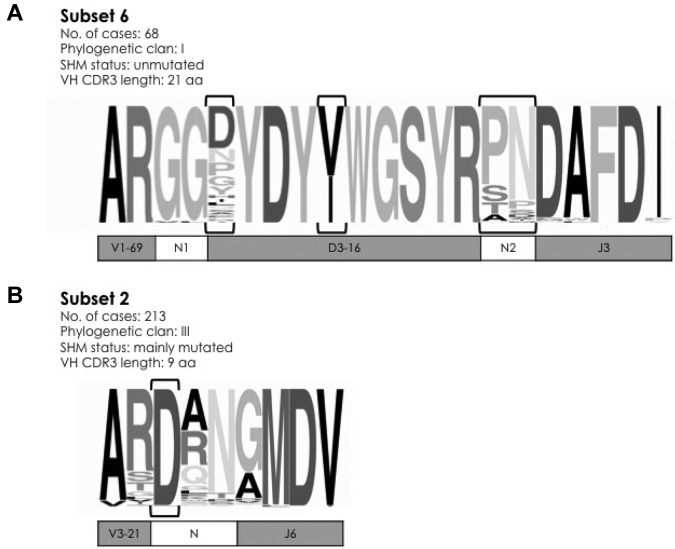
Sequence logos of selected major subsets in CLL. (A) Subset 6 comprises 68 unmutated IGHV1-69/IGHD3-16/IGHJ3 rearrangements, characterized by pronounced overall similarity. In fact, except for 4 VH CDR3 positions (encircled by brackets), which were characterized by variability, all other 17 positions were extremely, if not entirely, conserved. (B) Subset 2 is the largest high-level subset in the present study. Rearrangements belonging to this subset can be simply identified by a 9-aa long VH CDR3 with an acidic residue (aspartic acid D) at position 107 (encircled by brackets). The height of symbols within the stack indicates the relative frequency of each amino acid at that position. Amino acid position is according to the IMGT numbering for the V domain.
Figure 3
Figure 3
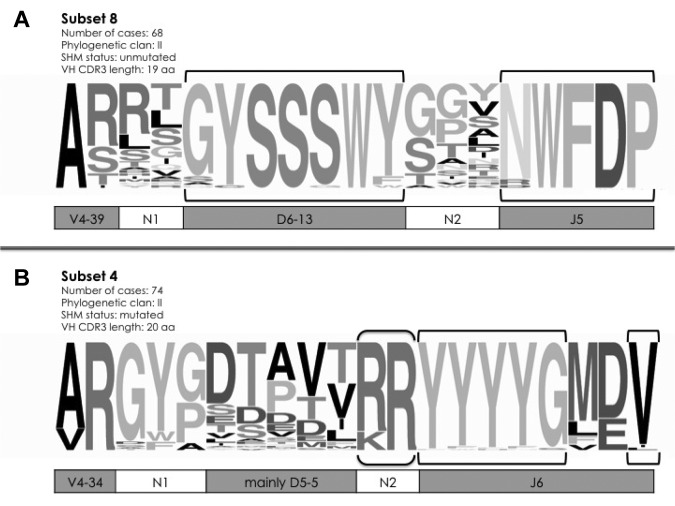
Two types of subset-defining VH CDR3 sequence patterns. (A) Mainly combinatorial. The pattern typical of subset 8 is exclusively composed of amino acids encoded by the unmutated D region of the IGHD6-13 and 5′J region of the IGHJ5 genes, whereas the junctional N-diversity regions (N1 and N2) are diverse. (B) Combinatorial+junctional. The pattern defining subset 4 consists of the junctional N2 amino acids [KR]R at positions 112.4 (tip of the CDR3 loop) and 112.3 and of the IGHJ6-encoded motif YYYYG. The height of symbols within the stack indicates the relative frequency of each amino acid at that position. Amino acid position is according to the IMGT numbering for the V domain.
Figure 4
Figure 4
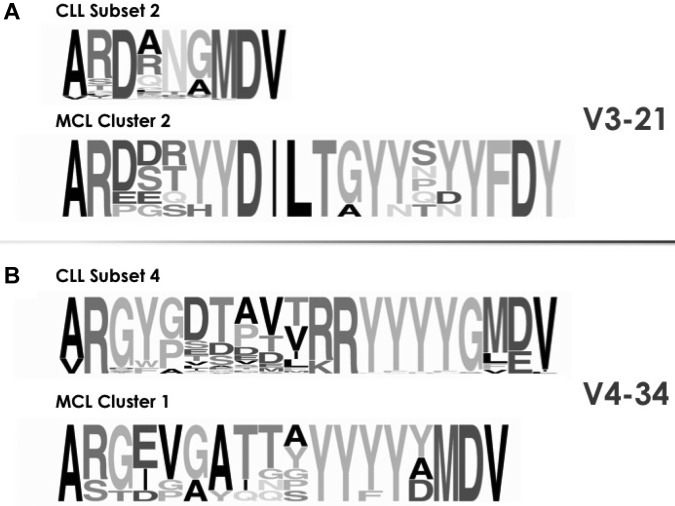
Stereotypes in CLL are disease-biased. As an example, the cross-entity comparison of VH CDR3 sequences among rearrangements from CLL and MCL using the same IGHV genes showed clear differences in a series of molecular features: IGHD and IGHJ gene utilization and also VH CDR3 length and amino acid composition. The height of symbols within the stack indicates the relative frequency of each amino or nucleic acid at that position. Amino acid position is according to the IMGT numbering for V domain.
Figure 5
Figure 5
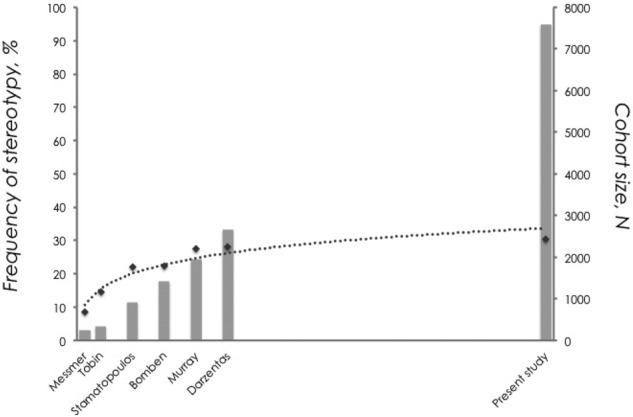
CLL Ig repertoire: one-third stereotyped, two-thirds heterogeneous. A continuous increase in cohort size results in a nonproportional increase in the frequency of VH CDR3 stereotypy. This is best depicted when considering the fact that despite a significant increase in sample size between the present series and the largest published series (almost 5000 additional cases), the increase in the frequency of stereotypy was only 2.4% (data are shown using a logarithmic trendline).
Figure 6
Figure 6
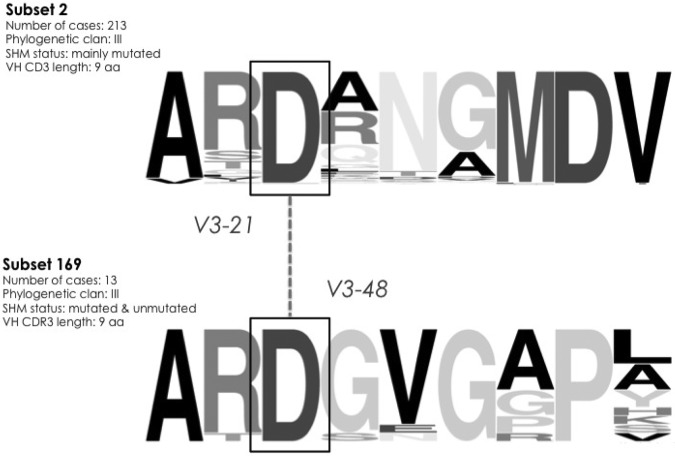
Intriguing sequence similarities between different high-level subsets. VH CDR3 sequences grouped to subsets 2 and 169 share molecular characteristics: a VH CDR3 composed of 9 aa and an aspartic acid (D) residue at position 107. Furthermore, the IGHV3-48 gene (utilized by all 169 rearrangements), is highly similar to the IGHV3-21 gene. The height of symbols within the stack indicates the relative frequency of each amino acid at that position. Amino acid position is according to the IMGT numbering for the V domain.

References

    1. Schroeder HW, Jr, Dighiero G. The pathogenesis of chronic lymphocytic leukemia: analysis of the antibody repertoire. Immunol Today. 1994;15(6):288–294. - PubMed
    1. Hashimoto S, Dono M, Wakai M, et al. Somatic diversification and selection of immunoglobulin heavy and light chain variable region genes in IgG+ CD5+ chronic lymphocytic leukemia B cells. J Exp Med. 1995;181(4):1507–1517. - PMC - PubMed
    1. Efremov DG, Ivanovski M, Siljanovski N, et al. Restricted immunoglobulin VH region repertoire in chronic lymphocytic leukemia patients with autoimmune hemolytic anemia. Blood. 1996;87(9):3869–3876. - PubMed
    1. Johnson TA, Rassenti LZ, Kipps TJ. Ig VH1 genes expressed in B cell chronic lymphocytic leukemia exhibit distinctive molecular features. J Immunol. 1997;158(1):235–246. - PubMed
    1. Fais F, Ghiotto F, Hashimoto S, et al. Chronic lymphocytic leukemia B cells express restricted sets of mutated and unmutated antigen receptors. J Clin Invest. 1998;102(8):1515–1525. - PMC - PubMed

Publication types

MeSH terms

Substances