Comparative Study
. 2012 Aug;21(8):1640-7.
doi: 10.1007/s00586-012-2256-5. Epub 2012 Mar 14.

Comparative effectiveness research across two spine registries

Collaborators, Affiliations
Comparative Study

Comparative effectiveness research across two spine registries

Emin Aghayev et al. Eur Spine J. 2012 Aug.

Abstract

Background: Comparative effectiveness research in spine surgery is still a rarity. In this study, pain alleviation and quality of life (QoL) improvement after lumbar total disc arthroplasty (TDA) and anterior lumbar interbody fusion (ALIF) were anonymously compared by surgeon and implant.

Methods: A total of 534 monosegmental TDAs from the SWISSspine registry were analyzed. Mean age was 42 years (19-65 years), 59% were females. Fifty cases with ALIF were documented in the international Spine Tango registry and used as concurrent comparator group for the pain analysis. Mean age was 46 years (21-69 years), 78% were females. The average follow-up time in both samples was 1 year. Comparison of back/leg pain alleviation and QoL improvement was performed. Unadjusted and adjusted probabilities for achievement of minimum clinically relevant improvements of 18 VAS points or 0.25 EQ-5D points were calculated for each surgeon.

Results: Mean preoperative back pain decreased from 69 to 30 points at 1 year (ØΔ 39pts) after TDA, and from 66 to 27 points after ALIF (ØΔ 39pts). Mean preoperative QoL improved from 0.34 to 0.74 points at 1 year (ØΔ 0.40pts). There were surgeons with better patient selection, indicated by lower adjusted probabilities reflecting worsening of outcomes if they had treated an average patient sample. ALIF had similar pain alleviation than TDA.

Conclusions: Pain alleviation after TDA and ALIF was similar. Differences in surgeon's patient selection based on pain and QoL were revealed. Some surgeons seem to miss the full therapeutic potential of TDA by selecting patients with lower symptom severity.


Figures
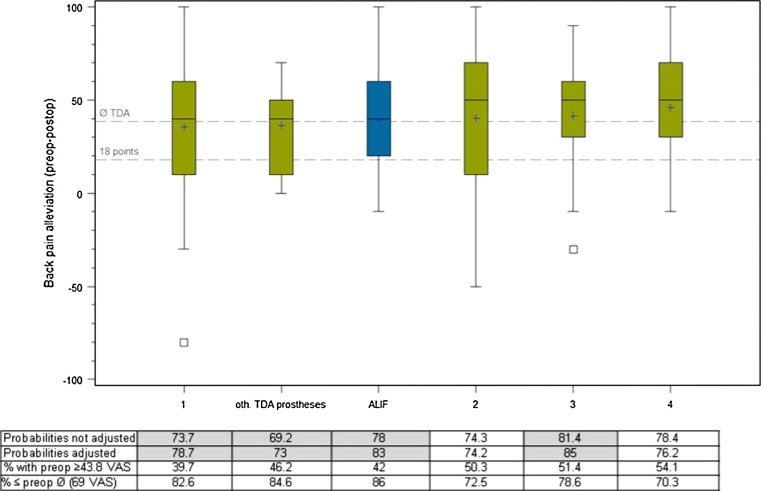
Fig. 1
Fig. 1
Back pain alleviation after TDA (green) and after ALIF (reference, blue) by supplier. The upper reference line represents the average post-operative back pain alleviation of 39 points. The lower reference line represents the 18 VAS points regarded as minimum clinically relevant pain improvement. The increased adjusted probabilities are marked in grey
Fig. 2
Fig. 2
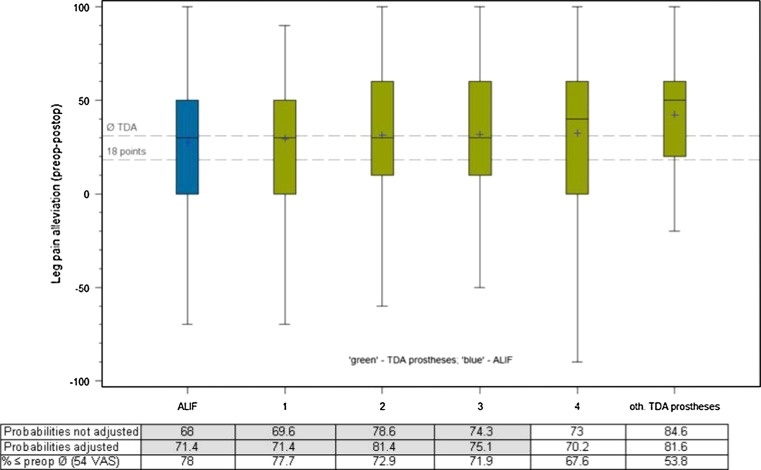
Leg pain alleviation after TDA (green) and after ALIF (reference, blue) by supplier. The upper reference line represents the average post-operative back pain alleviation of 31 points. The lower reference line represents the 18 VAS points regarded as minimum clinically relevant pain improvement. The increased adjusted probabilities are marked in grey
Fig. 3
Fig. 3
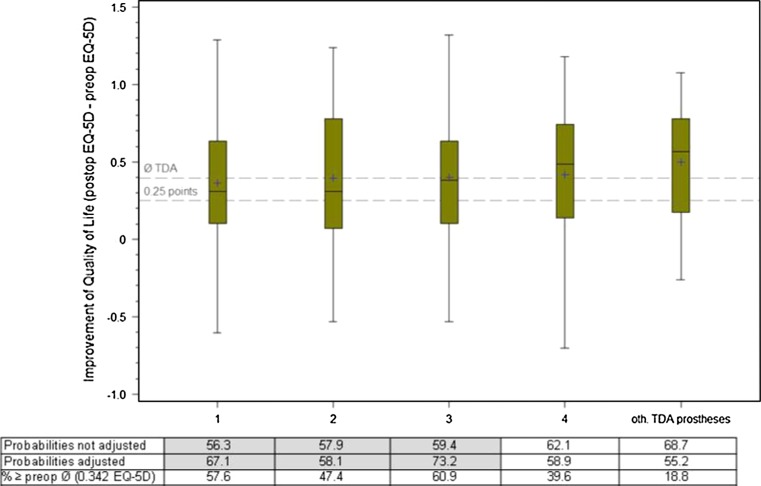
Improvement of quality of life after TDA by supplier. The upper reference line represents the average improvement of quality of life of 0.396 EQ-5D points. The lower reference line represents the 0.25 points regarded as minimum clinically relevant quality of life improvement. The increased adjusted probabilities, which means better outcome if the disc implant would be implanted in an average patient, are marked in grey
Fig. 4
Fig. 4
Back pain alleviation after TDA (green) and after ALIF (comparator, blue) by different surgeons. The upper reference line represents the average post-operative back pain alleviation of 39 points. The lower reference line represents the 18 VAS points regarded as minimum clinically relevant pain improvement. The thicknesses of box plots vary proportionally to the respective subgroup size. The increased adjusted probabilities are marked in grey
Fig. 5
Fig. 5
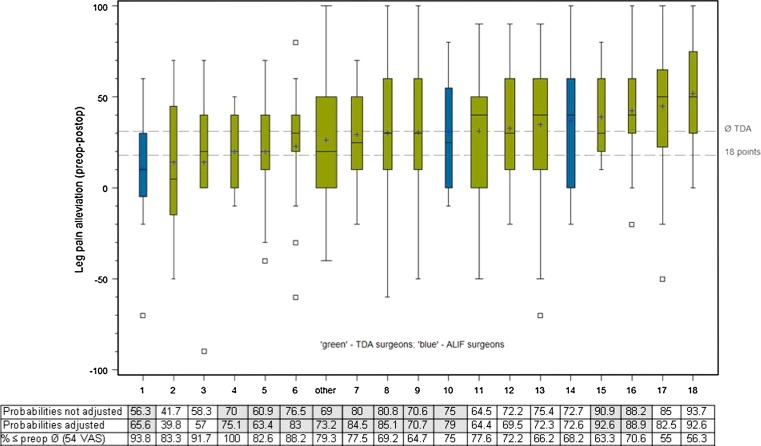
Leg pain alleviation after TDA (green) and after ALIF (comparator, blue) by different surgeons. The upper reference line represents the average post-operative leg pain alleviation of 31 points. The lower reference line represents the 18 VAS points regarded as minimum clinically relevant pain improvement. The thicknesses of box plots vary proportionally to the respective group size. The increased adjusted probabilities are marked in grey
Fig. 6
Fig. 6
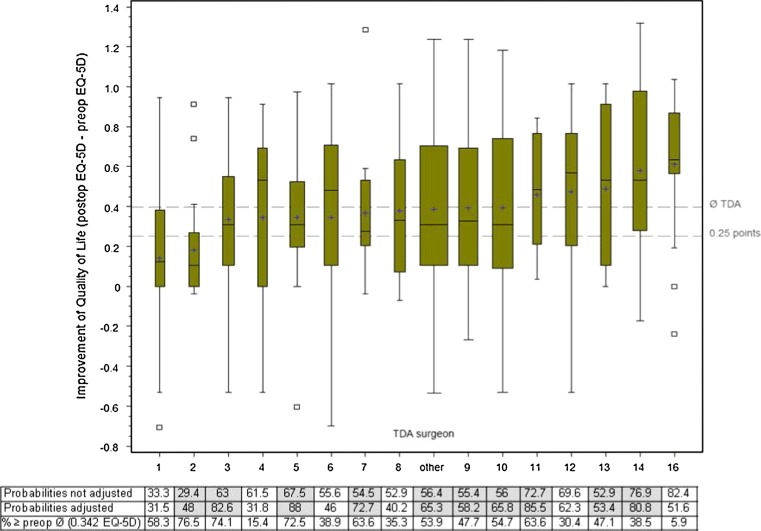
Improvement of quality of life after TDA by different surgeons. The upper reference line represents the average improvement of quality of life of 0.396 EQ-5D points. The lower reference line represents the 0.25 points regarded as minimum clinically relevant quality of life improvement. The thicknesses of box plots vary proportionally to the respective group size. The increased adjusted probabilities are marked in grey

References

    1. Schluessmann E, Aghayev E, Staub L, Moulin P, Zweig T, Roder C (2010) SWISSspine: the case of a governmentally required HTA-registry for total disc arthroplasty: results of cervical disc prostheses. Spine (Phila Pa 1976) 35:E1397–E1405. doi:10.1097/BRS.0b013e3181e0e871 - PubMed
    1. Schluessmann E, Diel P, Aghayev E, Zweig T, Moulin P, Roder C. SWISSspine: a nationwide registry for health technology assessment of lumbar disc prostheses. Eur Spine J. 2009;18:851–861. doi: 10.1007/s00586-009-0934-8. - DOI - PMC - PubMed
    1. Aghayev E, Roder C, Zweig T, Etter C, Schwarzenbach O. Benchmarking in the SWISSspine registry: results of 52 Dynardi lumbar total disc replacements compared with the data pool of 431 other lumbar disc prostheses. Eur Spine J. 2010;19:2190–2199. doi: 10.1007/s00586-010-1550-3. - DOI - PMC - PubMed
    1. Melloh M, Staub L, Aghayev E, Zweig T, Barz T, Theis JC, Chavanne A, Grob D, Aebi M, Roeder C. The international spine registry SPINE TANGO: status quo and first results. Eur Spine J. 2008;17:1201–1209. doi: 10.1007/s00586-008-0665-2. - DOI - PMC - PubMed
    1. Roder C, Staub L, Dietrich D, Zweig T, Melloh M, Aebi M. Benchmarking with Spine Tango: potentials and pitfalls. Eur Spine J. 2009;18(Suppl 3):305–311. doi: 10.1007/s00586-009-0943-7. - DOI - PMC - PubMed

Publication types