


Smoking in response to negative mood in men versus women as a function of distress tolerance
- PMID: 22416115
- PMCID: PMC3509012
- DOI: 10.1093/ntr/nts075
Smoking in response to negative mood in men versus women as a function of distress tolerance
Abstract
Introduction: Negative mood situations often increase smoking behavior and reward, effects that may be greater among women and smokers low in tolerance for distress.
Methods: Adult dependent smokers (N = 164; 86 men, 78 women) first completed measures of distress tolerance via self-report and by mirror-tracing and breath-holding tasks. They then participated in 2 virtually identical laboratory sessions, involving induction of negative versus neutral mood (control) via pictorial slides and music. They rated negative affect (NA) before and during mood induction and smoked their preferred brand ad libitum during the last 14 min of mood induction. Our aim was to examine mood effects on NA, smoking reward ("liking"), and smoking intake (puff volume and number) as a function of sex and distress tolerance.
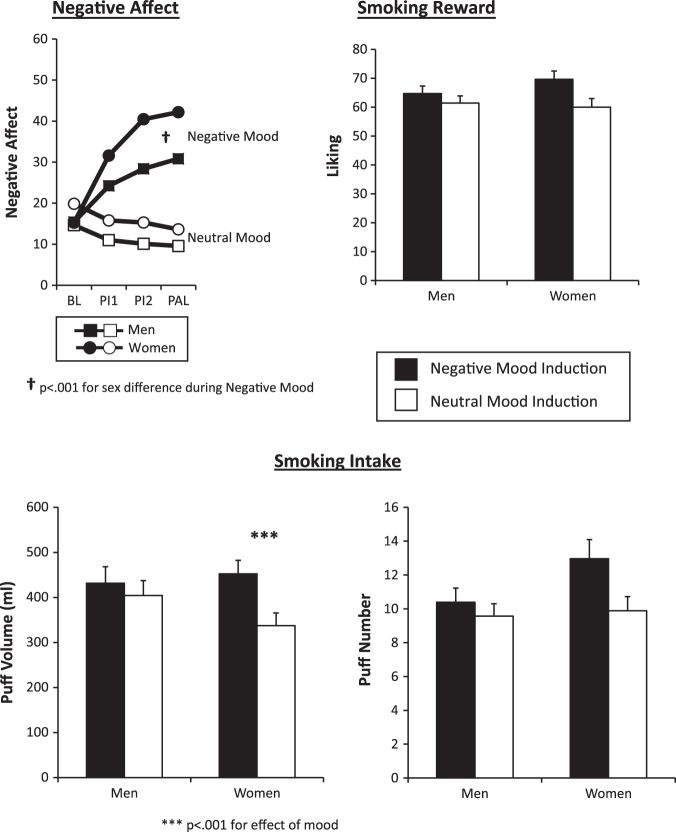
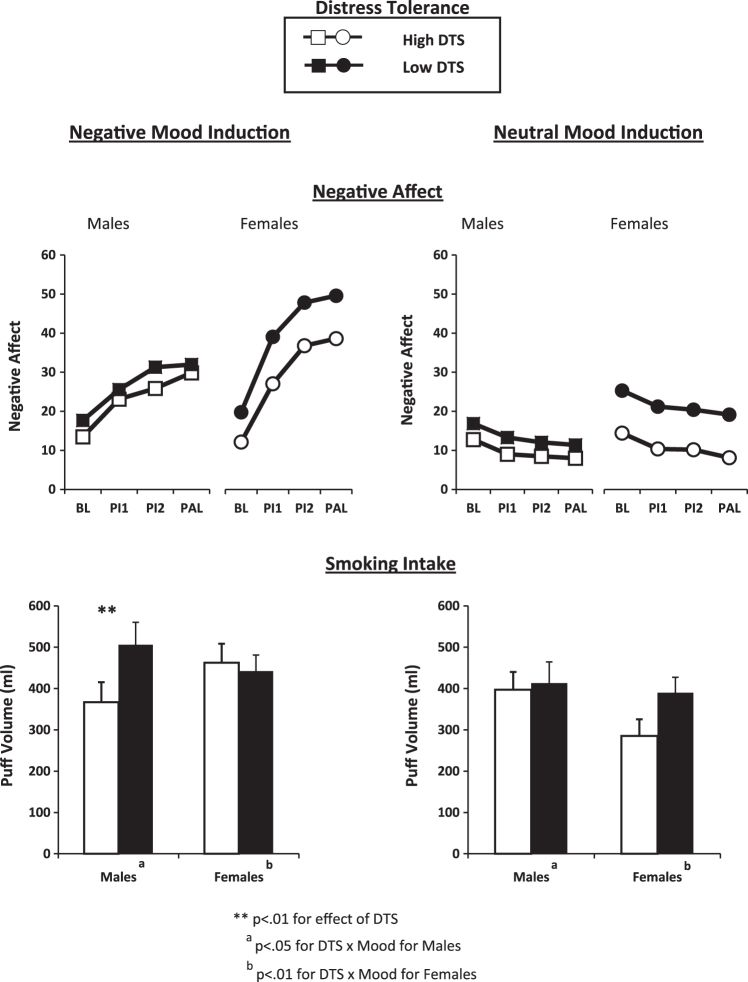
Results: Negative mood induction increased NA, as planned, and smoking reward and intake compared with neutral mood. Increases in NA and puff volume due to negative mood were greater in women compared with men, as hypothesized, but no main effects of the self-report or behavioral distress tolerance measures were seen in responses to mood induction. However, unexpectedly, lower self-reported distress tolerance was associated with greater smoking intake due to negative (but not neutral) mood in men and generally due to neutral (but not negative) mood in women.
Conclusions: Negative mood may increase smoking intake more in women compared with men. Yet, low distress tolerance may enhance smoking intake due to negative versus neutral mood differentially between women and men, suggesting that sex and distress tolerance may interact to influence smoking responses to negative mood.
Figures
References
-
- Baker TB, Piper ME, McCarthy DE, Majeskie MR, Fiore MC. Addiction motivation reformulated: An affective processing model of negative reinforcement. Psychological Review. 2004;1:33–51. doi:10.1037/0033-295X.111.1.33. - PubMed
-
- Bernstein A, Trafton J, Ilgen M, Zvolensky MJ. An evaluation of the role of smoking context on a biobehavioral index of distress tolerance. Addictive Behaviors. 2008;33:1409–1415. doi:10.1016/j.addbeh.2008.06.003. - PubMed
-
- Brandon TH, Herzog TA, Juliano LM, Irvin JE, Lazev AB, Simmons VN. Pretreatment task persistence predicts smoking cessation outcome. Journal of Abnormal Psychology. 2003;112:448–456. doi:10.1037/0021-843X.112.3.448. - PubMed
Publication types
MeSH terms
Grants and funding
LinkOut - more resources
Full Text Sources
