


Medication improves balance and complex gait performance in Parkinson disease
- PMID: 22418585
- PMCID: PMC3372628
- DOI: 10.1016/j.gaitpost.2012.02.009
Medication improves balance and complex gait performance in Parkinson disease
Abstract
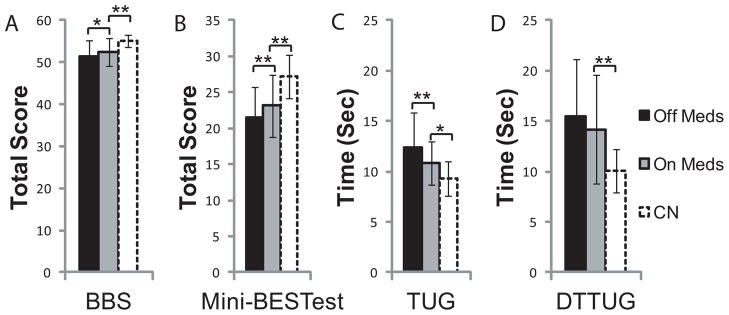
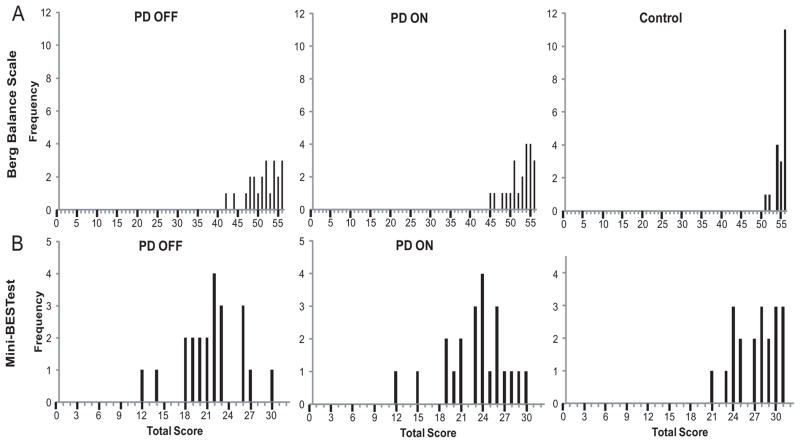
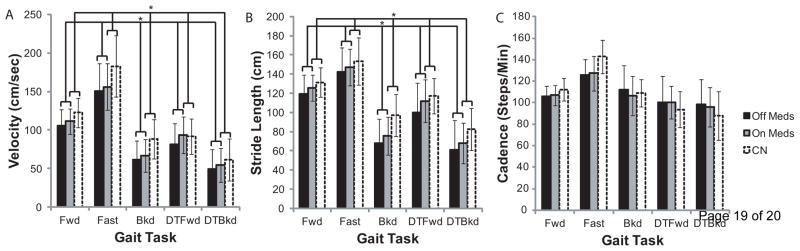
Gait and balance impairments in people with Parkinson disease (PD) may lead to falls and serious injuries. Therefore, it is critical to improve our understanding of the nature of these impairments, including how they respond to prescribed anti-Parkinson medication. This is particularly important for complex balance and gait tasks that may be associated with falls. We evaluated motor function, functional balance, and gait performance during various gait tasks in 22 people with PD OFF and ON medication (PD OFF, PD ON) and 20 healthy older adults. Although MDS-UPDRS-III score, Berg Balance Scale, Mini-Balance Evaluations Systems test, and Timed-Up-and-Go improved in PD with medication, impairments persisted in all measures on medication, compared to controls. Dual task Timed-Up-and-Go did not improve with medication, and PD ON required more time than controls. Gait velocity and stride length improved similarly with medication in PD across forward, fast, backward, dual task forward, and dual task backward gait tasks. Cadence did not change with medication, nor did it differ between PD ON and controls. Velocity and stride length were reduced in PD ON compared to controls. Velocity reductions in PD ON during fast gait were cadence-mediated, while velocity reductions in backward gait were stride length-mediated. Our results suggest functional balance improves with medication in PD and gait performance improves with medication, regardless of task complexity. Remaining impairments on medication highlight the need to examine additional therapeutic options for individuals with PD to reduce the risk of falls.
Copyright © 2012 Elsevier B.V. All rights reserved.
Figures
References
-
- Hametner E, Seppi K, Poewe W. The clinical spectrum of levodopa-induced motor complications. J Neurol. 2010;257(Suppl 2):S268–75. - PubMed
-
- Ganesan M, Pal PK, Gupta A, Sathyaprabha TN. Dynamic posturography in evaluation of balance in patients of Parkinson’s disease with normal pull test: concept of a diagonal pull test. Parkinsonism Relat Disord. 2010;16(9):595–9. - PubMed
-
- Colnat-Coulbois S, Gauchard GC, Maillard L, Barroche G, Vespignani H, Auque J, Perrin PP. Management of postural sensory conflict and dynamic balance control in late-stage Parkinson’s disease. Neuroscience. 2011;193:363–9. - PubMed
Publication types
MeSH terms
Substances
Grants and funding
LinkOut - more resources
Full Text Sources
Medical
Research Materials
Miscellaneous
