


Mouse model of touch-evoked itch (alloknesis)
- PMID: 22418875
- PMCID: PMC3375351
- DOI: 10.1038/jid.2012.52
Mouse model of touch-evoked itch (alloknesis)
Abstract
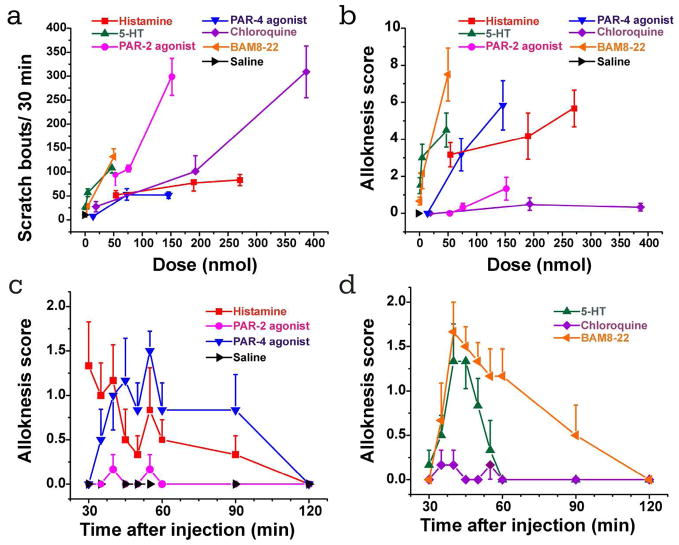
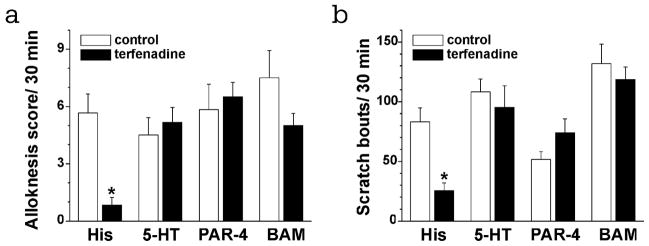
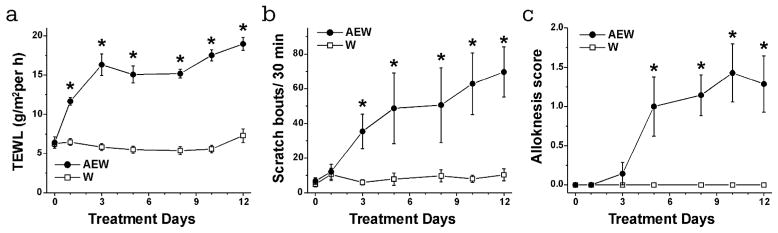
Lightly touching normal skin near a site of itch can elicit itch sensation, a phenomenon known as alloknesis. To investigate the neural mechanisms of alloknesis, we have developed an animal model. Low-threshold mechanical stimulation of the skin normally does not elicit any response in naive C57/BL6 mice. Following acute intradermal (i.d.) injection of histamine in the rostral back, mechanical stimulation 7 mm from the injection site elicited discrete hindlimb scratch bouts directed toward the stimulus. This began at 10 minutes and peaked 20-40 minutes post histamine injection, declining over the next hour. Histamine itself elicited bouts of scratching not associated with the mechanical stimulus, which ceased after 30 minutes. Histamine- and touch-evoked scratching was inhibited by the μ-opiate antagonist naltrexone. Touch-evoked scratching was observed following i.d. 5-HT (5-hydroxytryptamine), a protease-activated receptor (PAR)-4 agonist, and an MrgprC11 agonist BAM8-22, but not chloroquine or a PAR-2 agonist. The histamine H1 receptor antagonist terfenadine prevented scratching and alloknesis evoked by histamine, but not 5-HT, a PAR-4 agonist or an MrgprC11 agonist. In mice with experimental dry skin, there was a time-dependent increase in spontaneous and touch-evoked scratching. This animal model appears to be useful to investigate neural mechanisms of itch and alloknesis.
Conflict of interest statement
CONFLICT OF INTEREST: none.
Figures
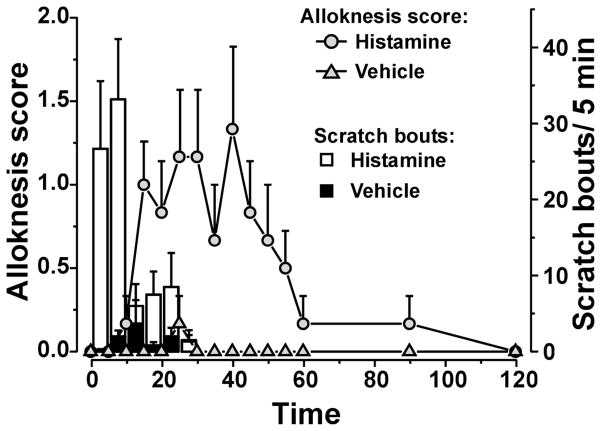
 ) or vehicle (
 ). Error bars are S.E.M. (n = 6/ group). Following intradermal injection of histamine (271 nmol/10 μl; open bars and
) or saline (vehicle; filled bars and
) in the nape of the neck, the mouse was placed into the recording arena and videotaped for 30 min. At 5-min intervals, an innocuous von Frey filament (bending force 0.7 mN) was applied 3 times at separate sites oriented radially at a distance of 7 mm from the histamine injection site, and the presence or absence of a hindlimb scratch bout following each stimulus was noted (maximum alloknesis score = 3). The number of histamine- or vehicle-evoked hindlimb scratch bouts directed to the injection site (not associated with the von Frey stimulus) was counted after the experiment by reviewing the videotape.
). Error bars are S.E.M. (n = 6/ group). Following intradermal injection of histamine (271 nmol/10 μl; open bars and
) or saline (vehicle; filled bars and
) in the nape of the neck, the mouse was placed into the recording arena and videotaped for 30 min. At 5-min intervals, an innocuous von Frey filament (bending force 0.7 mN) was applied 3 times at separate sites oriented radially at a distance of 7 mm from the histamine injection site, and the presence or absence of a hindlimb scratch bout following each stimulus was noted (maximum alloknesis score = 3). The number of histamine- or vehicle-evoked hindlimb scratch bouts directed to the injection site (not associated with the von Frey stimulus) was counted after the experiment by reviewing the videotape.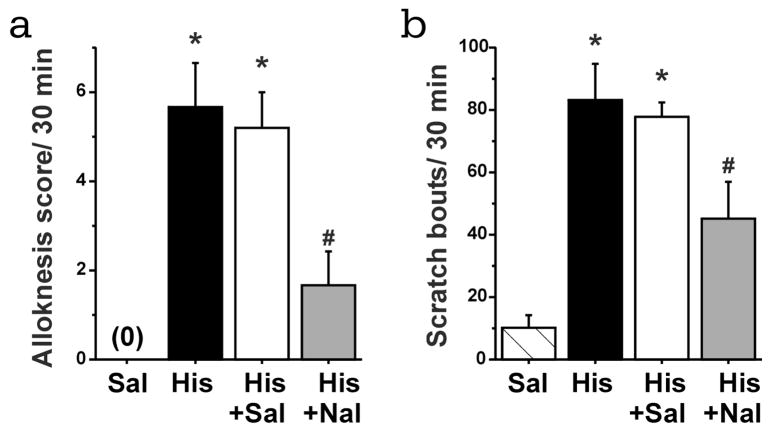
References
-
- Akiyama T, Carstens MI, Carstens E. Differential itch- and pain-related behavioral responses and micro-opoid modulation in mice. Acta Derm Venereol. 2010a;90:575–81. - PubMed
Publication types
MeSH terms
Substances
Grants and funding
LinkOut - more resources
Full Text Sources
Other Literature Sources
Medical
Research Materials
