Review
. 2012 Mar;190(3):841-54.
doi: 10.1534/genetics.111.136911.

Gene overexpression: uses, mechanisms, and interpretation

Affiliations
Review

Gene overexpression: uses, mechanisms, and interpretation

Gregory Prelich. Genetics. 2012 Mar.

Abstract

The classical genetic approach for exploring biological pathways typically begins by identifying mutations that cause a phenotype of interest. Overexpression or misexpression of a wild-type gene product, however, can also cause mutant phenotypes, providing geneticists with an alternative yet powerful tool to identify pathway components that might remain undetected using traditional loss-of-function analysis. This review describes the history of overexpression, the mechanisms that are responsible for overexpression phenotypes, tests that begin to distinguish between those mechanisms, the varied ways in which overexpression is used, the methods and reagents available in several organisms, and the relevance of overexpression to human disease.


Figures
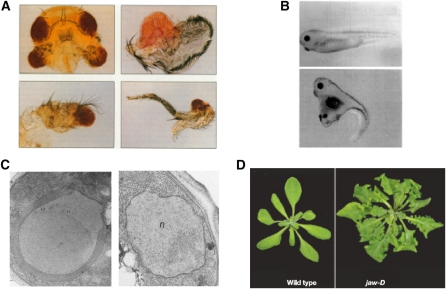
Figure 1
Figure 1
Examples of overexpression phenotypes. Overexpression has been used effectively in multiple organisms, with representative examples depicted here. (A) Overexpression of eyeless (Pax6) in the Drosophila head (top left), wing (top right), antenna (bottom left), or leg (bottom right) imaginal discs generates ectopic eye tissue (Halder et al. 1995). (B) Overexpression of Wnt-1 in Xenopus causes duplication of the dorsal body axis (Sokol et al. 1991). A dorsally injected embryo is shown on top, and an embryo injected ventrally with mouse Wnt-1 RNA is on bottom. (C) Overexpression HMG1 in yeast (left) results in the accumulation of ER stacks known as karmellae surrounding the nucleus (Wright et al. 1988). A nucleus from a cell not overexpressing HMG1 is presented on the right. (D) Overexpression of the JAW miRNA driven by a viral enhancer affects leaf development in Arabidopsis (Palatnik et al. 2003).
Figure 2
Figure 2
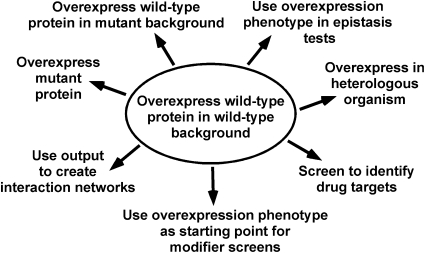
Common uses of overexpression. The prototypical strategy of overexpressing a wild-type gene in a wild-type cell is depicted in the center of the figure. The outer ring of variations on the founding core strategy is described in detail in the text.
Figure 3
Figure 3
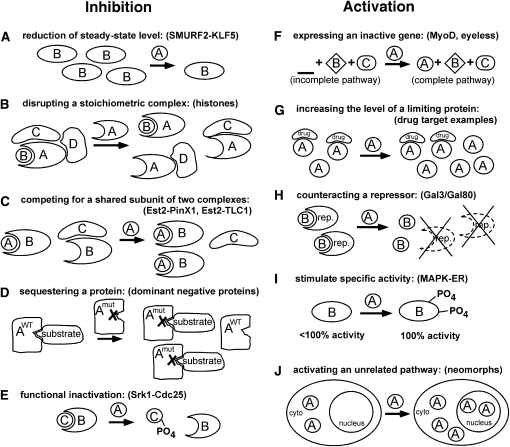
Mechanisms responsible for overexpression phenotypes. Overexpression mechanisms can be placed into two broad categories that can inhibit (left column) or activate (right column) proteins, with specific mechanisms depicted below. For each variation, a representative example that is discussed more fully in the text is provided in parentheses. (A) Overexpression can simply reduce the steady-state levels of other proteins, by affecting their transcription, translation, or their rate of degradation. (B) Overexpression of subunit A that make multiple contacts within a multi-protein complex can result in partial A-B, A-D, or A-C subassemblies, thereby reducing the amount of the intact functional A-B-C-D complex. (C) If protein B participates in two separate A-B and A-C complexes, overexpression of nonshared subunit A could effectively compete for limiting amounts of protein B, reducing the amount of functional B-C complexes. (D) Overexpression of a mutant enzyme A that can still bind to its substrate competes that substrate from wild-type enzyme A by a classical dominant negative or antimorphic mechanism. (E) Overexpression can functionally inactivate proteins independent of competition-based mechanisms. Depicted here, post-translational modification of one subunit disrupts a protein–protein interaction. (F) Expressing a normally silent gene under a condition where the rest of a pathway is intact can activate its pathway. (G) Overexpressing a gene under a condition where it is expressed, but limiting, could increase total activity and stimulate output. (H) Counteracting a repressor by any number of mechanisms, including degradation of the repressor, inactivating it by post-translational modification or by direct competition could activate a pathway. In this example, overexpression of gene A results in degradation of a repressor (rep.), releasing active protein B. (I) Overexpression can increase the specific activity of other proteins. The most common mechanism is likely via post-translational modifications. (J) Overexpression can activate new pathways via neomorphic effects. Here, overexpression of the normally cytoplasmic protein A results in accumulation of a subpopulation in the nucleus, which causes a novel phenotype. See text for details.

References

    1. Alt F. W., Kellems R. E., Schimke R. T., 1976. Synthesis and degradation of folate reductase in sensitive and methotrexate-resistant lines of S-180 cells. J. Biol. Chem. 251: 3063–3074 - PubMed
    1. Arnoldo A., Curak J., Kittanakom S., Chevelev I., Lee V. T., et al. , 2008. Identification of small molecule inhibitors of Pseudomonas aeruginosa exoenzyme S using a yeast phenotypic screen. PLoS Genet. 4: e1000005. - PMC - PubMed
    1. Barren B., Artemyev N. O., 2007. Mechanisms of dominant negative G-protein alpha subunits. J. Neurosci. Res. 85: 3505–3514 - PubMed
    1. Beaujouin M., Baghdiguian S., Glondu-Lassis M., Berchem G., Liaudet-Coopman E., 2006. Overexpression of both catalytically active and -inactive cathepsin D by cancer cells enhances apoptosis-dependent chemo-sensitivity. Oncogene 25: 1967–1973 - PMC - PubMed
    1. Beggs J. D., 1978. Transformation of yeast by a replicating hybrid plasmid. Nature 275: 104–109 - PubMed

Publication types