


Single dose oral celecoxib for acute postoperative pain in adults
- PMID: 22419293
- PMCID: PMC4161494
- DOI: 10.1002/14651858.CD004233.pub3
Single dose oral celecoxib for acute postoperative pain in adults
Update in
-
Single dose oral celecoxib for acute postoperative pain in adults.Cochrane Database Syst Rev. 2013 Oct 22;2013(10):CD004233. doi: 10.1002/14651858.CD004233.pub4. Cochrane Database Syst Rev. 2013. PMID: 24150982 Free PMC article.
Abstract
Background: This is an update of a review published in The Cochrane Library 2008, Issue 4. Celecoxib is a selective cyclo-oxygenase-2 (COX-2) inhibitor usually prescribed for the relief of chronic pain in osteoarthritis and rheumatoid arthritis. Celecoxib is believed to be associated with fewer upper gastrointestinal adverse effects than conventional non-steroidal anti-inflammatory drugs (NSAIDs). Its effectiveness in acute pain was demonstrated in the earlier reviews.
Objectives: To assess analgesic efficacy and adverse effects of a single oral dose of celecoxib for moderate to severe postoperative pain.
Search methods: We searched the Cochrane Central Register of Controlled Trials (CENTRAL), MEDLINE, EMBASE, the Oxford Pain Database, and ClinicalTrials.gov. The most recent search was to 3 January 2012.
Selection criteria: We included randomised, double-blind, placebo-controlled trials (RCTs) of adults prescribed any dose of oral celecoxib or placebo for acute postoperative pain.
Data collection and analysis: Two review authors assessed studies for quality and extracted data. We converted summed pain relief (TOTPAR) or pain intensity difference (SPID) into dichotomous information, yielding the number of participants with at least 50% pain relief over four to six hours, and used this to calculate the relative benefit (RB) and number needed to treat to benefit (NNT) for one patient to achieve at least 50% of maximum pain relief with celecoxib who would not have done so with placebo. We used information on use of rescue medication to calculate the proportion of participants requiring rescue medication and the weighted mean of the median time to use.
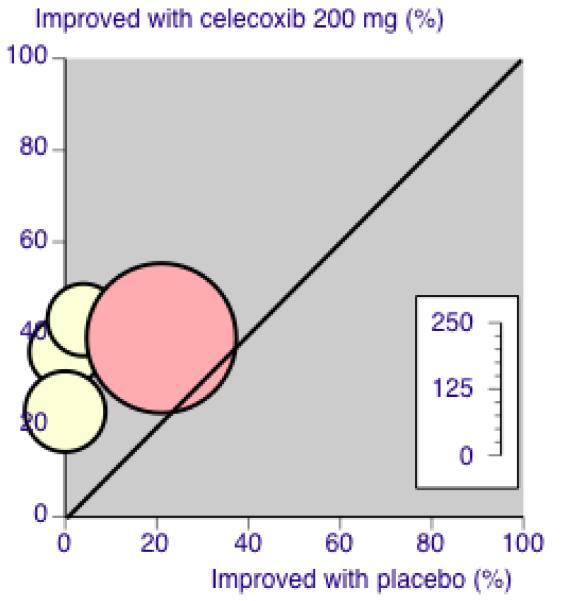
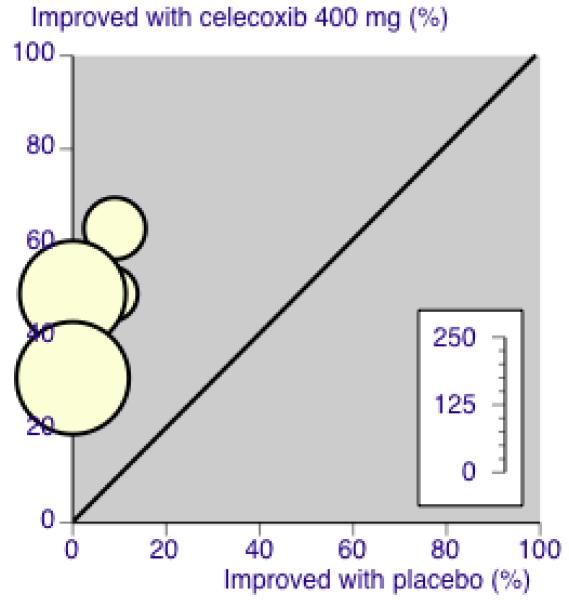
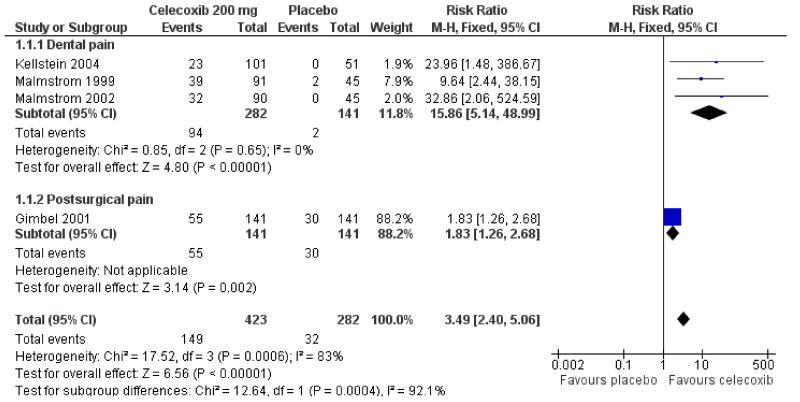
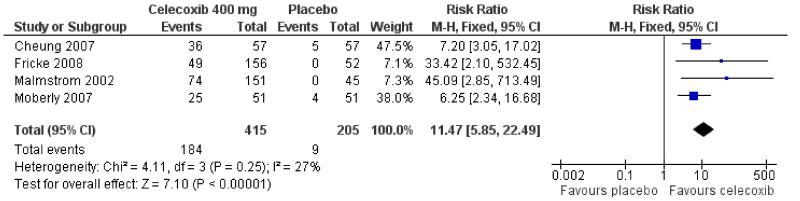
Main results: Eight studies (1380 participants) met the inclusion criteria. We identified five potentially relevant unpublished studies in the most recent searches, but data were not available at this time. The number of included studies therefore remains unchanged.The NNT for celecoxib 200 mg and 400 mg compared with placebo for at least 50% of maximum pain relief over four to six hours was 4.2 (95% confidence interval (CI) 3.4 to 5.6) and 2.5 (2.2 to 2.9) respectively. The median time to use of rescue medication was 6.6 hours with celecoxib 200 mg, 8.4 with celecoxib 400 mg, and 2.3 hours with placebo. The proportion of participants requiring rescue medication over 24 hours was 74% with celecoxib 200 mg, 63% for celecoxib 400 mg, and 91% for placebo. The NNT to prevent one patient using rescue medication was 4.8 (3.5 to 7.7) and 3.5 (2.9 to 4.6) for celecoxib 200 mg and 400 mg respectively. Adverse events were generally mild to moderate in severity, and were experienced by a similar proportion of participants in celecoxib and placebo groups. One serious adverse event probably related to celecoxib was reported.
Authors' conclusions: Single-dose oral celecoxib is an effective analgesic for postoperative pain relief. Indirect comparison suggests that the 400 mg dose has similar efficacy to ibuprofen 400 mg.
Figures
Update of
-
Single dose oral celecoxib for acute postoperative pain in adults.Cochrane Database Syst Rev. 2008 Oct 8;(4):CD004233. doi: 10.1002/14651858.CD004233.pub2. Cochrane Database Syst Rev. 2008. Update in: Cochrane Database Syst Rev. 2012 Mar 14;(3):CD004233. doi: 10.1002/14651858.CD004233.pub3. PMID: 18843655 Updated.
References
References to studies included in this review
-
- Cheung R, Krishnaswami S, Kowalski K. Analgesic efficacy of celecoxib in postoperative oral surgery pain: a single-dose, two-center, randomized, double-blind, active- and placebo-controlled study. Clinical Therapeutics. 2007;29(Suppl):2498–510. - PubMed
-
- Doyle G, Jayawardena S, Ashraf E, Cooper SA. Efficacy and tolerability of nonprescription ibuprofen versus celecoxib for dental pain. Journal of Clinical Pharmacology. 2002;42(8):912–9. - PubMed
-
- Fricke J, Davis N, Yu V, Krammer G. Lumiracoxib 400 mg compared with celecoxib 400 mg and placebo for treating pain following dental surgery: a randomized, controlled trial. Journal of Pain. 2008;9(1):20–7. - PubMed
-
- Gimbel JS, Brugger A, Zhao W, Verburg KM, Geis GS. Efficacy and tolerability of celecoxib versus hydrocodone/acetaminophen in the treatment of pain after ambulatory orthopedic surgery in adults. Clinical Therapeutics. 2001;23(2):228–41. - PubMed
-
- Kellstein D, Ott D, Jayawardene S, Fricke J. Analgesic efficacy of a single dose of lumiracoxib compared with rofecoxib, celecoxib and placebo in the treatment of post-operative dental pain. International Journal of Clinical Practice. 2004;58(3):244–50. - PubMed
References to studies excluded from this review
-
- Salo DF, Lavery R, Varma V, Goldberg J, Shapiro T, Kenwood A. A randomized, clinical trial comparing oral celecoxib 200 mg, celecoxib 400 mg, and ibuprofen 600 mg for acute pain. Academic Emergency Medicine. 2003;10:22–30. - PubMed
-
- White PF, Sacan O, Tufanogullari B, Eng M, Nuangchamnong N, Ogunnaike B. Effect of short-term postoperative celecoxib administration on patient outcomeafter outpatient laparoscopic surgery. Canadian Journal of Anaesthesia. 2007;54(5):342–8. - PubMed
References to studies awaiting assessment
-
- An etodolac- and placebo-controlled, multicenter, double-blind, group comparison study to verify the efficacy of YM177 (Celecoxib) in postoperative pain patients. CTG: NCT01118572.
-
-
ARRY-797-221 {unpublished data only}
-
-
- A randomized, double-blind, placebo- and active-controlled, parallel-group analgesic efficacy trial of oral ARRY-371797 in subjects undergoing third molar extraction. CTG: NCT00663767.
-
- A phase 2, randomized, double-blind, single-dose, parallel-group, active- and placebo-controlled study of diclofenac [Test] capsules for the treatment of pain after surgical removal of impacted third molars. CTG: NCT00985439.
-
- A phase 2, randomized, double-blind, single-dose, parallel-group, active- and placebo-controlled study of indomethacin test capsules for the treatment of pain after surgical removal of impacted third molars. CTG: NCT00964431.
Additional references
-
- Barden J, Edwards JE, McQuay HJ, Andrew Moore R. Pain and analgesic response after third molar extraction and other postsurgical pain. Pain. 2004;107(1-2):86–90. DOI: 10.1016/j.pain.2003.09.021. - PubMed
-
- Clarke R, Derry S, Moore RA, McQuay HJ. Single dose oral etoricoxib for postoperative pain. Cochrane Database of Systematic Reviews. 2012 Issue in press. - PubMed
-
- Collins SL, Moore RA, McQuay HJ. The visual analogue pain intensity scale: what is moderate pain in millimetres? Pain. 1997;72:95–7. - PubMed
-
- Collins SL, Edwards J, Moore RA, Smith LA, McQuay HJ. Seeking a simple measure of analgesia for mega-trials: is a single global assessment good enough? Pain. 2001;91:189–94. - PubMed
Publication types
MeSH terms
Substances
LinkOut - more resources
Full Text Sources
Research Materials
Miscellaneous
