Variations in non-pharmacological anti-infective measures in childhood leukemia--results of an international survey
- PMID: 22419572
- PMCID: PMC3487555
- DOI: 10.3324/haematol.2012.062885
Variations in non-pharmacological anti-infective measures in childhood leukemia--results of an international survey
Erratum in
- Haematologica. 2014 Jul;99(7):1272
Abstract
Background: Standardization in clinical practice may lead to improved outcomes. Unfortunately, little is known about the variability of non-pharmacological anti-infective measures in children with cancer.
Design and methods: A web-based survey assessed institutional recommendations regarding restrictions of social contacts, pets and food and instructions on wearing face masks in public for children with standard- risk acute lymphoblastic leukemia and acute myeloid leukemia during intensive chemotherapy.
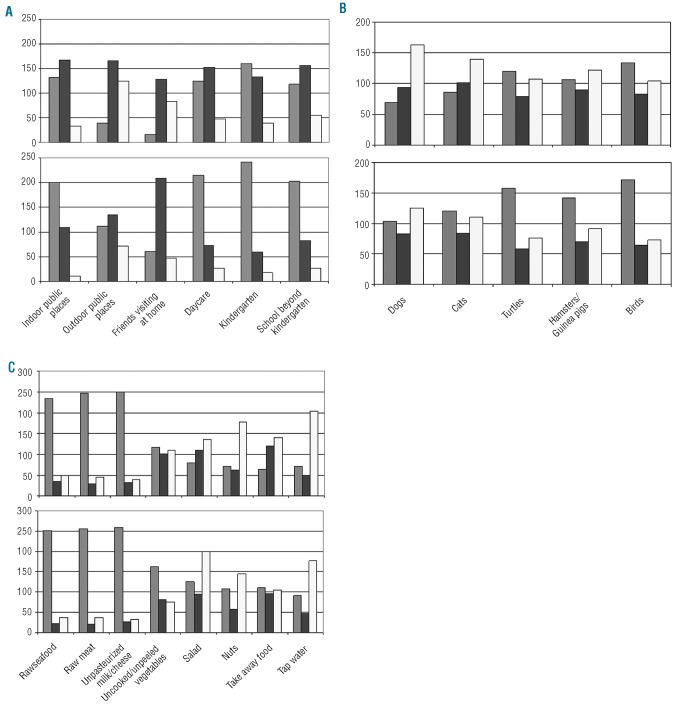
Results: A total of 336 institutions in 27 countries responded to the survey (range, 1-76 institutions per country; overall response rate 61%). Most institutions recommend that patients with acute myeloid leukemia avoid indoor public places and daycare, kindergarten and school, whereas recommendations for patients with acute lymphoblastic leukemia differ considerably by institution. In terms of restrictions related to pets, there was a wide variability between institutions for both acute lymphoblastic and acute myeloid leukemia patients. Most, but not all institutions do not allow children with either acute lymphoblastic or acute myeloid leukemia to eat raw meat, raw seafood or unpasteurized milk. Whereas most institutions do not routinely recommend that patients with acute lymphoblastic leukemia wear face masks in public, advice on this matter varies for patients with acute myeloid leukemia.
Conclusions: The survey demonstrates that there is a wide variation in recommendations on non-pharmacological anti-infective measures between different institutions, countries and continents. This information may be used to encourage harmonization of supportive care practices and future clinical trials.
Figures
References
-
- Castagnola E, Bagnasco F, Faraci M, Caviglia I, Caruso S, Cappelli B, et al. Incidence of bacteremias and invasive mycoses in children undergoing allogeneic hematopoietic stem cell transplantation: a single center experience. Bone Marrow Transplant. 2008; 41(4):339–47 - PubMed
-
- Sung L, Lange BJ, Gerbing RB, Alonzo TA, Feusner J. Microbiologically documented infections and infection-related mortality in children with acute myeloid leukemia. Blood 2007; 110(10):3532–9 - PubMed
-
- Rungoe C, Malchau EL, Larsen LN, Schroeder H. Infections during induction therapy for children with acute lymphoblastic leukemia. the role of sulfamethoxazoletrimethoprim (SMX-TMP) prophylaxis. Pediatr Blood Cancer. 2010;55(2):304–8 - PubMed
-
- Bochennek K, Tramsen L, Schedler N, Becker M, Klingebiel T, Groll AH, et al. Liposomal amphotericin B twice weekly as antifungal prophylaxis in pediatric high risk patients. Clin Microb Infect. 2011; 17(12):1868–74 - PubMed
-
- Sung L, Nathan PC, Lange B, Beyene J, Buchanan GR. Prophylactic granulocyte colony-stimulating factor and granulocytemacrophage colony-stimulating factor decrease febrile neutropenia after chemotherapy in children with cancer: a meta-analysis of randomized controlled trials. J Clin Oncol. 2004; 22(16):3350–6 - PubMed
Publication types
MeSH terms
LinkOut - more resources
Full Text Sources
Medical