A life course perspective on how racism may be related to health inequities
- PMID: 22420802
- PMCID: PMC3483932
- DOI: 10.2105/AJPH.2012.300666
A life course perspective on how racism may be related to health inequities
Abstract
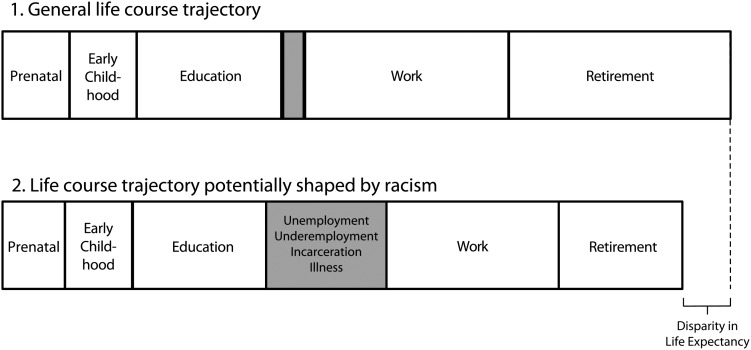
Recent studies show that racism may influence health inequities. As individuals grow from infancy into old age, they encounter social institutions that may create new exposures to racial bias. Yet, few studies have considered this idea fully. We suggest a framework that shows how racism and health inequities may be viewed from a life course perspective. It applies the ideas of age-patterned exposures, sensitive periods, linked lives, latency period, stress proliferation, historic period, and cohorts. It suggests an overarching idea that racism can structure one's time in asset-building contexts (e.g., education) or disadvantaged contexts (e.g., prison). This variation in time and exposure can contribute to racial inequities in life expectancy and other health outcomes across the life course and over generations.
Figures
References
-
- Krieger N. Embodying inequality: a review of concepts, measures, and methods for studying health consequences of discrimination. Int J Health Serv. 1999;29(2):295–352 - PubMed
MeSH terms
Grants and funding
LinkOut - more resources
Full Text Sources
Medical