


Rapid sequence intubation for pediatric emergency patients: higher frequency of failed attempts and adverse effects found by video review
- PMID: 22424653
- PMCID: PMC3400706
- DOI: 10.1016/j.annemergmed.2012.02.013
Rapid sequence intubation for pediatric emergency patients: higher frequency of failed attempts and adverse effects found by video review
Abstract
Study objective: Using video review, we seek to determine the frequencies of first-attempt success and adverse effects during rapid sequence intubation (RSI) in a large, tertiary care, pediatric emergency department (ED).
Methods: We conducted a retrospective study of children undergoing RSI in the ED of a pediatric institution. Data were collected from preexisting video and written records of care provided. The primary outcome was successful tracheal intubation on the first attempt at laryngoscopy. The secondary outcome was the occurrence of any adverse effect during RSI, including episodes of physiologic deterioration. We collected time data from the RSI process by using video review. We explored the association between physician type and first-attempt success.
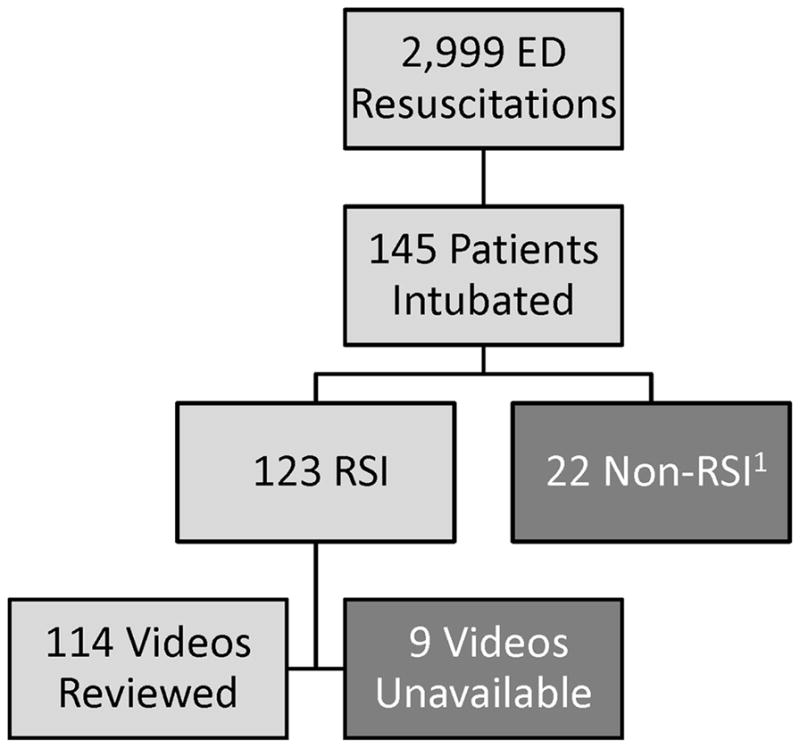
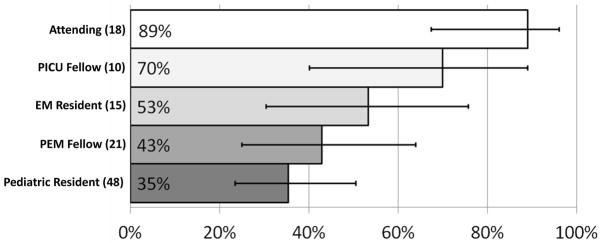
Results: We obtained complete records for 114 of 123 (93%) children who underwent RSI in the ED during 12 months. Median age was 2.4 years, and 89 (78%) were medical resuscitations. Of the 114 subjects, 59 (52%) were tracheally intubated on the first attempt. Seventy subjects (61%) had 1 or more adverse effects during RSI; 38 (33%) experienced oxyhemoglobin desaturation and 2 required cardiopulmonary resuscitation after physiologic deterioration. Fewer adverse effects were documented in the written records than were observed on video review. The median time from induction through final endotracheal tube placement was 3 minutes. After adjusting for patient characteristics and illness severity, attending-level providers were 10 times more likely to be successful on the first attempt than all trainees combined.
Conclusion: Video review of RSI revealed that first-attempt failure and adverse effects were much more common than previously reported for children in an ED.
Copyright © 2012. Published by Mosby, Inc.
Figures
Comment in
-
A is for airway: a pediatric emergency department challenge.Ann Emerg Med. 2012 Sep;60(3):261-3. doi: 10.1016/j.annemergmed.2012.03.019. Epub 2012 Apr 19. Ann Emerg Med. 2012. PMID: 22520991 No abstract available.
References
-
- Walls RM, Murphy MF, editors. Manual of Emergency Airway Management. 3. Lipincott, Williams, and Wilkins; 2008.
-
- Sagarin MJ, Barton ED, Chng YM, et al. Airway management by US and Canadian emergency medicine residents: a multicenter analysis of more than 6,000 endotracheal intubation attempts. Ann Emerg Med. 2005 Oct;46(4):328–336. - PubMed
-
- Sagarin MJ, Chiang V, Sakles JC, et al. Rapid sequence intubation for pediatric emergency airway management. Pediatr Emerg Care. 2002 Dec;18(6):417–423. - PubMed
-
- Sakles JC, Laurin EG, Rantapaa AA, et al. Airway management in the emergency department: a one-year study of 610 tracheal intubations. Ann Emerg Med. 1998 Mar;31(3):325–332. - PubMed
-
- Fastle R, Roback M. Pediatric rapid sequence intubation: incidence of reflex bradycardia and effects of pretreatment with atropine. Pediatr Emerg Care. 2004 Oct;20(10):651–655. - PubMed
Publication types
MeSH terms
Grants and funding
LinkOut - more resources
Full Text Sources
Medical
