


Why men are at higher risk for hepatocellular carcinoma?
- PMID: 22425699
- PMCID: PMC3506003
- DOI: 10.1016/j.jhep.2012.03.004
Why men are at higher risk for hepatocellular carcinoma?
Abstract
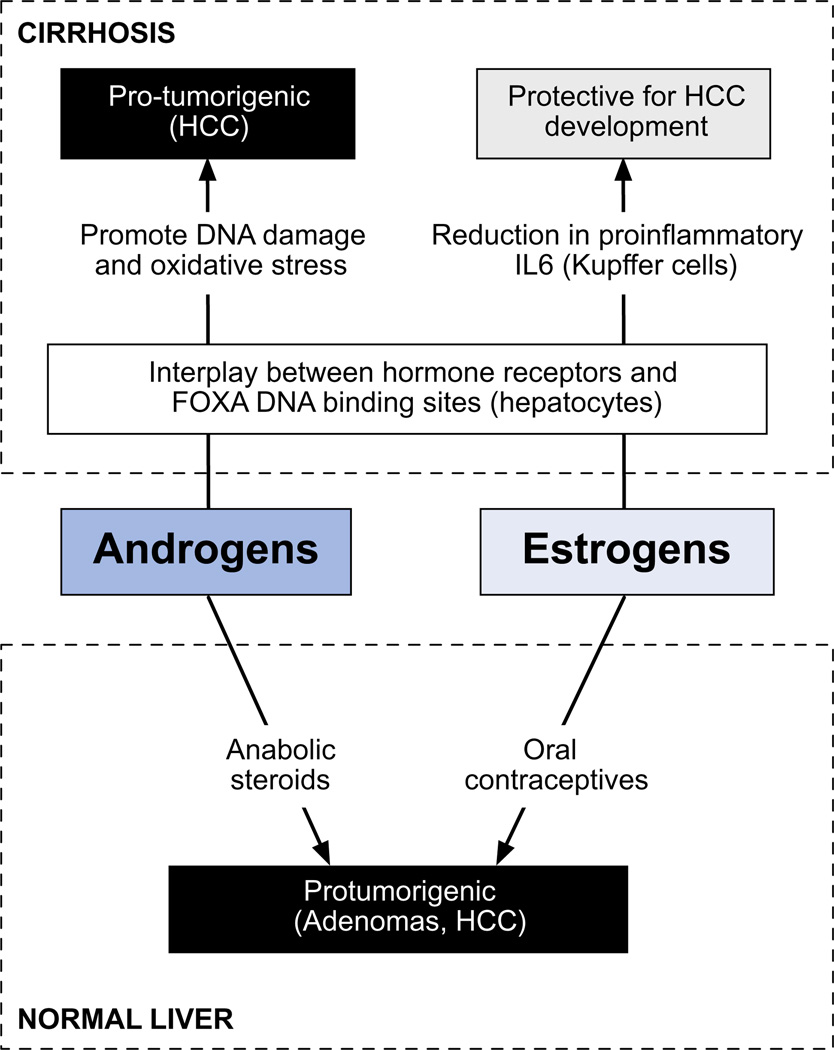
Hepatocellular carcinoma (HCC) is sexually dimorphic in both rodents and humans, with significantly higher incidence in males, an effect that is dependent on sex hormones. The molecular mechanisms by which estrogens prevent and androgens promote liver cancer remain unclear. Here, we discover that sexually dimorphic HCC is completely reversed in Foxa1- and Foxa2-deficient mice after diethylnitrosamine-induced hepatocarcinogenesis. Coregulation of target genes by Foxa1/a2 and either the estrogen receptor (ERα) or the androgen receptor (AR) was increased during hepatocarcinogenesis in normal female or male mice, respectively, but was lost in Foxa1/2-deficient mice. Thus, both estrogen-dependent resistance to and androgen-mediated facilitation of HCC depend on Foxa1/2. Strikingly, single nucleotide polymorphisms at FOXA2 binding sites reduce binding of both FOXA2 and ERα to their targets in human liver and correlate with HCC development in women. Thus, Foxa factors and their targets are central for the sexual dimorphism of HCC.
Conflict of interest statement
The authors declared that they do not have anything to disclose regarding funding or conflict of interest with respect to this manuscript.
Figures
Comment on
-
Foxa1 and Foxa2 are essential for sexual dimorphism in liver cancer.Cell. 2012 Jan 20;148(1-2):72-83. doi: 10.1016/j.cell.2011.11.026. Cell. 2012. PMID: 22265403 Free PMC article.
References
-
- Jemal A, Siegel R, Ward E, Hao Y, Xu J, Thun M. Cancer statistics, 2009. CA Cancer J Clin. 2009;59:225. - PubMed
-
- El-Serag HB, Rudolph KL. Hepatocellular carcinoma: epidemiology and molecular carcinogenesis. Gastroenterology. 2007;132:2557–2576. - PubMed
-
- Boyault S, Rickman DS, De Reyniès A, Balabaud C, Rebouissou S, Jeannot E, et al. Transcriptome classification of HCC is related to gene alterations and to new therapeutic targets. Hepatology. 2006;45:42–52. - PubMed
-
- Villanueva A, Newell P, Chiang D, Friedman SL, Llovet JM. Genomics and signaling pathways in hepatocellular carcinoma. Semin Liver Dis. 2007;27:55–76. - PubMed
Publication types
Grants and funding
LinkOut - more resources
Full Text Sources
Research Materials
