


Assessment of target enrichment platforms using massively parallel sequencing for the mutation detection for congenital muscular dystrophy
- PMID: 22426012
- PMCID: PMC3349841
- DOI: 10.1016/j.jmoldx.2012.01.009
Assessment of target enrichment platforms using massively parallel sequencing for the mutation detection for congenital muscular dystrophy
Abstract
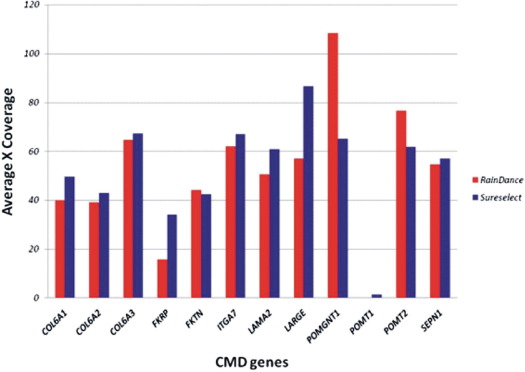
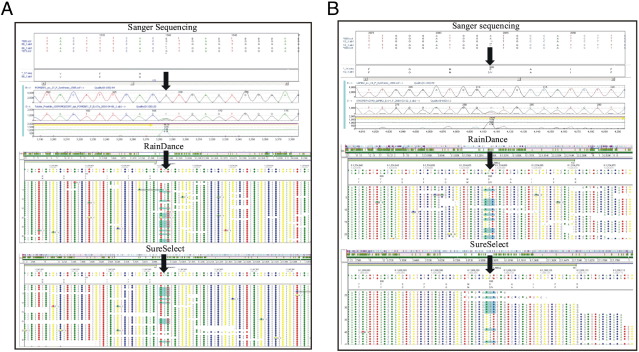
Sequencing individual genes by Sanger sequencing is a time-consuming and costly approach to resolve clinically heterogeneous genetic disorders. Panel testing offers the ability to efficiently and cost-effectively screen all of the genes for a particular genetic disorder. We assessed the analytical sensitivity and specificity of two different enrichment technologies, solution-based hybridization and microdroplet-based PCR target enrichment, in conjunction with next-generation sequencing (NGS), to identify mutations in 321 exons representing 12 different genes involved with congenital muscular dystrophies. Congenital muscular dystrophies present diagnostic challenges due to phenotypic variability, lack of standard access to and inherent difficulties with muscle immunohistochemical stains, and a general lack of clinician awareness. NGS results were analyzed across several parameters, including sequencing metrics and genotype concordance with Sanger sequencing. Genotyping data showed that both enrichment technologies produced suitable calls for use in clinical laboratories. However, microdroplet-based PCR target enrichment is more appropriate for a clinical laboratory, due to excellent sequence specificity and uniformity, reproducibility, high coverage of the target exons, and the ability to distinguish the active gene versus known pseudogenes. Regardless of the method, exons with highly repetitive and high GC regions are not well enriched and require Sanger sequencing for completeness. Our study demonstrates the successful application of targeted sequencing in conjunction with NGS to screen for mutations in hundreds of exons in a genetically heterogeneous human disorder.
Copyright © 2012 American Society for Investigative Pathology and the Association for Molecular Pathology. Published by Elsevier Inc. All rights reserved.
Figures
References
-
- Hu H., Wrogemann K., Kalscheuer V., Tzschach A., Richard H., Haas S.A., Menzel C., Bienek M., Froyen G., Raynaud M., Van Bokhoven H., Chelly J., Ropers H., Chen W. Mutation screening in 86 known X-linked mental retardation genes by droplet-based multiplex PCR and massive parallel sequencing. Hugo J. 2009;3:41–49. - PMC - PubMed
-
- Asmann Y.W., Wallace M.B., Thompson E.A. Transcriptome profiling using next-generation sequencing. Gastroenterology. 2008;135:1466–1468. - PubMed
-
- Holt R.A., Jones S.J.M. The new paradigm of flow cell sequencing. Genome Res. 2008;18:839–846. - PubMed
-
- Morozova O., Marra M.A. Applications of next-generation sequencing technologies in functional genomics. Genomics. 2008;92:255–264. - PubMed
Publication types
MeSH terms
Grants and funding
LinkOut - more resources
Full Text Sources
Other Literature Sources
Medical
Molecular Biology Databases
Miscellaneous
