. 2012 Mar 15;26(6):603-14.
doi: 10.1101/gad.180604.111.

Identification and characterization of ToRC, a novel ISWI-containing ATP-dependent chromatin assembly complex

Affiliations

Identification and characterization of ToRC, a novel ISWI-containing ATP-dependent chromatin assembly complex

Alexander V Emelyanov et al. Genes Dev. .

Abstract

SNF2-like motor proteins, such as ISWI, cooperate with histone chaperones in the assembly and remodeling of chromatin. Here we describe a novel, evolutionarily conserved, ISWI-containing complex termed ToRC (Toutatis-containing chromatin remodeling complex). ToRC comprises ISWI, Toutatis/TIP5 (TTF-I-interacting protein 5), and the transcriptional corepressor CtBP (C-terminal-binding protein). ToRC facilitates ATP-dependent nucleosome assembly in vitro. All three subunits are required for its maximal biochemical activity. The toutatis gene exhibits strong synthetic lethal interactions with CtBP. Thus, ToRC mediates, at least in part, biological activities of CtBP and Toutatis. ToRC subunits colocalize in euchromatic arms of polytene chromosomes. Furthermore, nuclear localization and precise distribution of ToRC in chromosomes are dependent on CtBP. ToRC is involved in CtBP-mediated regulation of transcription by RNA polymerase II in vivo. For instance, both Toutatis and CtBP are required for repression of genes of a proneural gene cluster, achaete-scute complex (AS-C), in Drosophila larvae. Intriguingly, native C-terminally truncated Toutatis isoforms do not associate with CtBP and localize predominantly to the nucleolus. Thus, Toutatis forms two alternative complexes that have differential distribution and can participate in distinct aspects of nuclear DNA metabolism.


Figures
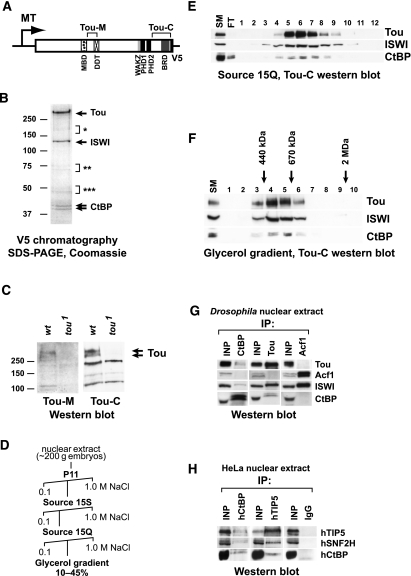
Figure 1.
Figure 1.
Drosophila Toutatis (Tou) protein forms a complex with ISWI and CtBP in S2 cells. (A) Transgene construct for ectopic expression of Tou in S2 cells. Full-length Tou (1–2999) was cloned in-frame with a C-terminal V5 tag (black box). Evolutionarily conserved domains are indicated. (Dotted box) MBD, residues 953–1027; (crossed box) DDT, residues 1255–1308; (light-gray box) WAKZ, residues 2470–2508; (black boxes) PHD fingers, residues 2509–2556 and 2563–2613; (dark-gray box) bromodomain (BRD), residues 2896–2975. Brackets at the top indicate polypeptide antigen fragments as follows: Tou-M, 1033–1265; and Tou-C, 2670–2999. (MT) Metallothionein promoter. (B) The protein complex formed by Tou in S2 cells. The protein was purified by V5 chromatography from S2 cells that extopically express Tou-V5. Arrows point to complex components identified by sequencing (Tou, ISWI, and CtBP). Brackets indicate Tou degradation products (*) or nonspecific polypeptide bands ([**]heat-shock proteins; [***] α-tubulin and β-tubulin [CG1913, CG9277, and CG3401]), which are also present in mock purifications from S2 cells that do not express Tou. Molecular weight markers are shown on the left. (C) Western blot analysis of Tou in Drosophila embryos. Several Tou isoforms (between 250 and 350 kDa) that are recognized by Tou-M (left panel) and Tou-C (right panel) antibodies in lysates of wild-type (wt) embryos are not present in lysates of homozygous tou1 embryos. (D) Partial purification of the native complex of Tou from Drosophila embryos. Nuclear extracts were subjected to four steps of purification. Peak fractions were identified by Western blot with Tou-C, ISWI, and CtBP antibodies. (E) Fractionation of the native complex of Tou on anion exchange (Source 15Q) column. Tou, ISWI, and CtBP cofractionate in a narrow range of the salt gradient (320–400 mM NaCl). (SM) Starting material (peak Tou- and CtBP-containing fractions from Source 15S chromatography); (FT) flowthrough. Fraction numbers are shown at the top. (F) Glycerol gradient (10%–45%) sedimentation of the native Tou complex. The complex of Tou, ISWI, and CtBP cosediments with a molecular weight between 440 and 670 kDa according to sedimentation profiles of molecular weight markers. (SM) Starting material (fractions 5–7 from Source 15Q chromatography). (G) Co-IP analysis of Tou, ISWI, and CtBP. Drosophila nuclear extract was immunoprecipitated with CtBP, Tou-M, or Acf1 antibodies, and precipitated material was analyzed by Western blot for the presence of Tou, Acf1, ISWI, and CtBP. CtBP and ISWI coimmunoprecipitate with Tou, whereas CtBP does not coimmunoprecipitate with Acf1. (INP) Nuclear extract, 10% of immunoprecipitation input. (H) Co-IP analysis of TIP5, SNF2H, and hCtBP, human orthologs of Tou, ISWI, and dCtBP. HeLa nuclear extract was immunoprecipitated with hCtBP, TIP5 antibodies, or an equivalent amount of control IgGs, and precipitated material was analyzed by Western blot for the presence of TIP5, SNF2H, and hCtBP. Similar to their Drosophila orthologs, human TIP5, SNF2H, and CtBP form a complex in HeLa nuclear extract. (INP) Nuclear extract, 10% of immunoprecipitation input.
Figure 2.
Figure 2.
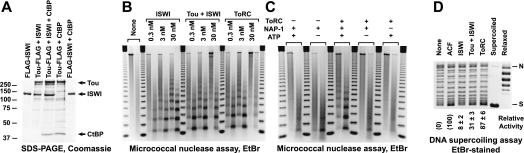
ToRC is an ATP-dependent chromatin assembly factor. (A) Purification of recombinant ToRC. Various combinations of Flag-tagged and untagged Tou, ISWI, and CtBP were coexpressed in Sf9 cells, purified in two steps by Flag and anion exchange (Source 15Q) chromatography, and analyzed by SDS-PAGE and Coomassie staining. ISWI and CtBP directly interact with Tou to form ToRC but do not interact with each other. Molecular weight markers are shown on the left, and arrows on the right point to recombinant polypeptides. (B) ATP-dependent chromatin assembly activity of ISWI, Tou–ISWI complex, and ToRC. Recombinant Flag-ISWI, Tou-Flag + ISWI, or Tou-Flag + ISWI + CtBP was used in the defined ATP-dependent chromatin assembly system (Fyodorov and Kadonaga 2003). Each reaction contained 2.5 nM relaxed plasmid DNA (∼3 kb), 100 nM each core histone polypeptide, 500 nM NAP-1 polypeptide, and indicated concentrations of ATP-dependent factors. After 2 h at 27°C, the assembled nucleosome arrays in each reaction were analyzed by partial digestion with two distinct amounts of micrococcal nuclease and DNA agarose gel electrophoresis. A 123-bp DNA ladder (Invitrogen) was used as a molecular weight marker. (C) Cofactor requirements for ToRC in the chromatin assembly reaction. The chromatin assembly activity was assayed as described in B in the presence of all or in the absence of one or more of the following components: ToRC, NAP-1, and ATP. ToRC assembles periodic nucleosome arrays in an ATP- and NAP-1-dependent manner. (D) Stimulation of nucleosome assembly activity of ISWI by Tou and CtBP. Chromatin was assembled in vitro with 0.3 nM indicated ATP-dependent factor for 10 min as described above, and histone deposition was assayed by DNA supercoiling. Supercoiling activity of NAP-1 in the absence of remodeling factors was set to 0. Supercoiling activity of recombinant ACF was set to 100%. The activity of ISWI alone (∼8%) was stimulated approximately fourfold in a complex with Tou and further stimulated (approximately threefold) when the complex (ToRC) additionally contained CtBP. Quantitation is presented as an average of four independent experiments with two distinct preparations of each factor. Standard deviations are shown. The positions of nicked (N) and highly negatively supercoiled (S) DNA bands on the gel are shown on the right.
Figure 3.
Figure 3.
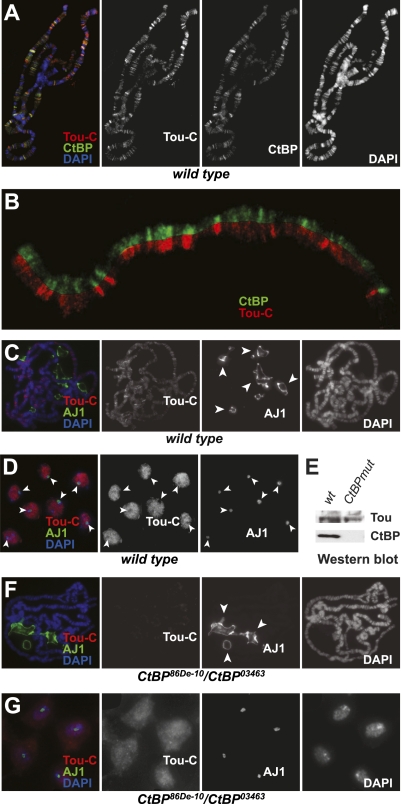
ToRC requires CtBP for proper localization on chromosome arms and is excluded from the nucleolus. (A) Genome-wide localization of ToRC. Localization patterns of Tou and CtBP in larval polytene chromosomes were analyzed by indirect IF staining with Tou-C and CtBP antibodies. Tou-C (red) and CtBP (green) signals extensively overlap in euchromatic arms of polytene chromosomes. DAPI staining is shown in blue. (B) Split image view of colocalization of CtBP and Tou. Tou-C-specific (red) and CtBP-specific (green) signals overlap in many but not all genomic loci on the distal 3L arm of the third chromosome. (C) Genome-wide localization of ToRC and nucleolus-specific antigen AJ1 in wild-type larvae. Localization patterns of Tou-C and AJ1 antigens in polytene chromosomes were analyzed by indirect IF staining with Tou-C and AJ1 antibodies. Whereas the AJ1 antibody (green) stains nucleolar structures in polytene spreads, the Tou-C antibody (red) stains multiple bands in euchromatic arms of polytene chromosomes but does not stain nucleoli. DAPI staining is shown in blue. (D) Subnuclear localization of ToRC in larval neuroblasts. Neuroblasts from wild-type L3 larvae were stained with Tou-C and AJ1 antibodies. AJ1 is present exclusively in nucleoli (arrowheads), whereas Tou-C signal is concentrated in nuclei but is weak or absent from nucleoli. (Red) Tou-C staining; (green) AJ1 staining; (blue) DAPI staining. (E) Expression of Tou and CtBP proteins in late L3 larvae. Whole wild-type and CtBP mutant (CtBP86De-10/CtBP03463) larvae were collected, and protein expression was analyzed by Western blot with Tou-C and CtBP antibodies. CtBP mutation eliminates detectable CtBP protein but does not substantially affect the expression of Tou. (F) Genome-wide localization of ToRC and nucleolus-specific antigen AJ1 in CtBP mutant larvae. Localization patterns of Tou-C and AJ1 antigens in CtBP86De-10/CtBP03463 polytene chromosomes were analyzed by indirect IF staining with Tou-C and AJ1 antibodies. AJ1 staining (green) is restricted to the nucleolus, similar to that of wild-type polytene spreads (Fig. 5C). No band-specific Tou-C staining (red) is observed in euchromatic arms of polytene chromosomes or elsewhere in polytene spreads. DAPI staining is shown in blue. (G) Abberrant distribution of ToRC in the neuroblasts of CtBP mutant larvae. Neuroblasts from CtBP86De-10/CtBP03463 L3 larvae were stained with Tou-C (red) and AJ1 (green) antibodies. The Tou-C signal does not localize in the nucleus, but rather is diffusely distributed throughout the cell. DAPI staining is shown in blue.
Figure 4.
Figure 4.
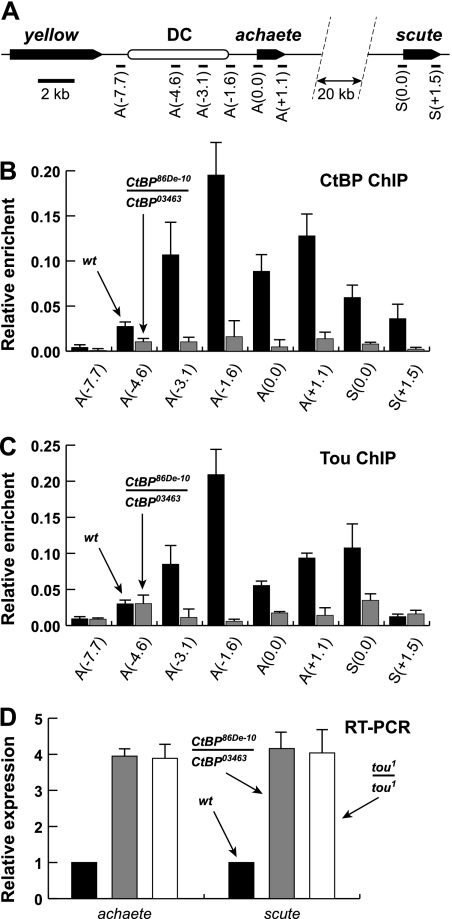
ToRC is a repressor of achaete and scute in Drosophila larvae. (A) Schematic of the yellow–scute genomic interval in Drosophila. Black arrows indicate genes, and a white oval designates the 5.7-kb DC enhancer element that regulates the expression of ac and sc in larval wing discs (Garcia-Garcia et al. 1999). Bars at the bottom indicate approximate genomic intervals in kilobase pairs (kb). Positions of primer pairs are shown as black bars below the locus schematic. In probe names, numbers in parentheses indicate approximate positions (in kilobase pairs [kb]) of the primer pairs relative to the transcription start sites of ac (A) and sc (S), respectively. (B) ChIP analyses of CtBP occupancy at genomic loci within AS-C. ChIP was performed with CtBP antibodies in wild-type (wt; black bars) and CtBP86DE-10/CtBP03463 mutant (gray bars) larvae. Relative enrichment of CtBP at indicated sites was measured by real-time PCR. Error bars indicate standard deviation of six independent data points. In wild-type larvae, CtBP is enriched in the proximal part of the DC enhancer element and in transcription units of ac and sc. In CtBP mutant larvae, CtBP occupancy is strongly reduced at all sites. The w1118 allele was used as the wild-type control. (C) ChIP analyses of Tou occupancy at genomic loci within AS-C. ChIP was performed with Tou-M antibodies in wild-type (wt; black bars) and CtBP86DE-10/CtBP03463 mutant (gray bars) larvae. Relative enrichment of Tou was measured and presented as in B. Tou and CtBP colocalize in the proximal part of the DC enhancer element and at ac and sc promoters (cf. B). In CtBP mutant larvae, Tou occupancy at these sites is strongly reduced. (D) RT–PCR analysis of ac and sc expression in vivo in whole L3 larvae. Relative expression was measured by real-time RT–PCR on RNA prepared from wild-type (wt; black bars), CtBP86DE-10/CtBP03463 (gray bars), or tou1 (white bars) mutant larvae. CT values were normalized to the reference gene (rpL32), and the expression in wild-type was set to 1. Error bars indicate standard deviation of six independent data points. The mutation of either CtBP or tou results in an approximately fourfold activation of both ac and sc. The expression of control genes (actin5C or piwi) was not significantly affected by either mutation (data not shown).
Figure 5.
Figure 5.
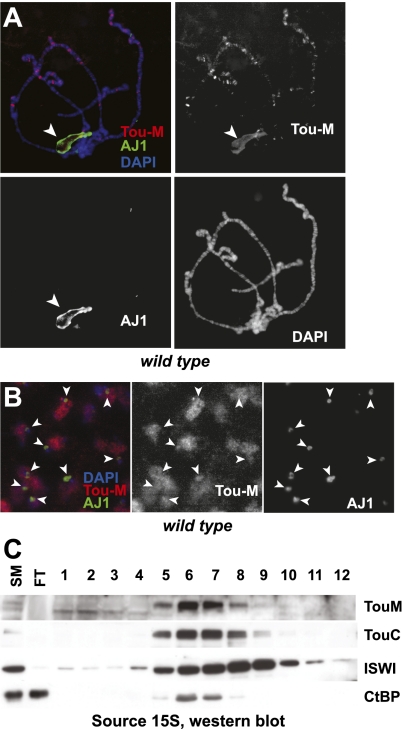
Alternative CtBP-free complex of Tou is localized in the nucleolus. (A) Genome-wide localization of Tou. The Tou-M antibody was used for IF staining of polytene chromosomes. In addition to multiple Tou-specific bands in chromosome arms that are also recognized by the Tou-C antibody, the Tou-M antibody produces a strong signal in the nucleolus of salivary gland cells (arrowhead). (Red) Tou-M antigen; (green) nucleolus-specific antigen AJ1. (B) Subnuclear localization of Tou in larval neuroblasts. Neuroblasts from wild-type L3 larvae were stained with Tou-M and AJ1 antibodies. AJ1 is present exclusively in nucleoli (arrowheads), whereas Tou-M signal is spread throughout the nuclei and is also present in nucleoli. (Red) Tou-M staining; (green) AJ1 staining; (blue) DAPI staining. (C) Alternative, CtBP-free native complex of Tou in Drosophila embryos: fractionation of the native complex of Tou on cation exchange (Source 15S) column. Full-length Tou and CtBP cofractionate in a narrow peak (280–350 mM NaCl; fractions 5–8) that corresponds to ToRC. An additional peak of Tou-specific material, which is recognized by Tou-M but not Tou-C antibody (200–260 mM NaCl; fractions 1–3), contains ISWI but not CtBP. (SM) Starting material (peak fractions of Tou-immunoreactive material from phosphocellulose P11 chromatography); (FT) flowthrough. Fraction numbers are shown at the top.

References

    1. Adams CR, Kamakaka RT 1999. Chromatin assembly: Biochemical identities and genetic redundancy. Curr Opin Genet Dev 9: 185–190 - PubMed
    1. Akey CW, Luger K 2003. Histone chaperones and nucleosome assembly. Curr Opin Struct Biol 13: 6–14 - PubMed
    1. Armstrong JA, Bieker JJ, Emerson BM 1998. A SWI/SNF-related chromatin remodeling complex, E-RC1, is required for tissue-specific transcriptional regulation by EKLF in vitro. Cell 95: 93–104 - PubMed
    1. Biryukova I, Heitzler P 2008. Drosophila C-terminal binding protein, dCtBP is required for sensory organ prepattern and sharpens proneural transcriptional activity of the GATA factor Pnr. Dev Biol 323: 64–75 - PubMed
    1. Chinnadurai G 2002. CtBP, an unconventional transcriptional corepressor in development and oncogenesis. Mol Cell 9: 213–224 - PubMed

Publication types

MeSH terms