


The non-human primate model of tuberculosis
- PMID: 22429048
- PMCID: PMC3961469
- DOI: 10.1111/j.1600-0684.2012.00536.x
The non-human primate model of tuberculosis
Abstract
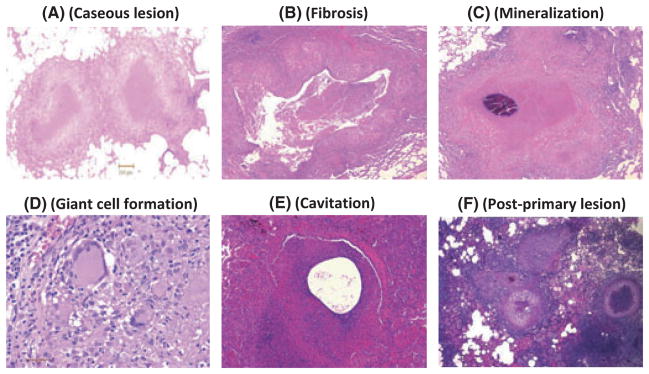
Non-human primates (NHPs) are used to model human disease owing to their remarkably similar genomes, physiology, and immune systems. Recently, there has been an increased interest in modeling tuberculosis (TB) in NHPs. Macaques are susceptible to infection with different strains of Mycobacterium tuberculosis (Mtb), producing the full spectrum of disease conditions, including latent infection, chronic progressive infection, and acute TB, depending on the route and dose of infection. Clearly, NHPs are an excellent model of human TB. While the initial aim of the NHP model was to allow preclinical testing of candidate vaccines and drugs, it is now also being used to study pathogenesis and immune correlates of protection. Recent advances in this field are discussed in this review. Key questions such as the effect of hypoxia on the biology of Mtb and the basis of reactivation of latent TB can now be investigated through the use of this model.
© 2012 John Wiley & Sons A/S.
Figures
Comment in
-
How well do you know your monkey TB model?J Med Primatol. 2013 Feb;42(1):46-7. doi: 10.1111/jmp.12030. Epub 2012 Dec 15. J Med Primatol. 2013. PMID: 23241171 Free PMC article. No abstract available.
-
How well do you know your monkeys?J Med Primatol. 2013 Feb;42(1):48-9. doi: 10.1111/jmp.12032. J Med Primatol. 2013. PMID: 23311579 Free PMC article. No abstract available.
References
-
- Dye C, Scheele C, Dolin P, Pathania V, Raviglione MC. Global burden of tuberculosis: estimated incidence, prevalence, and mortality by country. JAMA. 1999;282:677–86. - PubMed
-
- Shah NS, Wright A, Bai GH, Barrera L, Boulahbal F, Martín-Casabona N, Drobniewski F, Drobniewski F, Gilpin C, Havelková M, Lepe R, Lumb R, Metchock B, Portaels F, Rodrigues MF, Rüsch-Gerdes S, Van Deun A, Vincent V, Laserson K, Wells C, Cegielski JP. Worldwide emergence of extensively drug-resistant tuberculosis. Emerg Infect Dis. 2007;13:380–7. - PMC - PubMed
-
- Fletcher HA. Correlates of immune protection from tuberculosis. Curr Mol Med. 2007;7:319–25. - PubMed
-
- Harrington M. From HIV to tuberculosis and back again: a tale of activism in 2 pandemics. Clin Infect Dis. 2010;50:S260–6. - PubMed
-
- von Reyn CF, Kimambo S, Mtei L, Arbeit RD, Maro I, Bakari M, Matee M, Lahey T, Adams LV, Black W, Mackenzie T, Lyimo J, Tvaroha S, Waddell R, Kreiswirth B, Horsburgh CR, Pallangyo K. Disseminated tuberculosis in human immunodeficiency virus infection: ineffective immunity, polyclonal disease and high mortality. Int J Tuberc Lung Dis. 2011;15:1087–92. - PMC - PubMed
Publication types
MeSH terms
Grants and funding
- UC6 AI058609/AI/NIAID NIH HHS/United States
- R01 HL106790/HL/NHLBI NIH HHS/United States
- AI058609/AI/NIAID NIH HHS/United States
- C06 RR020112/RR/NCRR NIH HHS/United States
- P51 OD011104/OD/NIH HHS/United States
- AI091457/AI/NIAID NIH HHS/United States
- RR020159/RR/NCRR NIH HHS/United States
- RR026006/RR/NCRR NIH HHS/United States
- HL106790/HL/NHLBI NIH HHS/United States
- AI089323/AI/NIAID NIH HHS/United States
- R01 AI089323/AI/NIAID NIH HHS/United States
- RR000164/RR/NCRR NIH HHS/United States
- P20 RR020159/RR/NCRR NIH HHS/United States
- R21 RR026006/RR/NCRR NIH HHS/United States
- R21 AI091457/AI/NIAID NIH HHS/United States
- HHMI/Howard Hughes Medical Institute/United States
- P51 RR000164/RR/NCRR NIH HHS/United States
LinkOut - more resources
Full Text Sources
Medical
