


Breast and ovarian cancer risk and risk reduction in Jewish BRCA1/2 mutation carriers
- PMID: 22430266
- PMCID: PMC3341145
- DOI: 10.1200/JCO.2011.37.8133
Breast and ovarian cancer risk and risk reduction in Jewish BRCA1/2 mutation carriers
Abstract
Purpose: Mutations in BRCA1/2 dramatically increase the risk of both breast and ovarian cancers. Three mutations in these genes (185delAG, 5382insC, and 6174delT) occur at high frequency in Ashkenazi Jews. We evaluated how these common Jewish mutations (CJMs) affect cancer risks and risk reduction.
Methods: Our cohort comprised 4,649 women with disease-associated BRCA1/2 mutations from 22 centers in the Prevention and Observation of Surgical End Points Consortium. Of these women, 969 were self-identified Jewish women. Cox proportional hazards models were used to estimate breast and ovarian cancer risks, as well as risk reduction from risk-reducing salpingo-oophorectomy (RRSO), by CJM and self-identified Jewish status.
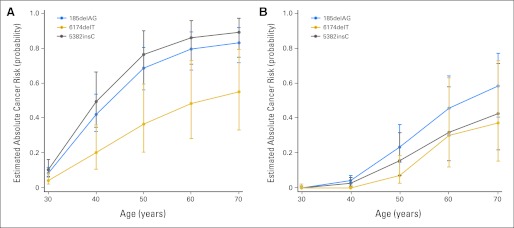
Results: Ninety-one percent of Jewish BRCA1/2-positive women carried a CJM. Jewish women were significantly more likely to undergo RRSO than non-Jewish women (54% v 41%, respectively; odds ratio, 1.87; 95% CI, 1.44 to 2.42). Relative risks of cancer varied by CJM, with the relative risk of breast cancer being significantly lower in 6174delT mutation carriers than in non-CJM BRCA2 carriers (hazard ratio, 0.35; 95% CI, 0.18 to 0.69). No significant difference was seen in cancer risk reduction after RRSO among subgroups.
Conclusion: Consistent with previous results, risks for breast and ovarian cancer varied by CJM in BRCA1/2 carriers. In particular, 6174delT carriers had a lower risk of breast cancer. This finding requires additional confirmation in larger prospective and population-based cohort studies before being integrated into clinical care.
Conflict of interest statement
Authors' disclosures of potential conflicts of interest and author contributions are found at the end of this article.
Figures
References
-
- King MC, Marks JH, Mandell JB. Breast and ovarian cancer risks due to inherited mutations in BRCA1 and BRCA2. Science. 2003;302:643–646. - PubMed
-
- Struewing JP, Hartge P, Wacholder S, et al. The risk of cancer associated with specific mutations of BRCA1 and BRCA2 among Ashkenazi Jews. N Engl J Med. 1997;336:1401–1408. - PubMed
Publication types
MeSH terms
Grants and funding
- R01-CA102776/CA/NCI NIH HHS/United States
- RC4 CA153828/CA/NCI NIH HHS/United States
- C5047/A8385/CRUK_/Cancer Research UK/United Kingdom
- T32 GM007170/GM/NIGMS NIH HHS/United States
- R01 CA128978/CA/NCI NIH HHS/United States
- R01 CA083855/CA/NCI NIH HHS/United States
- P30 CA051008/CA/NCI NIH HHS/United States
- 15007/CRUK_/Cancer Research UK/United Kingdom
- R01-CA083855/CA/NCI NIH HHS/United States
- R01 CA102776/CA/NCI NIH HHS/United States
- T32-GM07170/GM/NIGMS NIH HHS/United States
- P30-CA051008-17/CA/NCI NIH HHS/United States
LinkOut - more resources
Full Text Sources
Medical
Miscellaneous
