


Bone density in post-pubertal adolescent survivors of childhood brain tumors
- PMID: 22431246
- PMCID: PMC3313076
- DOI: 10.1002/pbc.23300
Bone density in post-pubertal adolescent survivors of childhood brain tumors
Abstract
Background: Childhood cancer survivors are at high risk for reduced bone mineral density (BMD). Our objective was to determine whether post-pubertal adolescent survivors of brain tumors, whose tumor or treatments placed them at risk for pituitary hormone deficiencies, have low BMD near time of peak bone mass accrual, and to assess risk factors for decreased BMD.
Procedure: Chart review of 36 post-pubertal adolescents with history of tumor or radiation therapy (RT) of the hypothalamic-pituitary area who had undergone BMD screening via dual-energy X-ray absorptiometry (DXA).
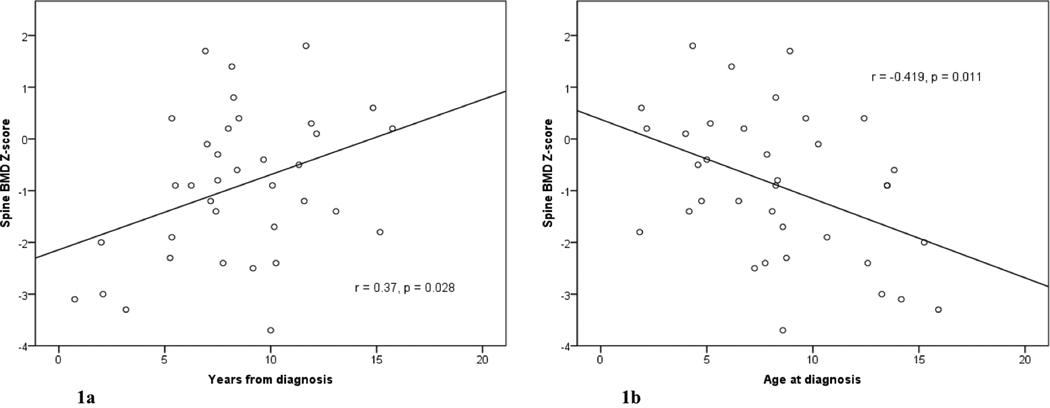
Results: Age at DXA was 16.9 ± 1.9 years (mean ± SD). Time since diagnosis was 8.5 ± 3.6 years. Median BMD Z scores were -0.95 (range -2.7 to 1.7) at the femoral neck, -1.20 (-3.6 to 1.8) at the hip, and -0.90 (-3.7 to 1.8) at the spine. Bone mineral apparent density (BMAD) Z scores were -0.23 (-2.7 to 1.9) at the femoral neck and -0.45 (-3.0 to 2.3) at the spine. Those with history of ≥1 fracture had lower BMD Z scores of the femoral neck, total hip, and spine (P < 0.05). Those with treated GH deficiency (GHD) had a higher BMD Z-score at the femoral neck, total hip, and spine (P < 0.05) than those not treated. There was no difference in BMD with respect to treatment with chemotherapy, cranial or spinal RT, or hypogonadism. Spontaneous menarche and regular periods did not correlate with BMD.
Conclusions: In post-pubertal adolescent survivors of childhood brain tumors, fracture history and untreated GHD are risk factors for decreased BMD.
Copyright © 2011 Wiley Periodicals, Inc.
Figures
References
-
- Vassilopoulou-Sellin R, Brosnan P, Delpassand A, et al. Osteopenia in young adult survivors of childhood cancer. Med Pediatr Oncol. 1999;32:272–278. - PubMed
-
- Aisenberg J, Hsieh K, Kalaitzoglou G, et al. Bone mineral density in young adult survivors of childhood cancer. J Pediatr Hematol Oncol. 1998;20:241–245. - PubMed
-
- Tillman V, Darlington ASE, Eiser C, et al. Male sex and low physical activity are associated with reduced spine bone mineral density in survivors of childhood lymphoblastic leukemia. J Bone Miner Res. 2002;17:1073–1080. - PubMed
-
- Halton JM, Atkinson SA, Fraher L, et al. Mineral homeostasis and bone mass at diagnosis in children with acute lymphoblastic leukemia. J Pediatr. 1995;126:557–564. - PubMed
-
- Arikoski P, Komulainen J, Riikonen P, et al. Alterations in bone turnover and impaired development of bone mineral density in newly diagnosed children with cancer: A 1-year prospective study. J Clin Endocrinol Metab. 1999;84:3174–3181. - PubMed
Publication types
MeSH terms
Substances
Grants and funding
LinkOut - more resources
Full Text Sources
Medical
