. 2012 Apr 10;18(15):4522-32.
doi: 10.1002/chem.201103936. Epub 2012 Mar 16.

Design and synthesis of fluorescent pilicides and curlicides: bioactive tools to study bacterial virulence mechanisms

Affiliations
Free PMC article

Design and synthesis of fluorescent pilicides and curlicides: bioactive tools to study bacterial virulence mechanisms

Erik Chorell et al. Chemistry. .
Free PMC article

Abstract

Pilicides and curlicides are compounds that block the formation of the virulence factors pili and curli, respectively. To facilitate studies of the interaction between these compounds and the pili and curli assembly systems, fluorescent pilicides and curlicides have been synthesized. This was achieved by using a strategy based on structure-activity knowledge, in which key pilicide and curlicide substituents on the ring-fused dihydrothiazolo 2-pyridone central fragment were replaced by fluorophores. Several of the resulting fluorescent compounds had improved activities as measured in pili- and curli-dependent biofilm assays. We created fluorescent pilicides and curlicides by introducing coumarin and 4,4-difluoro-4-bora-3a,4a-diaza-s-indacene (BODIPY) fluorophores at two positions on the peptidomimetic pilicide and curlicide central fragment. Fluorescence images of the uropathogenic Escherichia coli (UPEC) strain UTI89 grown in the presence of these compounds shows that the compounds are strongly associated with the bacteria with a heterogeneous distribution.


Figures

Figure 1
Figure 1
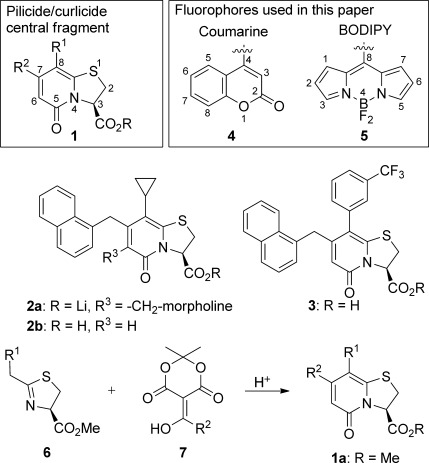
The dihydrothiazolo ring-fused 2-pyridone central fragment 1 (R=H or Li for biological activity), pilicide (2 a,b), curlicide (3), coumarin fluorophore 4, BODIPY fluorophore 5. Synthesis of the thiazolo ring-fused 2-pyridone central fragment (1 a) is performed by using 2-thiazolines (6) and Meldrum’s acid derivatives (7).
Figure 2
Figure 2
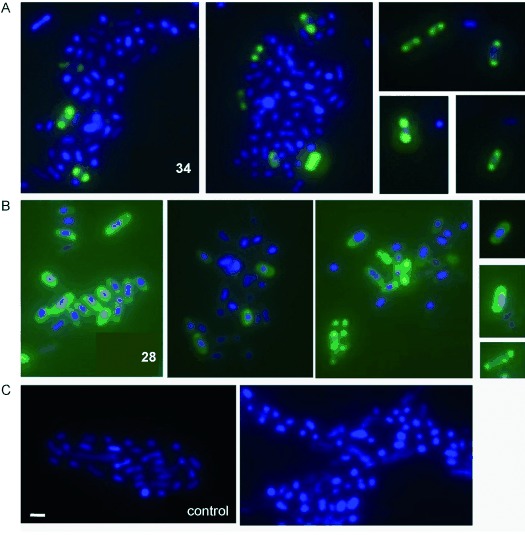
The UPEC strain UTI89 grown for 24 h with and without 100 μM of dual pilicide-curlicide 34 and 28. Blue is DAPI-nuclear stain, green is the compound. A) Bacteria grown in the presence of 100 μM of compound 34. B) Bacteria grown in the presence of 100 μM of compound 28. C) Bacteria grown without any added compound (scale bar is 2 μm).
Scheme 1
Scheme 1
a) TFA, dichloroethane, microwave irradiation (MWI): 120 °C, 140 s (10 ad: 77 %, 86 %, 77 and 68 %, respectively); b) i) 0.1 M aq LiOH, THF/MeOH (4:1); ii) AcOH (11 ad: 66, 58, 53 and 66 %, respectively).
Scheme 2
Scheme 2
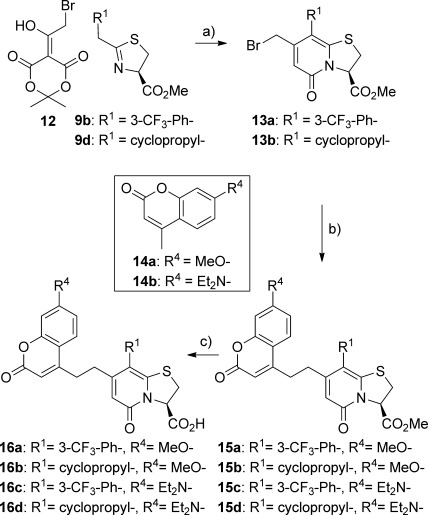
a) TFA, dichloroethane, MWI: 120 °C, 140 s (13 a,b: 92 and 87 %, respectively); b) 14 a or 14 b, LiHMDS, THF, −35 °C, 1 h (15 ad: 74, 82, 83 and 75 %, respectively); c) For 16 a,c: 0.1 M aq LiOH, THF/MeOH (4:1) 1.5 h; ii) AcOH (16 a,c: 86 and 82 %, respectively), For 16 b,d: i) LiBr, TEA, MeCN (+2 v/v % H2O), RT, 3 h; ii) AcOH (16 b,d: 91 and 81 %, respectively).
Scheme 3
Scheme 3
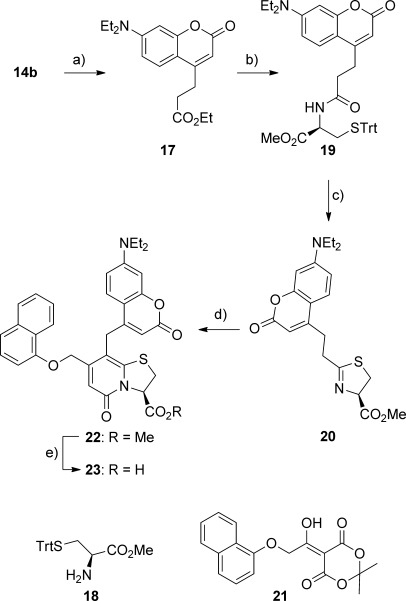
a) LiHMDS, DMPU, ethyl 2-bromoacetate, THF, −20 °C, 35 min, 77 %; b) i) 1 M (aq) LiOH, THF, RT, 16 h, ii) HBTU, 18, DMF, RT, 17 h, 60 %; c) TiCl4, CH2Cl2, 0 °C to RT, 16 h, 40 %; d) 21, TFA, dichloroethane, MWI: 120 °C, 3 min, 73 %; e) 0.1 M aqueous LiOH, THF, RT, 1 h; ii) AcOH, 91 %.
Scheme 4
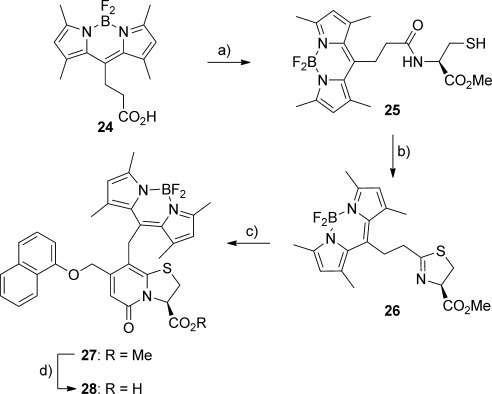
Scheme 4
a) i) (COCl)2, CH2Cl2, RT, 17 h; ii) TEA, cysteine methyl ester, CH2Cl2, 0 °C to RT, 4.5 h, 64 %; b) i) TiCl4, CH2Cl2, 0 °C to RT, 4.5 h; ii) BF3OEt2, CH2Cl2, RT, 40 min, 75 %; c) 21, TFA, dichloroethane, MWI: 120 °C, 140 s, 64 %; d) i) LiI, pyridine, MWI: 140 °C, 15 min; ii) TEA, BF3OEt2, dichloroethane, 80 °C, 15 min, 29 %.
Scheme 5
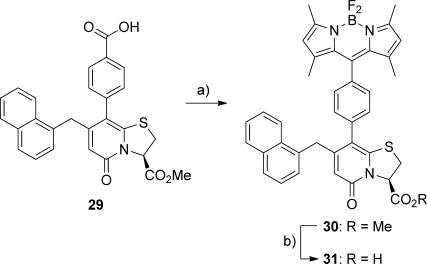
Scheme 5
a) i) (COCl)2, DMF, CH2Cl2, RT, 1 h; ii) TEA, BF3OEt2, 2,4-dimethylpyrrole, dichloroethane, MWI: 140 °C, 50 min, 15 %; b) 0.1 M aqueous LiOH, THF, RT, 1 h; ii) H+, 84 %.
Scheme 6
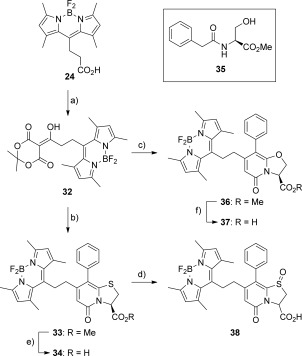
Scheme 6
a) DCC, Meldrum’s acid, DMAP, CH2Cl2, 0 °C RT, 8 h, 82 %; b) 9 a, TFA, dichloroethane, MWI: 120 °C, 140 s, 85 %; c) i) 35, (NH4)2MoO4, toluene, reflux soxhlet (3 MS), 6 h; ii) 32, TFA, toluene, reflux soxhlet (3 MS), 2 h, 73 %; d) starting from 34, mCPBA, CH2Cl2, RT, 15 min, 80 %; e) i) 0.1 M aq LiOH, THF/MeOH (4:1); ii) AcOH, 88 %; f) i) LiBr, TEA, MeCN (+2 v/v % H2O), RT, 3 h; ii) AcOH, 88 %.

References

    1. Boucher HW, Talbot GH, Bradley JS, Edwards JE, Gilbert D, Rice LB, Scheld M, Spellberg B, Bartlett J. Clin. Infect. Dis. 2009;48:1. - PubMed
    1. Anderson GG, Palermo JJ, Schilling JD, Roth R, Heuser J, Hultgren SJ. Science. 2003;301:105. - PubMed
    1. Mulvey MA, Lopez-Boado YS, Wilson CL, Roth R, Parks WC, Heuser J, Hultgren SJ. Science. 1998;282:1494. - PubMed
    1. Mulvey MA, Schilling JD, Hultgren SJ. Infect. Immun. 2001;69:4572. - PMC - PubMed
    1. Schilling JD, Lorenz RG, Hultgren SJ. Infect. Immun. 2002;70:7042. - PMC - PubMed

Publication types

MeSH terms