. 2012 May 17:210:243-8.
doi: 10.1016/j.neuroscience.2012.02.036. Epub 2012 Mar 2.

Orexin signaling in the paraventricular thalamic nucleus modulates mesolimbic dopamine and hedonic feeding in the rat

Affiliations

Orexin signaling in the paraventricular thalamic nucleus modulates mesolimbic dopamine and hedonic feeding in the rat

D L Choi et al. Neuroscience. .

Abstract

Data from our laboratory indicate that the orexin system is involved in the regulation of both conditioned and unconditioned responding for palatable foods. Anticipation of food rewards activates orexin receptor containing neurons within the paraventricular nucleus of the thalamus (PVT). The PVT regulates mesolimbic dopamine neurochemistry through direct connections with the nucleus accumbens and modulates the processing of cognitive-emotional information, suggesting that the PVT may represent a unique brain region with the capacity to mediate orexinergic effects on brain dopamine and behavior. Here, we tested the hypothesis that PVT orexin signaling mediates mesolimbic dopamine and reward-based feeding. To do this we used a behavioral pharmacological approach in tandem with central genetic manipulation of the orexin-1 receptor in the PVT. Data from these studies indicate that orexin-A action in the PVT increases dopamine levels in the nucleus accumbens. In addition, endogenous orexin signaling in the PVT mediates locomotor activity and hedonic feeding responses. Together these data highlight the PVT as a critical site capable of mediating orexin action on brain dopamine and reward-based feeding.


Figures

Figure 1
Figure 1
Intra-paraventricular thalamic (PVT) orexin-A differentially increases dopamine levels in limbic regions. (A) Illustrates dopamine content in the medial Prefrontal Cortex (mPFC) following 1 or 5 nmole orexin-A administered directly into the paraventricular thalamus (PVT). (B) Depicts significantly elevated dopamine content in the nucleus accumbens (NAcc) following 1 or 5 nmole orexin-A administered directly into the PVT. (* p<0.05).
Figure 2
Figure 2
Verifcation of virus-mediated shRNA injection site and quantification of subsequent orexin-1 receptor (OX1R) knockdown. (A) A representative lower-magnification image of AAV-OX1R-shRNA injection site in the PVT as shown by immunolabeling (green) of green fluorescent protein (GFP) at approximately Bregma −3.00 mm. Scale bar: 500 μm. (B) Quantitative real-time polymerase chain reaction (qPCR) analysis indicates a significant reduction in relative OX1R mRNA expression in PVT micro-dissected tissue samples from OX1R-shRNA treated rats (OX1R shRNA) when compared to scrambled control-shRNA treated rats (SC shRNA; * p<0.01).
Figure 3
Figure 3
OX1R knockdown in the PVT increases dark phase locomotor activity but has no effects on body weight. (A) There are no differences in the changes in body weights, taken at 16, 52 and 71 days post-surgery, between OX1R knockdown and control groups. (B) OX1R knockdown rats exhibit significantly increased locomotor activity, as measured by total beam breaks in a 12-hr dark phase, when compared to control rats (* p<0.05).
Figure 4
Figure 4
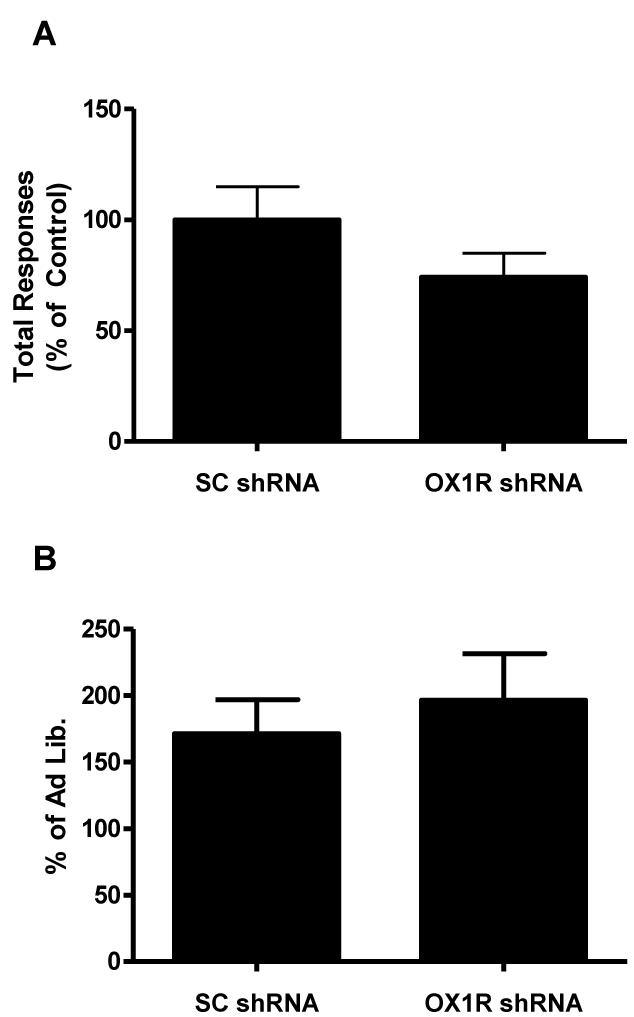
OX1R knockdown in the PVT has no effects on (A) total responses made up to break point under a progressive ratio (PR) schedule to obtain sweet high fat pellets, and on (B) percent change in total responses made in 1 hour under a PR schedule to obtain sweet high fat pellets following an 18-hr food deprivation challenge.
Figure 5
Figure 5
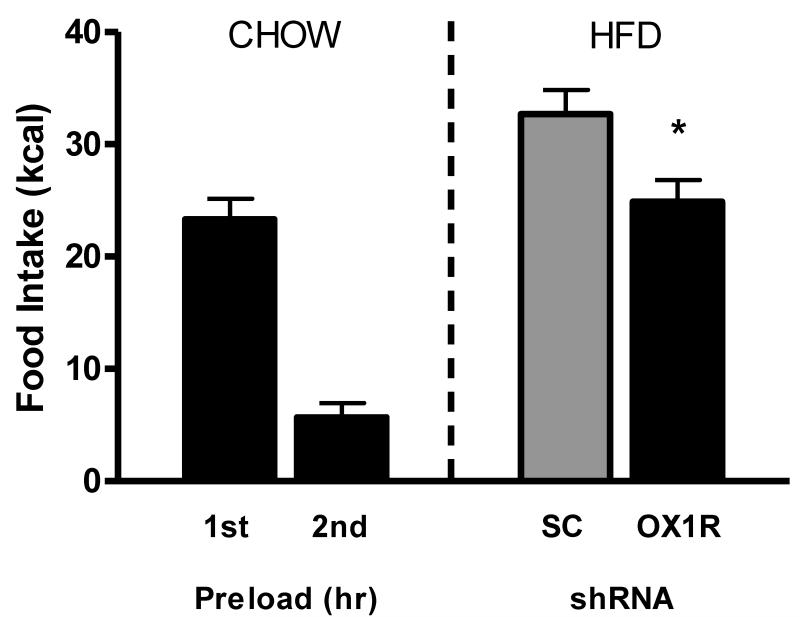
OX1R knockdown in the PVT attenuates 1-hr high fat diet (HFD) overconsumption following 46-hr food deprivation and 2 hours of chow preload when compared to control rats as measured in kcal (* p<0.05).

References

    1. Aston-Jones G, Smith RJ, et al. Role of lateral hypothalamic orexin neurons in reward processing and addiction. Neuropharmacology. 2009;56(Suppl 1):112–121. - PMC - PubMed
    1. Borgland SL, Chang SJ, et al. Orexin A/hypocretin-1 selectively promotes motivation for positive reinforcers. J Neurosci. 2009;29(36):11215–11225. - PMC - PubMed
    1. Boutrel B, Cannella N, et al. The role of hypocretin in driving arousal and goal-oriented behaviors. Brain Res. 2010;1314:103–111. - PMC - PubMed
    1. Cason AM, Smith RJ, et al. Role of orexin/hypocretin in reward-seeking and addiction: implications for obesity. Physiol Behav. 2010;100(5):419–428. - PMC - PubMed
    1. Choi DL, Davis JF, et al. The role of orexin-A in food motivation, reward-based feeding behavior and food-induced neuronal activation in rats. Neuroscience. 2010;167(1):11–20. - PubMed

Publication types