


Study design and baseline description of the BMI2 trial: reducing paediatric obesity in primary care practices
- PMID: 22434735
- PMCID: PMC5427511
- DOI: 10.1111/j.2047-6310.2011.00001.x
Study design and baseline description of the BMI2 trial: reducing paediatric obesity in primary care practices
Abstract
Objectives: This study will test the efficacy of motivational interviewing (MI) conducted by primary care providers and dieticians among children ages 2-8 years old with a body mass index (BMI) ≥ 85th and ≤ 97th percentile.
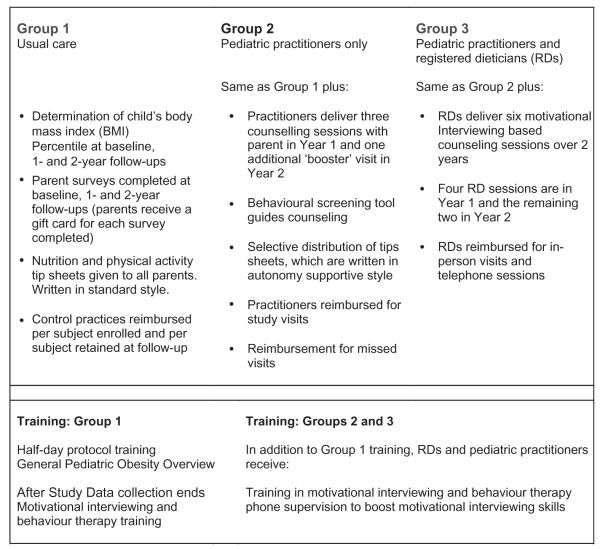
Methods: Forty-two practices from the American Academy of Pediatrics, Pediatric Research in Office Settings Network were assigned to one of three groups. Group 1 (usual care) measures BMI percentile at baseline, and at 1- and 2-year follow-ups and receives standard health education materials. Group 2 providers deliver three proactive MI counselling sessions with a parent of the index child in Year 1 and one additional 'booster' visit in Year 2. Group 3 adds six MI counselling sessions from a trained dietician. The primary outcome is the child's BMI percentile at 2-year follow-up. Secondary outcomes include parent report of the child's screen time, physical activity, intake of fruits and vegetables, and sugar-sweetened beverages.
Results: We enrolled 633 eligible children whose mean BMI percentile was 92.0 and mean age of 5.1. The cohort was 57% female. Almost 70% of parents reported a household income of ≥ $40,000 per year, and 39% had at least a college education. The cohort was 63% white, 23% Hispanic, 7% black and 7% Asian. Parent self-reported confidence that their child will achieve a healthy weight was on average an 8 (out of 10).
Conclusion: To date, several aspects of the study can inform similar efforts including our ability to use volunteer clinicians to recruit participants and their willingness to dedicate their time, without pay, to receive training in MI.
Trial registration: ClinicalTrials.gov NCT01335308.
© 2011 The Authors Pediatric Obesity © 2011 International Association for the Study of Obesity.
Figures
References
-
- Ogden CL, Carroll MD, Curtin LR, Lamb MM, Flegal KM. Prevalence of high body mass index in US children and adolescents, 2007–2008. JAMA. 2010;303:242–249. - PubMed
-
- Lee WW. An overview of pediatric obesity. Pediatr Diabetes. 2007;8(Suppl. 9):76–87. - PubMed
-
- Finkelstein E, Fiebelkorn I, Wang G. National medical spending attributable to overweight and obesity: how much, and who’s paying? Health Aff. 2003;W3:219–226. - PubMed
-
- Wolf A, Colditz GA. Current estimates of the economic cost of obesity in the United States. Obes Res. 1998;6:97–106. - PubMed
-
- Must A, Spadano J, Coakley EH, Field AE, Colditz G, Dietz WH. The disease burden associated with overweight and obesity. JAMA. 1999;282:1523–1529. - PubMed
Publication types
MeSH terms
Associated data
Grants and funding
LinkOut - more resources
Full Text Sources
Medical
