. 2012 Jul;40(12):e94.
doi: 10.1093/nar/gks251. Epub 2012 Mar 19.

Grinder: a versatile amplicon and shotgun sequence simulator

Affiliations

Grinder: a versatile amplicon and shotgun sequence simulator

Florent E Angly et al. Nucleic Acids Res. 2012 Jul.

Abstract

We introduce Grinder (http://sourceforge.net/projects/biogrinder/), an open-source bioinformatic tool to simulate amplicon and shotgun (genomic, metagenomic, transcriptomic and metatranscriptomic) datasets from reference sequences. This is the first tool to simulate amplicon datasets (e.g. 16S rRNA) widely used by microbial ecologists. Grinder can create sequence libraries with a specific community structure, α and β diversities and experimental biases (e.g. chimeras, gene copy number variation) for commonly used sequencing platforms. This versatility allows the creation of simple to complex read datasets necessary for hypothesis testing when developing bioinformatic software, benchmarking existing tools or designing sequence-based experiments. Grinder is particularly useful for simulating clinical or environmental microbial communities and complements the use of in vitro mock communities.


Figures
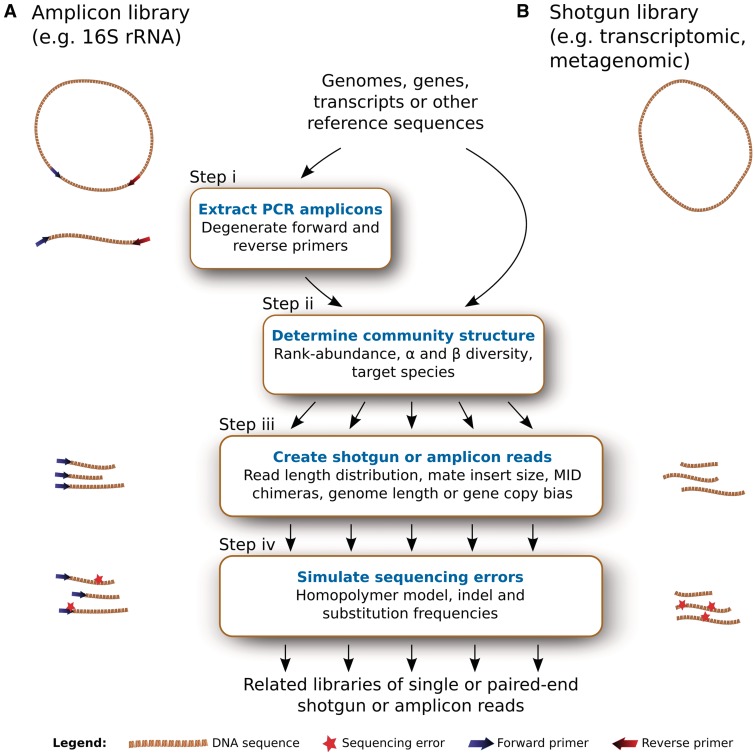
Figure 1.
Figure 1.
Flowchart of the processes and parameters used by Grinder to generate related (A) amplicon and (B) shotgun libraries.
Figure 2.
Figure 2.
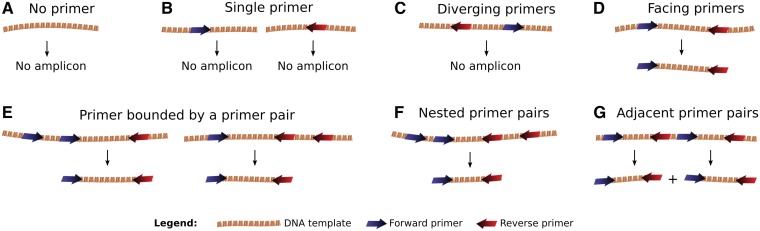
Grinder PCR amplicon selection process. All possible combinations of degenerate primer matches on the template DNA are considered. By default, Grinder will extract the shortest amplicon.
Figure 3.
Figure 3.
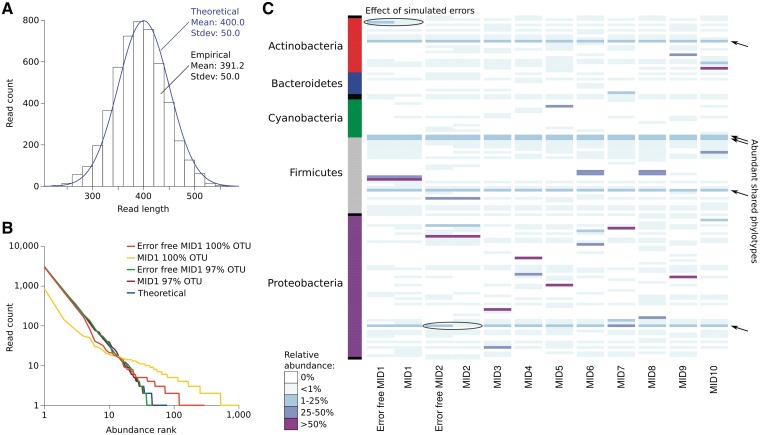
Analysis of 10 MID-containing 16S rRNA gene amplicon libraries generated by Grinder that share 20% of their phylotypes. (A) Histogram of read lengths for the libraries and curve representing their expected normal distribution. (B) Log-log plot of phylotype rank-abundance in the MID1 amplicon library, with and without simulated sequencing errors, using 97% and 100% identity for OTU clustering in QIIME. (C) Heatmap comparison of the OTU distribution in the amplicon libraries analyzed with QIIME at 97% identity OTU clustering.

References

    1. Haas BJ, Gevers D, Earl AM, Feldgarden M, Ward DV, Giannoukos G, Ciulla D, Tabbaa D, Highlander SK, Sodergren E, et al. Chimeric 16S rRNA sequence formation and detection in Sanger and 454-pyrosequenced PCR amplicons. Genome Res. 2011;21:494–504. - PMC - PubMed
    1. Turnbaugh PJ, Quince C, Faith JJ, McHardy AC, Yatsunenko T, Niazi F, Affourtit J, Egholm M, Henrissat B, Knight R, et al. Organismal, genetic, and transcriptional variation in the deeply sequenced gut microbiomes of identical twins. Proc. Natl Acad. Sci. USA. 2010;107:7503–7508. - PMC - PubMed
    1. Sun Y, Cai Y, Liu L, Yu F, Farrell ML, McKendree W, Farmerie W. ESPRIT: estimating species richness using large collections of 16S rRNA pyrosequences. Nucleic Acids Res. 2009;37:e76. - PMC - PubMed
    1. Quince C, Lanzén A, Curtis TP, Davenport RJ, Hall N, Head IM, Read LF, Sloan WT. Accurate determination of microbial diversity from 454 pyrosequencing data. Nat. Methods. 2009;6:639–641. - PubMed

    1. Henn MR, Sullivan MB, Stange-Thomann N, Osburne MS, Berlin AM, Kelly L, Yandava C, Kodira C, Zeng Q, Weiand M, et al. Analysis of high-throughput sequencing and annotation strategies for phage genomes. PLoS One. 2010;5:e9083. - PMC - PubMed

Publication types

Substances