. 2012 Jul;40(13):5876-89.
doi: 10.1093/nar/gks246. Epub 2012 Mar 20.

Phase variable genes of Campylobacter jejuni exhibit high mutation rates and specific mutational patterns but mutability is not the major determinant of population structure during host colonization

Affiliations

Phase variable genes of Campylobacter jejuni exhibit high mutation rates and specific mutational patterns but mutability is not the major determinant of population structure during host colonization

Christopher D Bayliss et al. Nucleic Acids Res. 2012 Jul.

Abstract

Phase variation of surface structures occurs in diverse bacterial species due to stochastic, high frequency, reversible mutations. Multiple genes of Campylobacter jejuni are subject to phase variable gene expression due to mutations in polyC/G tracts. A modal length of nine repeats was detected for polyC/G tracts within C. jejuni genomes. Switching rates for these tracts were measured using chromosomally-located reporter constructs and high rates were observed for cj1139 (G8) and cj0031 (G9). Alteration of the cj1139 tract from G8 to G11 increased mutability 10-fold and changed the mutational pattern from predominantly insertions to mainly deletions. Using a multiplex PCR, major changes were detected in 'on/off' status for some phase variable genes during passage of C. jejuni in chickens. Utilization of observed switching rates in a stochastic, theoretical model of phase variation demonstrated links between mutability and genetic diversity but could not replicate observed population diversity. We propose that modal repeat numbers have evolved in C. jejuni genomes due to molecular drivers associated with the mutational patterns of these polyC/G repeats, rather than by selection for particular switching rates, and that factors other than mutational drift are responsible for generating genetic diversity during host colonization by this bacterial pathogen.


Figures
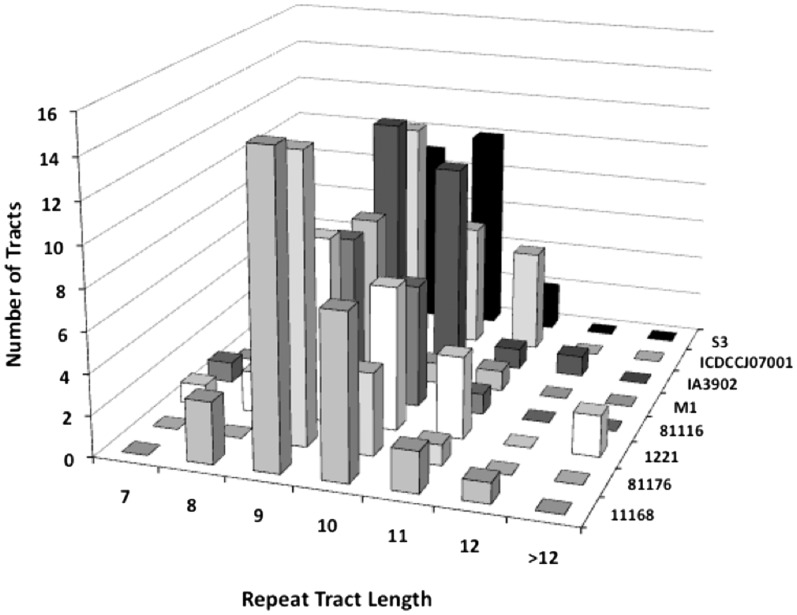
Figure 1.
Figure 1.
Lengths of polyC/G repeat tracts in C. jejuni genomes. Published genome sequences (z-axis) were scanned for simple sequence repeat tracts containing seven or more C or G residues. The x-axis indicates the lengths of the tracts; the y-axis indicates the number of loci containing tracts of a particular length.
Figure 2.
Figure 2.
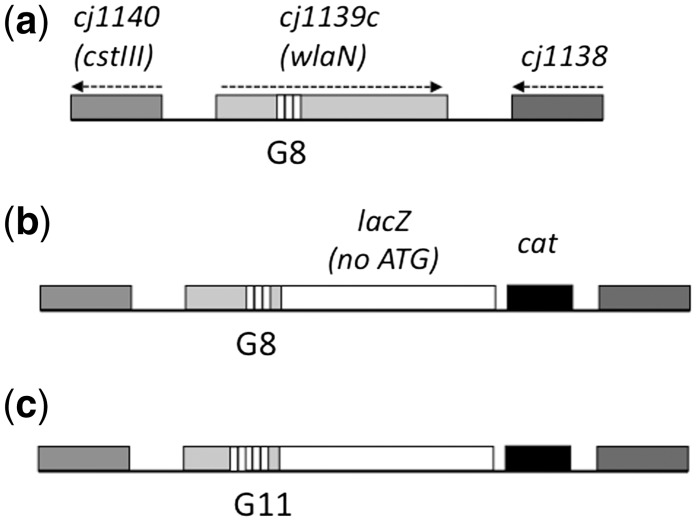
Schematic representation of the reporter constructs for cj1139c. The upper diagram, (a), represents the wild-type locus in C. jejuni strain NCTC11168. The ORFs are represented by shaded rectangles and the direction of transcription by dotted lines. The repeat tract in cj1139c is indicated by a series of small, white rectangles. The middle diagram, (b), represents the reporter construct. In this construct, a lacZ gene lacking a promoter and initiation codon was fused to cj1139c downstream of the repeat tract. A chloramphenicol cassette (cat) was inserted at the 3′-end of the lacZ gene and utilized as a selective marker during insertion of this construct into the chromosome of C. jejuni strain NCTC11168. The lower diagram, (c), shows the reporter construct containing a G11 repeat tract. This construct was derived from the G8 construct by site-directed mutagenesis of the repeat tract prior to recombination into the chromosome.
Figure 3.
Figure 3.
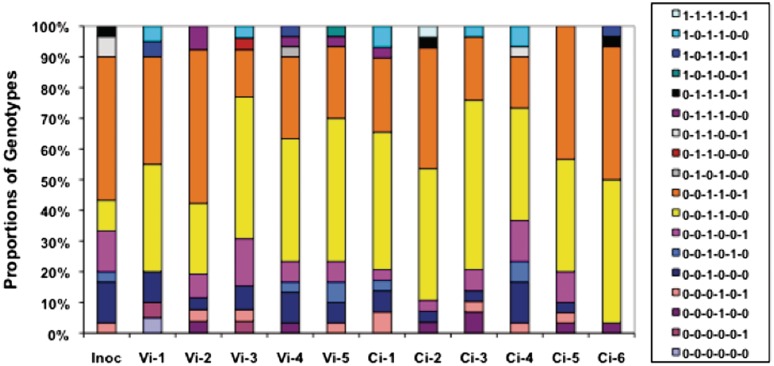
Changes in the proportions of each genotype following in vitro passage of C. jejuni strain NCTC11168. An initial inoculum of either constant (Ci; 3.5 × 10−8 cfu) or variable (Vi; 3.5 × 10−8 to 3.5 × 10−4 cfu) size was subjected to three passages in 5 ml of MHB (see Supplementary Data for further details). Genotypes were derived from 30 colonies for the inoculum and each ouput sample by assigning a ‘1’ for an ‘on’ or ‘0’ an ‘off’ phenotype to each of six genes (cj1326, cj0031, cj1139, cj0685, cj0045 and capA, respectively) based on the numbers of repeats present within the gene. Inoc, inoculum; Vi-1 to Vi-5, variable inoculum samples; Ci-1 to Ci-6, constant inoculum samples.
Figure 4.
Figure 4.
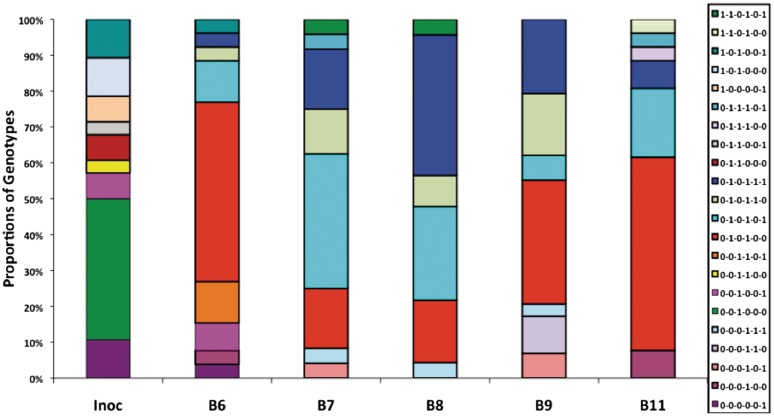
Changes in the proportions of genotypes following in vivo passage of a hypermotile variant of C. jejuni strain NCTC11168. Two-week-old out-bred chickens were inoculated with 1 × 108 cfu. Caecal samples were collected 2 weeks after inoculation and C. jejuni was enumerated by growth of dilutions on selective plates. The genotypes for phase variable genes were derived by the same approach as in Figure 3 for the same six genes. Genotypes were derived for 30 colonies from the inoculum and for 23–29 colonies from output populations following growth under identical conditions. Inoc, inoculum; B6–B11, individual birds.
Figure 5.
Figure 5.
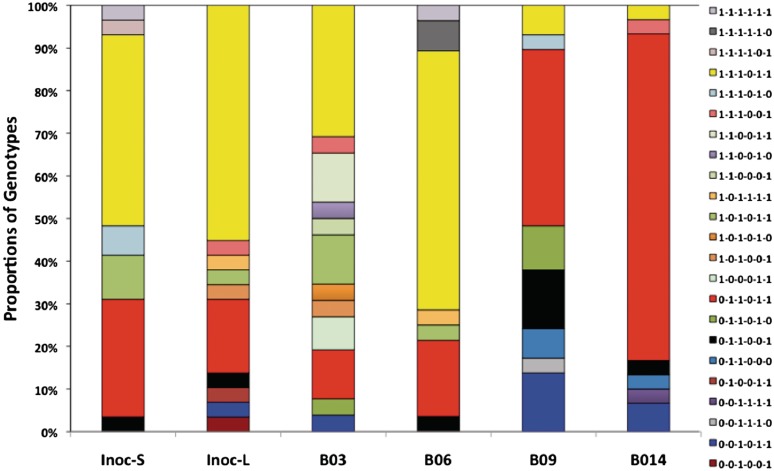
Changes in the proportions of genotypes following in vivo passage of a chicken-adapted variant of C. jejuni strain 81–176. The genotypes were derived by the same approach as in Figure 4 for the following six genes: 81176-0083, 81176-0646, 81176-0708, 81176-1160, 81176-1312 and 81176-1325. Genotypes for 29 small colonies (Inoc-S) and 29 large colonies of the inoculum were derived following growth on campylobacter selective plates. The genotypes for output populations were derived for 26–30 colonies from dilutions of caecal samples grown under identical conditions. Caecal samples were collected 2 weeks after inoculation of chickens with 1 × 108 cfu. Inoc-S, small colonies in inoculum; Inoc-L, large colonies in inoculum; B03, B06, B09 and B014, individual birds.
Figure 6.
Figure 6.
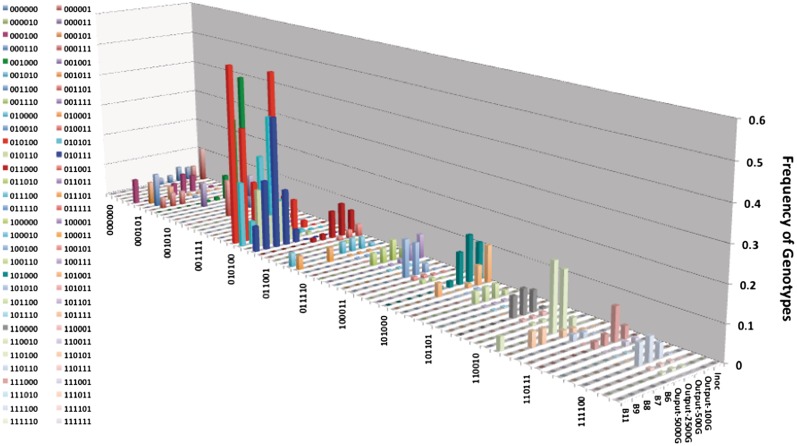
Comparison of the changes in proportions of phase variable genotypes for theoretical and experimental in vivo passaged populations of strain NCTC11168. The proportions of genotypes for the inoculum were used as input to the theoretical model of PV, which was then run for a varying number of generations. Genotypes were for the six genes with 0 representing an OFF phase variant and 1 an ON variant. The order of the genes and the ON-to-OFF and OFF-to-ON switching rates (×10−4) were as follows: cj1326, 10.3, 17.9; cj0031, 10.3, 17.9; cj1139, 6.9, 2.1; cj0685, 2.1, 6.9; cj0045, 38.8, 3.7; capA, 38.8, 3.7. Inoc, inoculum; Ouput-100 G,-500 G,-2500 G and-5000 G, are output data from the model for runs of 100, 500, 2500 and 5000 generations; B6, B7, B8, B9 and B11 are experimental data for output populations obtained from five different chickens.
Figure 7.
Figure 7.
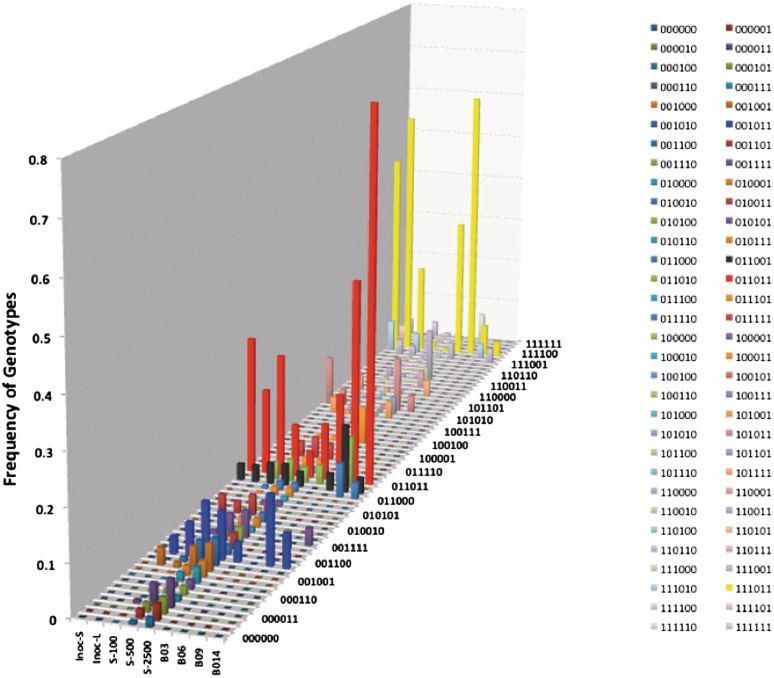
Comparison of the changes in proportions of phase variable genotypes for theoretical and experimental in vivo passaged populations of strain 81–176. The proportions of genotypes for the inoculum were used as input to the theoretical model of PV, which was then run for a varying number of generations. Genotypes were for the six genes with 0 representing an OFF phase variant and 1 an ON variant. The order of the genes and the ON-to-OFF and OFF-to-ON switching rates (×10−4) were as follows: 81176-0083, 38.8, 3.7; 81176-0646, 17.9, 10.3; 81176-0708, 10.3, 17.9; 81176-1160, 17.9, 10.3; 81176-1312, 10.3, 17.9; 81176-1325, 10.3, 17.9. Inoc-S, small colonies in inoculum; Inoc-L, large colonies in inoculum; S-100, S-500 and S-2500 are output data from the model for runs of 100, 500 and 2500 generations using Inoc-S as the input to the model; B03, B06, B09 and B014 are experimental data for output populations obtained from four different chickens.

References

    1. Bayliss CD. Determinants of phase variation rate and the fitness implications of differing rates for bacterial pathogens and commensals. FEMS Microbiol. Rev. 2009;33:504–520. - PubMed
    1. Deitsch KW, Lukehart SA, Stringer JR. Common strategies for antigenic variation by bacterial, fungal and protozoan pathogens. Nat. Rev. Microbiol. 2009;7:493–503. - PMC - PubMed
    1. Moxon ER, Bayliss CD, Hood DW. Bacterial contingency loci: the role of simple sequence DNA repeats in bacterial adaptation. Ann. Rev. Genet. 2007;40:307–333. - PubMed
    1. van der Woude MW, Baumler AJ. Phase and antigenic variation in bacteria. Clin. Microbiol. Rev. 2004;17:581–611. - PMC - PubMed
    1. De Bolle X, Bayliss CD, Field D, van de Ven T, Saunders NJ, Hood DW, Moxon ER. The length of a tetranucleotide repeat tract in Haemophilus influenzae determines the phase variation rate of a gene with homology to type III DNA methyltransferases. Mol. Microbiol. 2000;35:211–222. - PubMed

Publication types