


Studies of isolated global brain ischaemia: I. A new large animal model of global brain ischaemia and its baseline perfusion studies
- PMID: 22436249
- PMCID: PMC3327861
- DOI: 10.1093/ejcts/ezr316
Studies of isolated global brain ischaemia: I. A new large animal model of global brain ischaemia and its baseline perfusion studies
Abstract
Objectives: Neurological injury after global brain ischaemia (i.e. sudden death) remains problematic, despite improving cardiac survival. Unfortunately, sudden death models introduce unwanted variables for studying the brain because of multiple organ injury. To circumvent this, a new minimally invasive large animal model of isolated global brain ischaemia, together with baseline perfusion studies is described.
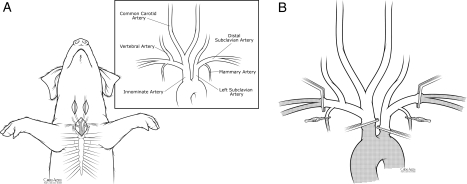
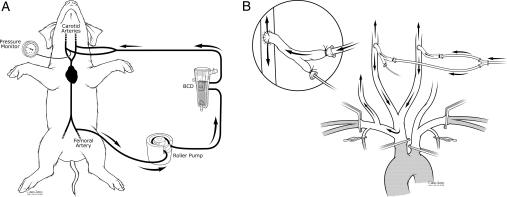
Methods: The model employs neck and small (3-4 inches) supra-sternal incisions to block inflow from carotid and vertebral arteries for 30 min of normothermic ischaemia. Neurological changes after 24 h in six pigs was compared with six Sham pigs assessing neurological deficit score (NDS, 0 = normal, 500 = brain death), brain oedema and cerebral infarction by 2,3,5-triphenyltetrazolium chloride (TTC) stain. Six other pigs had baseline perfusion characteristics in this new model evaluated at carotid flows of 750, 550 and 450 cc/min, with cerebral perfusion pressure, cerebral oximeter saturation [IN Vivo Optical Spectroscopy (INVOS)] and transcranial O(2) uptake measurements.
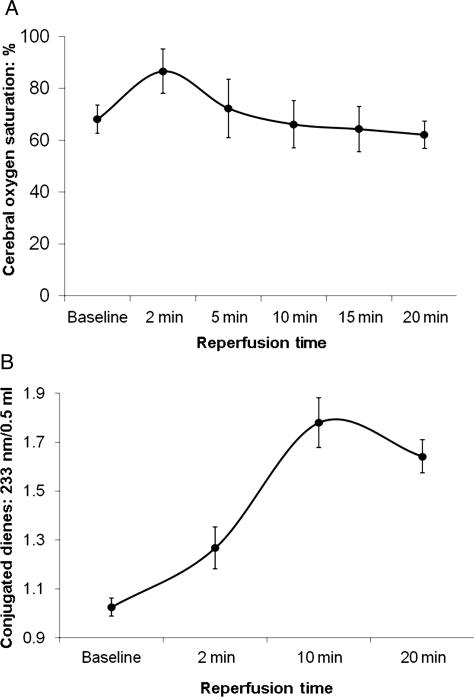
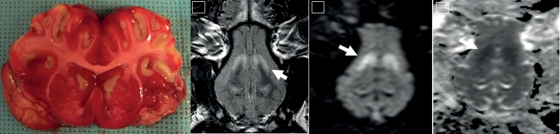
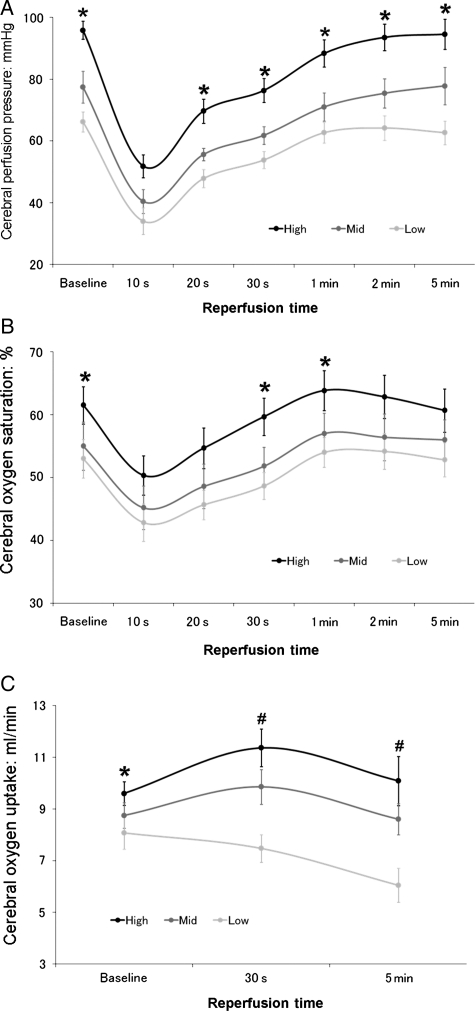
Results: The model never altered cardiac or pulmonary function, and six Sham pigs had normal (NDS = 0) neurological recovery without brain injury. Conversely, 24 h analysis showed that 30 min of global normothermic brain ischaemia caused multiple post-reperfusion seizures (P < 0.001 versus Sham), raised NDS (231 ± 16; P < 0.001 versus Sham) in four of six survivors and caused marked post-brain oedema (P < 0.001 versus Sham) and extensive cerebral infarctions (TTC stain; P < 0.001 versus Sham). Baseline perfusion showed 750 cc/min flow rate produced normal INVOS levels and O(2) consumption at mean 90-100 mmHg carotid pressure. Carotid pressure and INVOS fell at mid- and low-flow rates. Although INVOS did not change, 450 cc/min flow lowered global O(2) consumption, which further decreased after transient ischaemia (30 s) and 5 min of reperfusion.
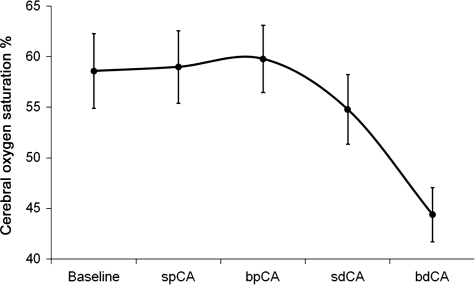
Conclusions: This new isolated global brain model consistently caused anatomic, biochemical and functional neurological damage in pigs after 30 min of ischaemia. Flows of 750 cc/min maintained normal mean systemic arterial (90-100 mmHg) pressure, INVOS levels and O(2) consumption. Cerebral pressure and INVOS fell in mid- and low-flow studies. A disparity existed between INVOS oxygen saturation and global O(2) consumption at lower flow rates of 450 cc/min following transient ischaemia, indicating that surface oxygen saturation measurement does not reflect global brain O(2) consumption.
Figures
Comment in
-
Save the brain: a new option!Eur J Cardiothorac Surg. 2012 May;41(5):1163-5. doi: 10.1093/ejcts/ezs158. Eur J Cardiothorac Surg. 2012. PMID: 22511800 No abstract available.
References
-
- Liakopoulos OJ, Allen BS, Buckberg GD, Hristov N, Tan Z, Villablanca JP, et al. Resuscitation after prolonged cardiac arrest: role of cardiopulmonary bypass and systemic hyperkalemia. Ann Thorac Surg. 2010;89:1972–9. - PubMed
-
- Allen BS, Buckberg GD. Studies of isolated global brain ischaemia: I. Overview of irreversible brain injury and evolution of a new concept–redefining the time of brain death. Eur J Cardiothorc Surg. 2012;41:1132–7. - PubMed
-
- Boyle EM, Jr, Pohlman TH, Cornejo CJ, Verrier ED. Endothelial cell injury in cardiovascular surgery: ischemia-reperfusion. Ann Thorac Surg. 1996;62:1868–75. - PubMed
-
- Allen BS. Pediatric myocardial protection: a cardioplegic strategy is the ‘solution’. Semin Thorac Cardiovasc Surg Pediatr Card Surg Annu. 2004;7:141–54. - PubMed
-
- Trummer G, Foerster K, Buckberg GD, Benk C, Heilmann C, Mader I. Successful resuscitation after prolonged periods of cardiac arrest: a new field in cardiac surgery. J Thorac Cardiovasc Surg. 2010;139:1325–32. - PubMed
Publication types
MeSH terms
Substances
Grants and funding
LinkOut - more resources
Full Text Sources
Other Literature Sources
