. 2012 Jun 1;302(11):E1390-8.
doi: 10.1152/ajpendo.00519.2011. Epub 2012 Mar 20.

A role for aberrant protein palmitoylation in FFA-induced ER stress and β-cell death

Affiliations

A role for aberrant protein palmitoylation in FFA-induced ER stress and β-cell death

Aaron C Baldwin et al. Am J Physiol Endocrinol Metab. .

Abstract

Exposure of insulin-producing cells to elevated levels of the free fatty acid (FFA) palmitate results in the loss of β-cell function and induction of apoptosis. The induction of endoplasmic reticulum (ER) stress is one mechanism proposed to be responsible for the loss of β-cell viability in response to palmitate treatment; however, the pathways responsible for the induction of ER stress by palmitate have yet to be determined. Protein palmitoylation is a major posttranslational modification that regulates protein localization, stability, and activity. Defects in, or dysregulation of, protein palmitoylation could be one mechanism by which palmitate may induce ER stress in β-cells. The purpose of this study was to evaluate the hypothesis that palmitate-induced ER stress and β-cell toxicity are mediated by excess or aberrant protein palmitoylation. In a concentration-dependent fashion, palmitate treatment of RINm5F cells results in a loss of viability. Similar to palmitate, stearate also induces a concentration-related loss of RINm5F cell viability, while the monounsaturated fatty acids, such as palmoleate and oleate, are not toxic to RINm5F cells. 2-Bromopalmitate (2BrP), a classical inhibitor of protein palmitoylation that has been extensively used as an inhibitor of G protein-coupled receptor signaling, attenuates palmitate-induced RINm5F cell death in a concentration-dependent manner. The protective effects of 2BrP are associated with the inhibition of [(3)H]palmitate incorporation into RINm5F cell protein. Furthermore, 2BrP does not inhibit, but appears to enhance, the oxidation of palmitate. The induction of ER stress in response to palmitate treatment and the activation of caspase activity are attenuated by 2BrP. Consistent with protective effects on insulinoma cells, 2BrP also attenuates the inhibitory actions of prolonged palmitate treatment on insulin secretion by isolated rat islets. These studies support a role for aberrant protein palmitoylation as a mechanism by which palmitate enhances ER stress activation and causes the loss of insulinoma cell viability.


Figures
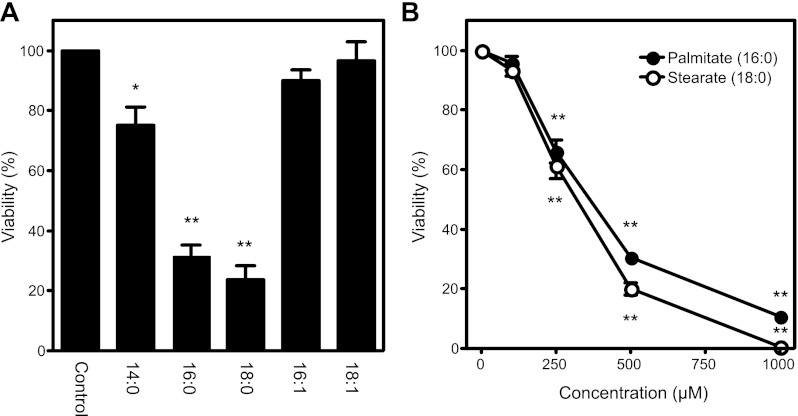
Fig. 1.
Fig. 1.
Loss of viability of insulinoma cells treated with free fatty acids (FFAs). A: RINm5F cells were treated for 24 h with 500 μM myristate (14:0), 500 μM palmitate (16:0), 500 μM stearate (18:0), 500 μM palmitolate (16:1), or 500 μM oleate (18:1). B: RINm5F cells were treated for 24 h with palmitate or stearate (0–1,000 μM), and cell viability was determined using the neutral red uptake assay. Values are means ± SE of 3 individual experiments. Statistically significant loss of viability: *P < 0.05; **P < 0.001.
Fig. 2.
Fig. 2.
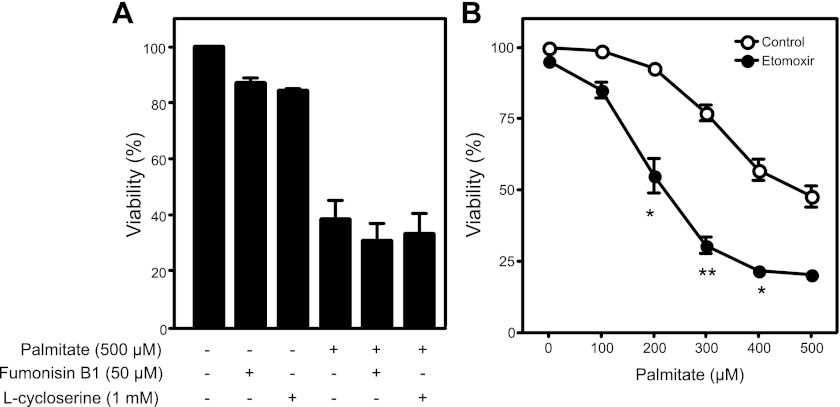
Role of ceramide synthesis and β-oxidation in palmitate-induced cell toxicity. A: RINm5F cells were treated for 24 h with the ceramide synthesis inhibitors fumonisin B1 (50 μM) or l-cycloserine (1 mM) with or without palmitate (500 μM). B: RINm5F cells were treated for 24 h with 0–500 μM palmitate with or without 0.2 mM etomoxir, an inhibitor of mitochondrial long-chain fatty acid oxidation, and cell viability was determined using the neutral red uptake assay. Values are means ± SE of 3 individual experiments. Statistically significant loss of viability: *P < 0.05; **P < 0.001.
Fig. 3.
Fig. 3.
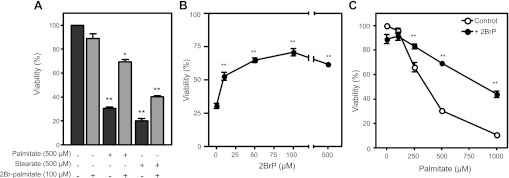
2-Bromopalmitate (2BrP) attenuates saturated FFA-induced cell death. A: RINm5F cells were treated with palmitate (500 μM) with or without 2BrP (100 μM) or with stearate (500 μM) with or without 2BrP (100 μM) for 24 h, and cell viability was examined. B: concentration-dependent effects of 2BrP on palmitate-induced cell death following a 24-h incubation. C: concentration-dependent effects of 24-h incubation with palmitate on RINm5F cell viability in the presence and absence of 2BrP (100 μM). Cell viability was determined using the neutral red uptake assay. Values are means ± SE of 3 individual experiments. Statistically significant loss of viability compared with control, untreated cells: *P < 0.05; **P < 0.001. Enhanced viability of cells treated with 50 vs. 10 μM 2BrP and with 100 vs. 10 μM 2BrP achieved statistical significance (P < 0.05).
Fig. 4.
Fig. 4.
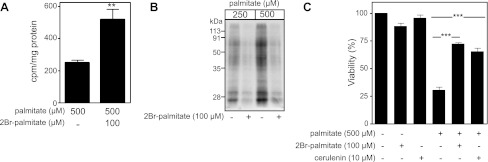
2BrP inhibits protein S-acylation. A: 14CO2 end products from fatty acid oxidation of [1-14C]palmitate in RINm5F cells after 5 h of culture with or without 2BrP (100 μM). B: RINm5F cells were pretreated with or without 2BrP (100 μM) for 3 h before addition of [3H]palmitate and incubation for another 4 h. Cells were lysed, and proteins were separated by SDS-PAGE and visualized by fluorography. Data are representative of results from 2 independent experiments. C: RINm5F cells were treated with or without palmitate (500 μM) in the presence of 2BrP (100 μM) or cerulenin (10 μM) for 24 h, and cell viability was determined using the neutral red uptake assay. Values are means ± SE of 3 individual experiments. Statistically significant changes: *P < 0.01; ***P < 0.001.
Fig. 5.
Fig. 5.
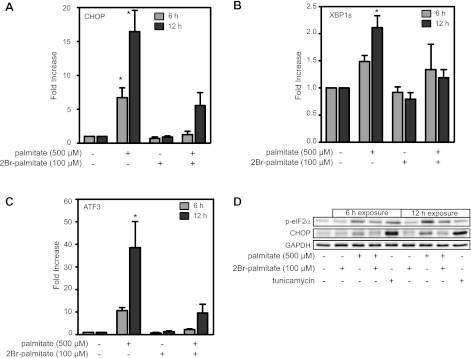
2BrP attenuates induction of endoplasmic reticulum (ER) stress in FFA-treated cells. A–C: RINm5F cells were treated with palmitate (500 μM) and/or 2BrP (100 μM) for 6 and 12 h. Total RNA was isolated, and C/EBP homologous protein (CHOP, A), spliced X-box binding protein-1 (XBP1, B), or activating transcription factor-3 (ATF3, C) mRNA accumulation was detected by real-time PCR and normalized to β-actin levels. Values are means ± SE of 3 individual experiments. Statistically significant changes in mRNA accumulation: *P < 0.05. D: under conditions similar to those described for A–C, palmitate induces CHOP expression and eukaryotic initiation factor-2α (eIF2α) phosphorylation (p-eIF2α) as determined by Western blot analysis. Tunicamycin (2 μg/ml) was used as a positive control for induction of ER stress. Data are representative of results from 3 individual experiments.
Fig. 6.
Fig. 6.
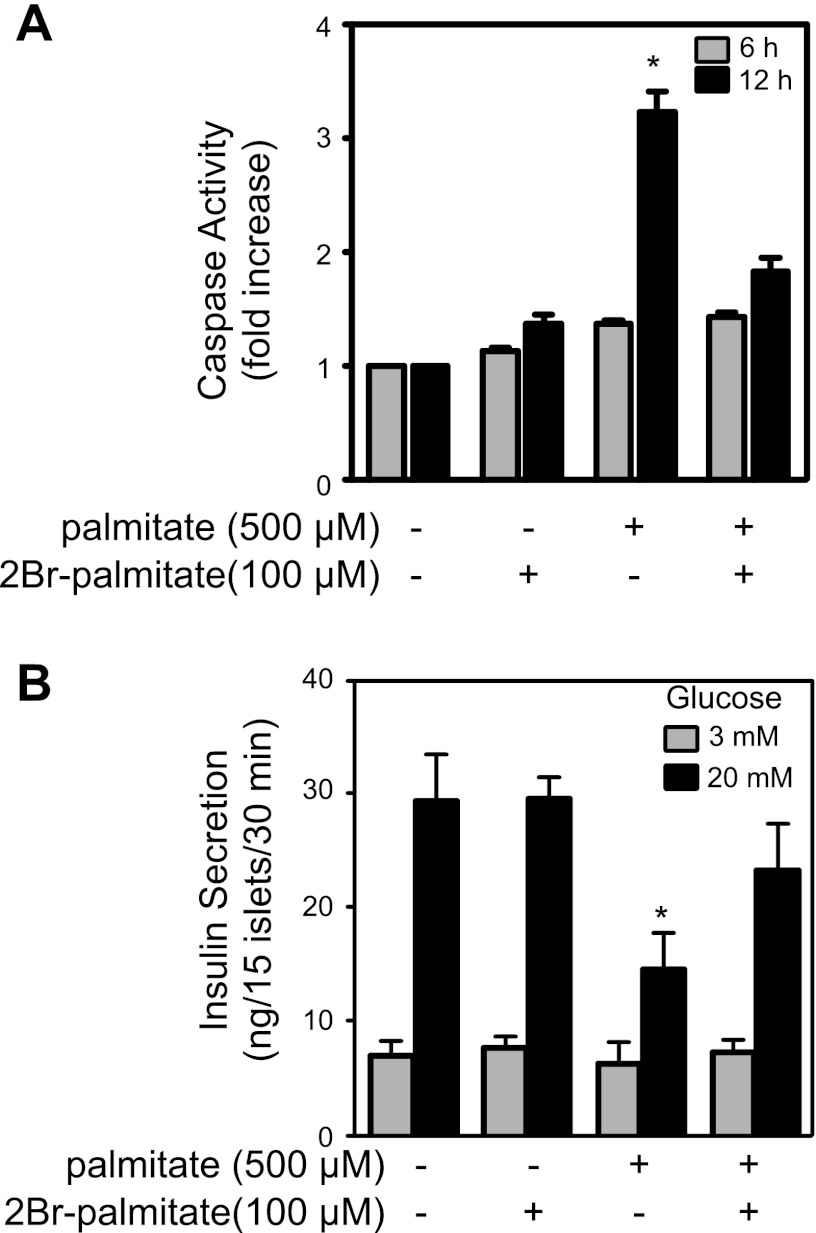
2BrP attenuates FFA induction of caspase-3/7 activity and inhibition of insulin secretion. A: RINm5F cells were treated with palmitate (500 μM) in the presence or absence of 2BrP (100 μM) for 6 and 12 h, cells were lysed, and caspase-3/7 activity was measured. Values are means ± SE of 3 individual experiments containing 3 replicates per condition. B: isolated rat islets were treated with palmitate (500 μM) and/or 2BrP (100 μM) for 48 h, and glucose-stimulated insulin secretion was examined. Values are means ± SE of 3 independent rat islet isolations. *P < 0.05.

References

    1. Abrami L, Leppla SH, van der Goot FG. Receptor palmitoylation and ubiquitination regulate anthrax toxin endocytosis. J Cell Biol 172: 309–320, 2006 - PMC - PubMed
    1. Bachar E, Ariav Y, Ketzinel-Gilad M, Cerasi E, Kaiser N, Leibowitz G. Glucose amplifies fatty acid-induced endoplasmic reticulum stress in pancreatic β-cells via activation of mTORC1. PLos One 4: e4954, 2009 - PMC - PubMed
    1. Berthiaume L, Resh MD. Biochemical characterization of a palmitoyl acyltransferase activity that palmitoylates myristoylated proteins. J Biol Chem 270: 22399–22405, 1995 - PubMed
    1. Bijlmakers MJ, Marsh M. The on-off story of protein palmitoylation. Trends Cell Biol 13: 32–42, 2003 - PubMed
    1. Bizzozero OA, Bixler HA, Pastuszyn A. Structural determinants influencing the reaction of cysteine-containing peptides with palmitoyl-coenzyme A and other thioesters. Biochim Biophys Acta 1545: 278–288, 2001 - PubMed

Publication types

MeSH terms

LinkOut - more resources