


Deuterium-labeled phylloquinone has tissue-specific conversion to menaquinone-4 among Fischer 344 male rats
- PMID: 22437559
- PMCID: PMC3327742
- DOI: 10.3945/jn.111.155804
Deuterium-labeled phylloquinone has tissue-specific conversion to menaquinone-4 among Fischer 344 male rats
Abstract
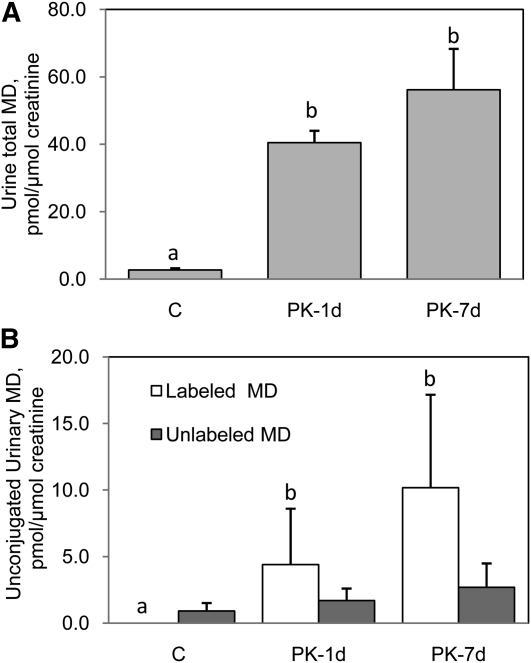
Phylloquinone (PK) is converted into menaquinone-4 (MK-4) via side chain removal-addition. Stable isotope use is an effective approach to identify the tissue location of this conversion, which is currently unknown. Following a 14-d PK-deficient diet, male Fischer 344 rats (8 mo; n = 15) were fed 1.6 mg deuterium-labeled PK (L-PK) per kg diet for 0 (control), 1 d (PK-1d), and 7 d (PK-7d). Both L-PK and deuterium-labeled MK-4 (L-MK-4) were detected in tissues in PK-1d and PK-7d, although the results varied. Whereas some tissues had an overall increase in MK-4 in response to L-PK, total brain, testes, and fat MK-4 concentrations did not. In contrast, L-MK-4 concentrations increased in all 3 tissues. The deuterium label was found only on the L-MK-4 naphthoquinone ring, confirming the need for side chain removal for the formation of MK-4. Labeled menadione (MD) was detected in urine and serum in PK-1d and PK-7d, confirming its role as an intermediate. A Caco-2 cell monolayer model was used to study the role of the enterocytes in the conversion process. Neither MK-4 nor MD was detected in Caco-2 cells treated with PK. However, when Caco-2 cells were treated with MD, MK-4 was formed. Similarly, MK-4 was formed in response to MD-treated 293T kidney cells, but not HuH7 liver cells. These data demonstrate that MK-4 is the predominant form of vitamin K in multiple tissues, but there appears to be a tissue-specific regulation for the conversion of PK to MK-4.
Conflict of interest statement
Author disclosures: A. Al Rajabi, S. L. Booth, J. W. Peterson, S. W. Choi, J. W. Suttie, M. K. Shea, B. Miao, M. A. Grusak, and X. Fu, no conflicts of interest.
Figures
References
-
- Davidson RT, Foley AL, Engelke JA, Suttie JW. Conversion of dietary phylloquinone to tissue menaquinone-4 in rats is not dependent on gut bacteria. J Nutr. 1998;128:220–3 - PubMed
-
- Suttie J. Vitamin K in Health and Disease Series. Vitamin K in health and disease. Boca Raton, Florida: CRC Press; 2009
-
- Yoshida T, Miyazawa K, Kasuga I, Yokoyama T, Minemura K, Ustumi K, Aoshima M, Ohyashiki K. Apoptosis induction of vitamin K2 in lung carcinoma cell lines: the possibility of vitamin K2 therapy for lung cancer. Int J Oncol. 2003;23:627–32 - PubMed
-
- Yaguchi M, Miyazawa K, Katagiri T, Nishimaki J, Kizaki M, Tohyama K, Toyama K. Vitamin K2 and its derivatives induce apoptosis in leukemia cells and enhance the effect of all-trans retinoic acid. Leukemia. 1997;11:779–87 - PubMed
Publication types
MeSH terms
Substances
Grants and funding
LinkOut - more resources
Full Text Sources
Other Literature Sources
