. 2012 Mar;21(1):1-8.
doi: 10.5607/en.2012.21.1.1. Epub 2012 Feb 28.

Neuronal autophagy: a housekeeper or a fighter in neuronal cell survival?

Affiliations

Neuronal autophagy: a housekeeper or a fighter in neuronal cell survival?

Jin-A Lee. Exp Neurobiol. 2012 Mar.

Abstract

Neurons have highly dynamic cellular processes for their proper functions such as cell growth, synaptic formation, or synaptic plasticity by regulating protein synthesis and degradation. Therefore, the quality control of proteins in neurons is essential for their physiology and pathology. Autophagy is a cellular degradation pathway by which cytosolic components are sequestered in autophagosomes and degraded upon their fusion with lysosomal components. Thus, the autophagic pathway may play important roles in neuronal cell survival and neuronal function under physiological condition and pathological conditions. Recent several findings suggest that the loss of basal autophagy or imbalance of autophagic flux leads to neurodegeneration. Autophagosomes accumulate abnormally in affected neurons of several neurodegenerative diseases such as Alzheimer's disease (AD), Huntington's disease (HD), Parkinson's disease (PD), or Frontotemporal dementia (FTD). Thus, the understanding how autophagy is associated with several neurological diseases would be the first step for new therapeutic intervention in neurological disorders. In this review, I will discuss the molecular mechanism of autophagy in neurons and autophagy-associated neurodegenerative diseases.

Keywords: autophagy; homeostasis; neurodegenerative disease; neuron.


Figures
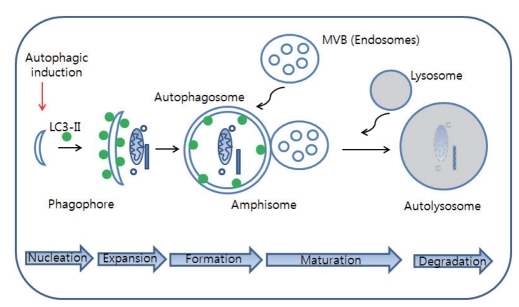
Fig. 1
Fig. 1
The cellular processes during autophagy. Autophagic process follows distinct stages: vesicle nucleation (formation of phagophore), vesicle expansion (autophagosome formation), maturation (fusion of autophagosome with MVB (multivesicular body)/lysosome, degradation (acidification). Once autophagy is induced by autophagic stimuli such as inhibition of mTOR, phagophore (isolation membrane) begin to be formed and then cytosolic components are sequestered by autophagosomes characterized by LC3-II-positive double membrane structure. Endosome such as MVB or lysosome can be fused with autophagosome to form amphisome or autolysosome, respectively. In final step, cytosolic components are degraded in autolysosome.
Fig. 2
Fig. 2
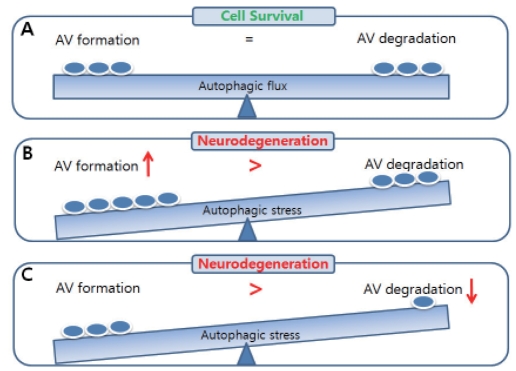
The balance of autophagic flux in neuronal cell survival. Autophagic flux indicates the balance between autophagosome formation and autophagic degradation. (A) If autophagosomes can be efficiently degraded in autolysosomes either at a basal level or at an activated level, neuronal cells maintain their homeostasis leading to neuronal cell survival. (B) When the rate of autophagosome formation highly exceeds the rate of autophagic degradation or (C) when late stage of autophagic process (maturation or degradation) has defects, autophagic degradation is impaired and causes accumulation of autophagic vacuoles leading to neurodegeneration [62].

References

    1. Xie Z, Klionsky DJ. Autophagosome formation: core machinery and adaptations. Nat Cell Biol. 2007;9:1102–1109. - PubMed
    1. Levine B, Kroemer G. Autophagy in the pathogenesis of disease. Cell. 2008;132:27–42. - PMC - PubMed
    1. Mizushima N, Levine B, Cuervo AM, Klionsky DJ. Autophagy fights disease through cellular self-digestion. Nature. 2008;451:1069–1075. - PMC - PubMed
    1. Yang Z, Klionsky DJ. Eaten alive: a history of macroautophagy. Nat Cell Biol. 2010;12:814–822. - PMC - PubMed
    1. He C, Klionsky DJ. Regulation mechanisms and signaling pathways of autophagy. Annu Rev Genet. 2009;43:67–93. - PMC - PubMed