


The database for aggregate analysis of ClinicalTrials.gov (AACT) and subsequent regrouping by clinical specialty
- PMID: 22438982
- PMCID: PMC3306288
- DOI: 10.1371/journal.pone.0033677
The database for aggregate analysis of ClinicalTrials.gov (AACT) and subsequent regrouping by clinical specialty
Abstract
Background: The ClinicalTrials.gov registry provides information regarding characteristics of past, current, and planned clinical studies to patients, clinicians, and researchers; in addition, registry data are available for bulk download. However, issues related to data structure, nomenclature, and changes in data collection over time present challenges to the aggregate analysis and interpretation of these data in general and to the analysis of trials according to clinical specialty in particular. Improving usability of these data could enhance the utility of ClinicalTrials.gov as a research resource.
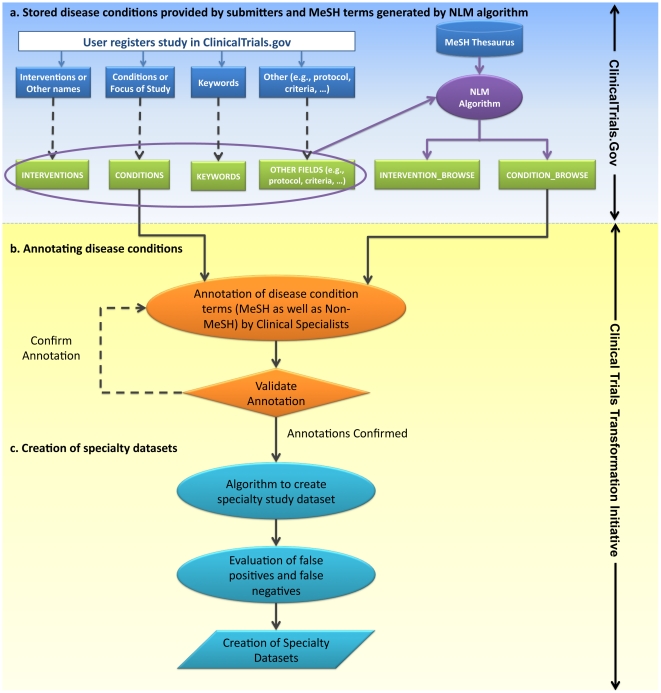
Methods/principal results: The purpose of our project was twofold. First, we sought to extend the usability of ClinicalTrials.gov for research purposes by developing a database for aggregate analysis of ClinicalTrials.gov (AACT) that contains data from the 96,346 clinical trials registered as of September 27, 2010. Second, we developed and validated a methodology for annotating studies by clinical specialty, using a custom taxonomy employing Medical Subject Heading (MeSH) terms applied by an NLM algorithm, as well as MeSH terms and other disease condition terms provided by study sponsors. Clinical specialists reviewed and annotated MeSH and non-MeSH disease condition terms, and an algorithm was created to classify studies into clinical specialties based on both MeSH and non-MeSH annotations. False positives and false negatives were evaluated by comparing algorithmic classification with manual classification for three specialties.
Conclusions/significance: The resulting AACT database features study design attributes parsed into discrete fields, integrated metadata, and an integrated MeSH thesaurus, and is available for download as Oracle extracts (.dmp file and text format). This publicly-accessible dataset will facilitate analysis of studies and permit detailed characterization and analysis of the U.S. clinical trials enterprise as a whole. In addition, the methodology we present for creating specialty datasets may facilitate other efforts to analyze studies by specialty groups.
Conflict of interest statement
Figures




References
-
- Public Law 105–115. The Food and Drug Administration Modernization Act. Available: http://www.fda.gov/RegulatoryInformation/Legislation/FederalFoodDrugandC.... Accessed 2012 Jan 9.
-
- ClinicalTrials.gov Web site. About ClinicalTrials.gov. Available: http://www.clinicaltrials.gov/ct2/info/about. Accessed 2011 May 6.
-
- DeAngelis CD, Drazen JM, Frizelle FA, Haug C, Hoey J, et al. Clinical trial registration: a statement from the International Committee of Medical Journal Editors. JAMA. 2004;292:1363–1364. - PubMed
-
- Zarin DA, Tse T, Williams RJ, Califf RM, Ide NC. The ClinicalTrials.gov results database–update and key issues. N Engl J Med. 2011;364:852–60. - PMC - PubMed
-
- Clinical Trials Transformation Initiative Web site. Welcome to CTTI. Available: https://www.trialstransformation.org. Accessed 2012 Jan 9.
Publication types
MeSH terms
Grants and funding
LinkOut - more resources
Full Text Sources
Medical
Miscellaneous
