Comparative Study
. 2012 Jun;23(6):1019-26.
doi: 10.1681/ASN.2011080842. Epub 2012 Mar 22.

The circadian clock modulates renal sodium handling

Affiliations
Comparative Study

The circadian clock modulates renal sodium handling

Svetlana Nikolaeva et al. J Am Soc Nephrol. 2012 Jun.

Abstract

The circadian clock contributes to the control of BP, but the underlying mechanisms remain unclear. We analyzed circadian rhythms in kidneys of wild-type mice and mice lacking the circadian transcriptional activator clock gene. Mice deficient in clock exhibited dramatic changes in the circadian rhythm of renal sodium excretion. In parallel, these mice lost the normal circadian rhythm of plasma aldosterone levels. Analysis of renal circadian transcriptomes demonstrated changes in multiple mechanisms involved in maintaining sodium balance. Pathway analysis revealed the strongest effect on the enzymatic system involved in the formation of 20-HETE, a powerful regulator of renal sodium excretion, renal vascular tone, and BP. This correlated with a significant decrease in the renal and urinary content of 20-HETE in clock-deficient mice. In summary, this study demonstrates that the circadian clock modulates renal function and identifies the 20-HETE synthesis pathway as one of its principal renal targets. It also suggests that the circadian clock affects BP, at least in part, by exerting dynamic control over renal sodium handling.


Figures
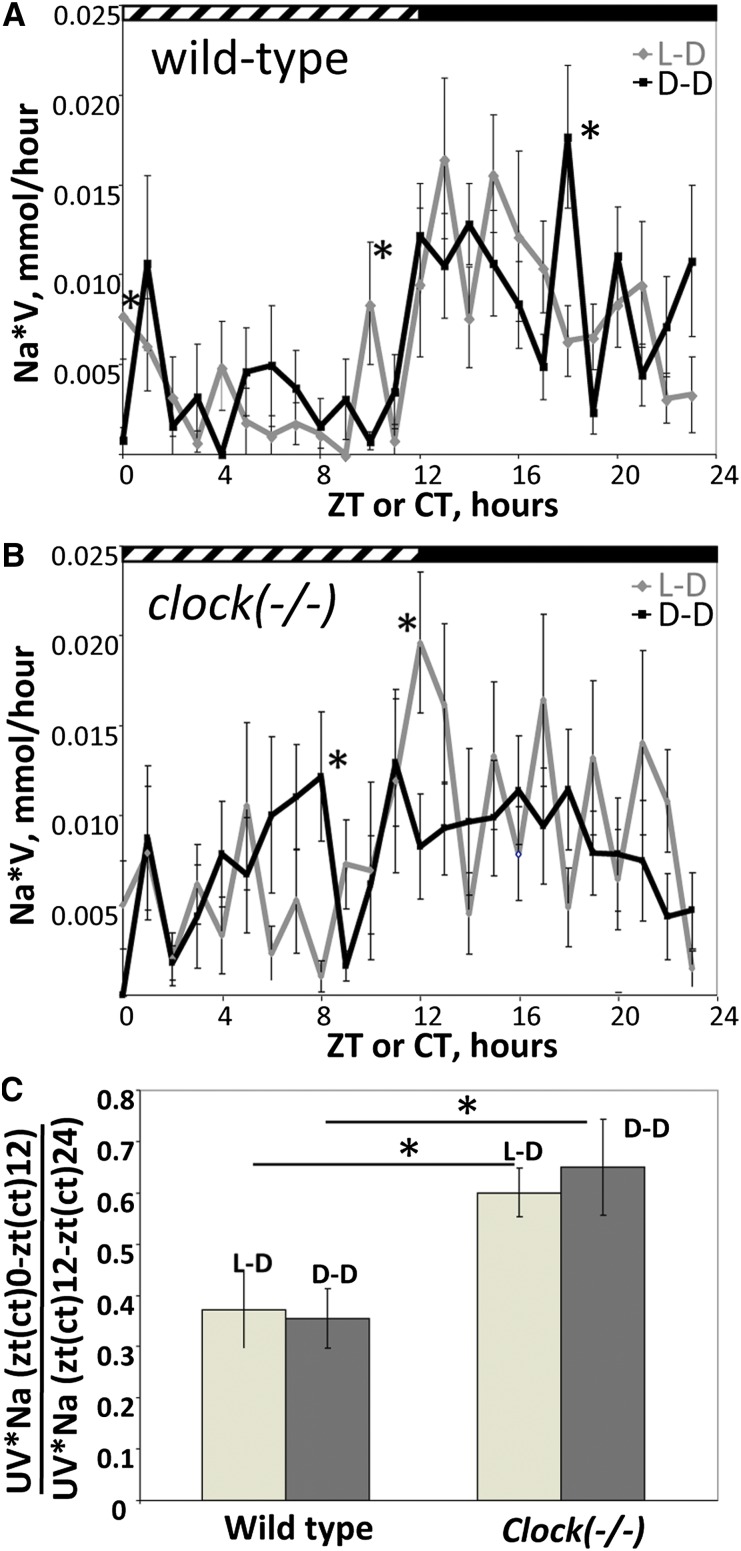
Figure 1.
Figure 1.
The circadian clock controls the temporal profile of urinary sodium excretion. (A) Temporal profile of renal sodium excretion rates in wild-type mice in LD or DD conditions. (B) Temporal profile of renal sodium excretion rates in clock(−/−) mice in LD or DD conditions. (C) Ratio between sodium excreted during the day (ZT0–ZT12) and the night (ZT12–ZT24) in LD conditions or during the subjective day (CT0–CT12) and subjective night (CT12–CT24) in DD conditions. Values are means ± SEM from 11 mice. Statistical significance was calculated using unpaired t test. UV*Na, urinary sodium excretion rate. *P<0.05.
Figure 2.
Figure 2.
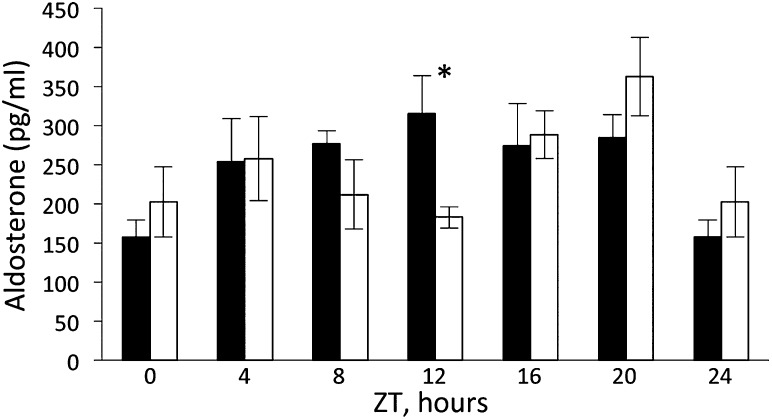
Temporal profiles of plasma aldosterone levels in wild-type (black bars) and clock(−/−) mice (white bars). Values are means ± SEM from five mice. Statistical significance was calculated using unpaired t test. *P<0.05.
Figure 3.
Figure 3.
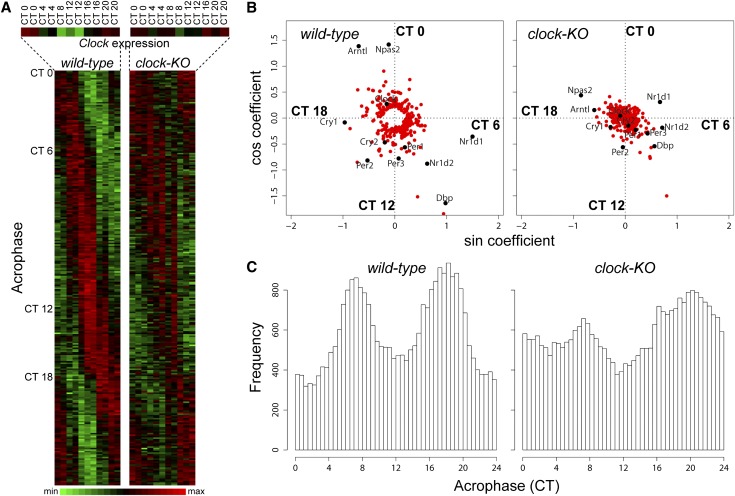
Deletion of the clock gene affects circadian patterns of gene expression in the kidney. (A) Phase ordering of 277 genes oscillating in wild-type mice. On the left are wild-type transcripts; on the right, clock(−/−) transcripts. The temporal expression of the clock gene is shown in the enlargement. Green and red represent minimal and maximal expression levels, respectively. The time of maximal transcript expression (acrophase) is indicated on the left. (B) Oscillating transcripts shown in A are plotted according to their amplitude and phase in wild-type and clock(−/−) mice. Principal elements of molecular clock are indicated in black. (C) Density distribution of acrophases for all 28,220 transcripts tested on microarrays in wild-type and clock(−/−) mice.
Figure 4.
Figure 4.
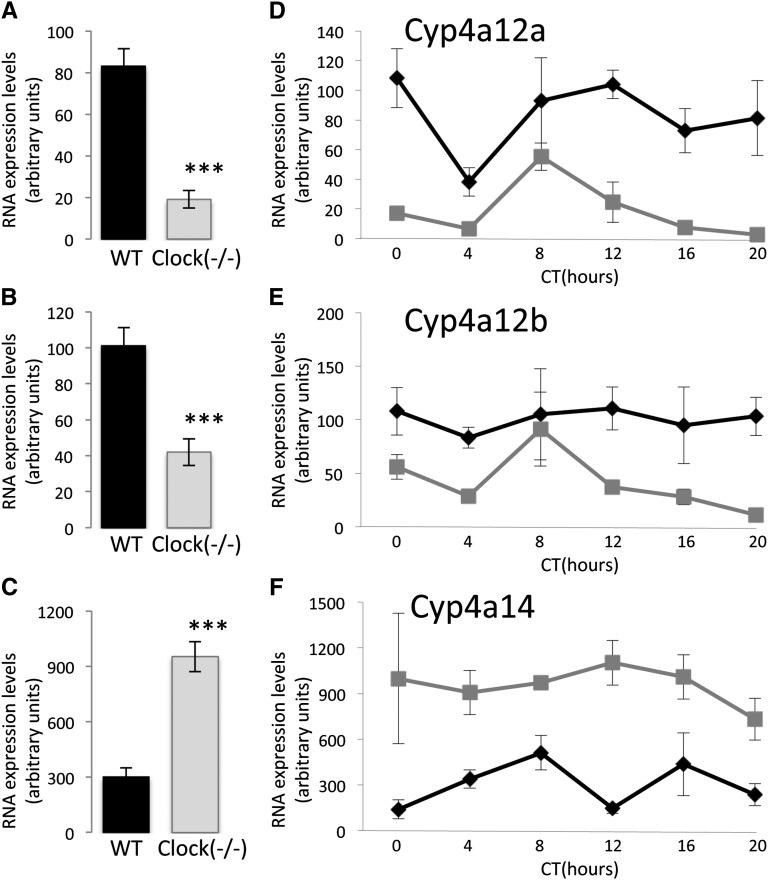
Expression levels of Cyp4a12a, Cyp4a12b, and Cyp4a14 transcripts in kidneys of wild-type and clock(−/−) mice. (A–C) Real-time PCR–based quantitation of 24-hour mean expression levels of Cyp4a12a, Cyp4a12b, and Cyp4a14, respectively. Values are means ± SEM from 30 mice. ***P<0.001, two-way ANOVA. (D–F) Real-time PCR–based temporal profiling of Cyp4a12a, Cyp4a12b, and Cyp4a14 RNA expression in kidneys of wild-type (black line) and clock(−/−) (gray line) mice, respectively. Values are means ± SEM from five mice.
Figure 5.
Figure 5.
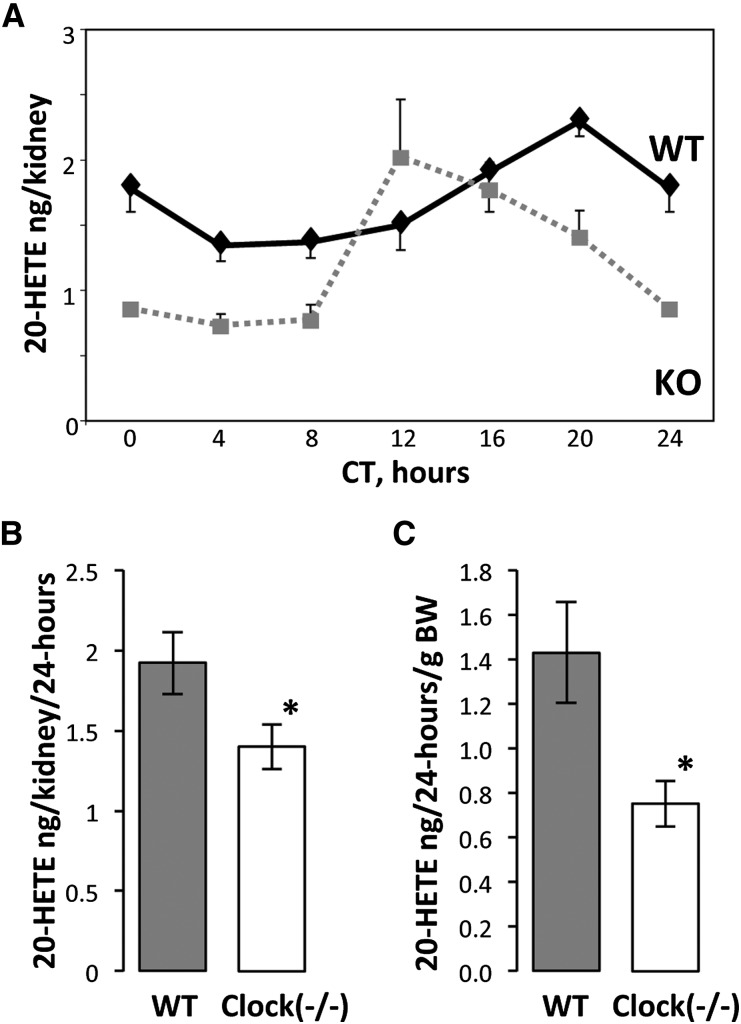
The clock(−/−) mice exhibit a significant reduction in 20-HETE levels in kidney microsomes and in urine. (A) Temporal profiles of 20-HETE levels in kidney microsomes of wild-type (black lane) and clock(−/−) mice (gray lane). Values are means ± SEM from six mice. KO, knockout; WT, wild-type. (B) Twenty-four–hour mean 20-HETE levels in kidney microsomes. Values are means ± SEM from 35 mice. *P<0.05, two-way ANOVA. (C) Twenty-four–hour mean 20-HETE levels in the urine of wild-type and clock(−/−) mice. Values are means ± SEM from six mice. BW, body weight. *P<0.05, t test.

References

    1. Curtis AM, Cheng Y, Kapoor S, Reilly D, Price TS, Fitzgerald GA: Circadian variation of blood pressure and the vascular response to asynchronous stress. Proc Natl Acad Sci USA 104: 3450–3455, 2007 - PMC - PubMed
    1. Zuber AM, Centeno G, Pradervand S, Nikolaeva S, Maquelin L, Cardinaux L, Bonny O, Firsov D: Molecular clock is involved in predictive circadian adjustment of renal function. Proc Natl Acad Sci USA 106: 16523–16528, 2009 - PMC - PubMed
    1. Doi M, Takahashi Y, Komatsu R, Yamazaki F, Yamada H, Haraguchi S, Emoto N, Okuno Y, Tsujimoto G, Kanematsu A, Ogawa O, Todo T, Tsutsui K, van der Horst GT, Okamura H: Salt-sensitive hypertension in circadian clock-deficient Cry-null mice involves dysregulated adrenal Hsd3b6. Nat Med 16: 67–74, 2010 - PubMed
    1. Rudic RD, Fulton DJ: Pressed for time: The circadian clock and hypertension. J Appl Physiol 107: 1328–1338, 2009 - PMC - PubMed
    1. Wang Q, Maillard M, Schibler U, Burnier M, Gachon F: Cardiac hypertrophy, low blood pressure, and low aldosterone levels in mice devoid of the three circadian PAR bZip transcription factors DBP, HLF, and TEF. Am J Physiol Regul Integr Comp Physiol 299: R1013–R1019, 2010 - PubMed

Publication types

MeSH terms