Memory B cell and other immune responses in children receiving two doses of an oral killed cholera vaccine compared to responses following natural cholera infection in Bangladesh
- PMID: 22441386
- PMCID: PMC3346319
- DOI: 10.1128/CVI.05615-11
Memory B cell and other immune responses in children receiving two doses of an oral killed cholera vaccine compared to responses following natural cholera infection in Bangladesh
Erratum in
- Clin Vaccine Immunol. 2012 Aug;19(8):1337
Abstract
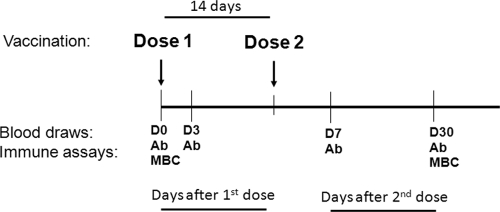
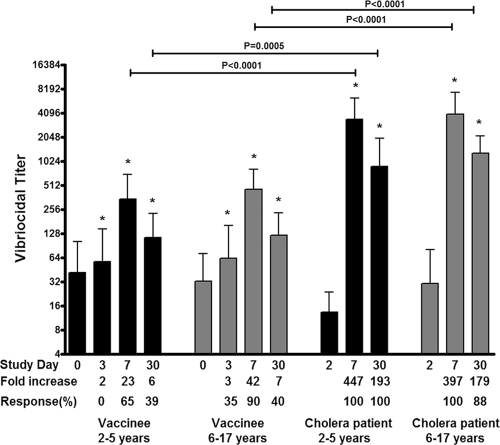
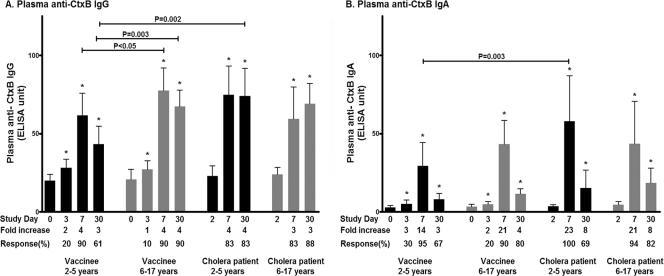
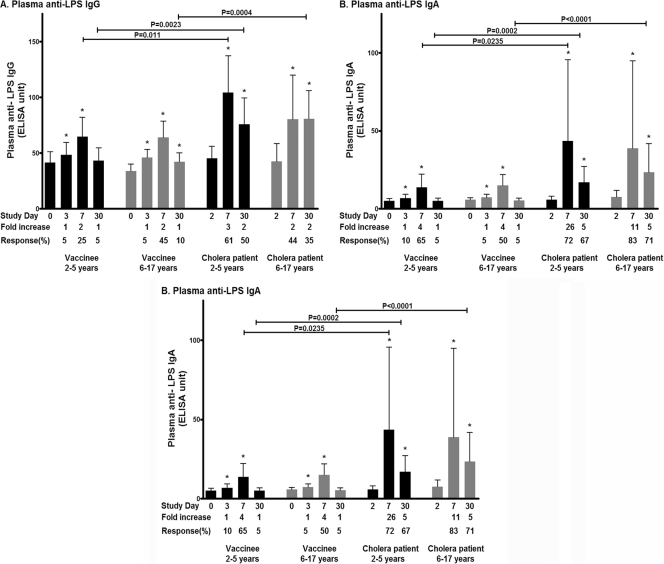
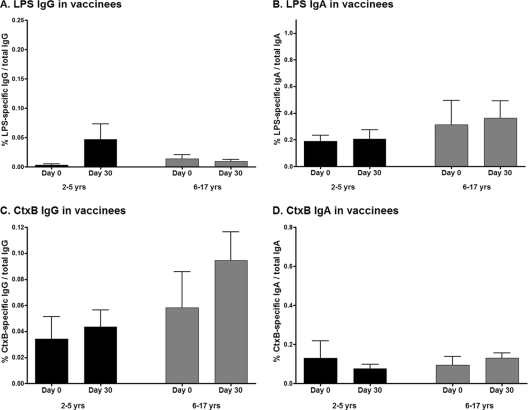
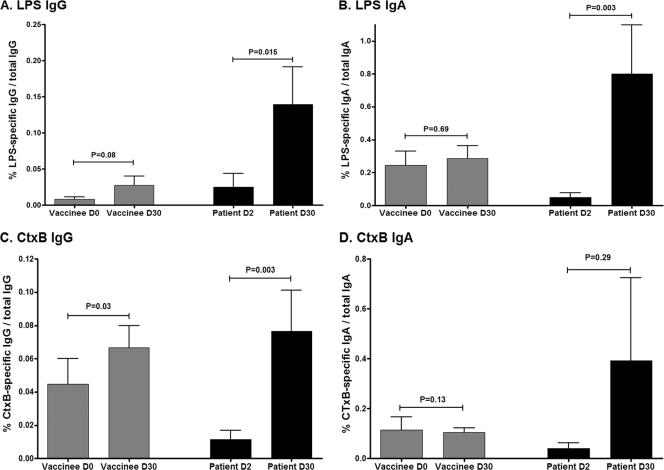
Current oral cholera vaccines induce lower protective efficacy and shorter duration of protection against cholera than wild-type infection provides, and this difference is most pronounced in young children. Despite this, there are limited data comparing immune responses in children following wild-type disease versus vaccination, especially with regard to memory responses associated with long-term immunity. Here, we report a comparison of immune responses in young children (2 to 5 years of age; n = 20) and older children (6 to 17 years of age; n = 20) given two doses of an oral killed cholera vaccine containing recombinant cholera toxin B subunit (CtxB) 14 days apart and compare these responses to those induced in similarly aged children recovering from infection with Vibrio cholerae O1 Ogawa in Bangladesh. We found that the two vaccine groups had comparable vibriocidal and lipopolysaccharide (LPS)-specific plasma antibody responses. Vaccinees developed lower levels of IgG memory B cell (MBC) responses against CtxB but no significant MBC responses against LPS. In contrast, children recovering from natural cholera infection developed prominent LPS IgG and IgA MBC responses, as well as CtxB IgG MBC responses. Plasma LPS IgG, IgA, and IgM responses, as well as vibriocidal responses, were also significantly higher in children following disease than after vaccination. Our findings suggest that acute and memory immune responses following oral cholera vaccination in children are significantly lower than those observed following wild-type disease, especially responses targeting LPS. These findings may explain, in part, the lower efficacy of oral cholera vaccination in children.
Figures
References
-
- Ahmed T, Svennerholm AM, Al Tarique A, Sultana GN, Qadri F. 2009. Enhanced immunogenicity of an oral inactivated cholera vaccine in infants in Bangladesh obtained by zinc supplementation and by temporary withholding breast-feeding. Vaccine 27:1433–1439 - PubMed
-
- Albert MJ, et al. 2003. Supplementation with zinc, but not vitamin A, improves seroconversion to vibriocidal antibody in children given an oral cholera vaccine. J. Infect. Dis. 187:909–913 - PubMed
Publication types
MeSH terms
Substances
Grants and funding
- U01 AI077883/AI/NIAID NIH HHS/United States
- TW05572/TW/FIC NIH HHS/United States
- TW005572/TW/FIC NIH HHS/United States
- HHMI/Howard Hughes Medical Institute/United States
- TW07144/TW/FIC NIH HHS/United States
- K01 TW007144/TW/FIC NIH HHS/United States
- R24 TW007988/TW/FIC NIH HHS/United States
- K01 TW007409/TW/FIC NIH HHS/United States
- K01 TW07409/TW/FIC NIH HHS/United States
- K08 AI089721/AI/NIAID NIH HHS/United States
- U01 AI058935/AI/NIAID NIH HHS/United States
- D43 TW005572/TW/FIC NIH HHS/United States
- R03 AI063079/AI/NIAID NIH HHS/United States
LinkOut - more resources
Full Text Sources
Medical
Miscellaneous