


Mapsembler, targeted and micro assembly of large NGS datasets on a desktop computer
- PMID: 22443449
- PMCID: PMC3514201
- DOI: 10.1186/1471-2105-13-48
Mapsembler, targeted and micro assembly of large NGS datasets on a desktop computer
Abstract
Background: The analysis of next-generation sequencing data from large genomes is a timely research topic. Sequencers are producing billions of short sequence fragments from newly sequenced organisms. Computational methods for reconstructing whole genomes/transcriptomes (de novo assemblers) are typically employed to process such data. However, these methods require large memory resources and computation time. Many basic biological questions could be answered targeting specific information in the reads, thus avoiding complete assembly.
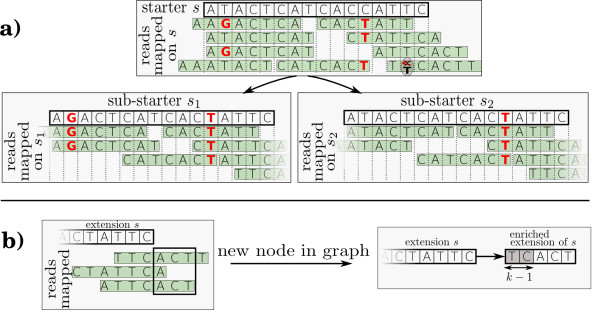
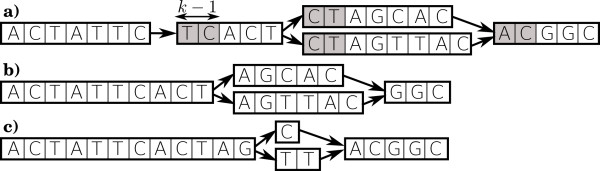
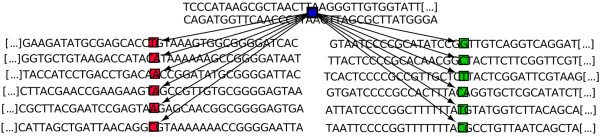
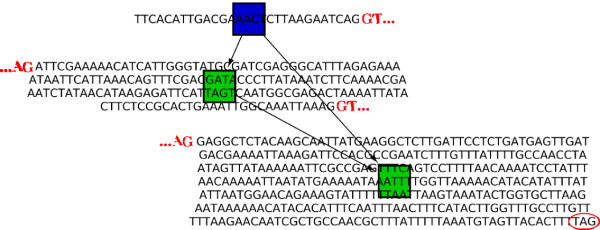
Results: We present Mapsembler, an iterative micro and targeted assembler which processes large datasets of reads on commodity hardware. Mapsembler checks for the presence of given regions of interest that can be constructed from reads and builds a short assembly around it, either as a plain sequence or as a graph, showing contextual structure. We introduce new algorithms to retrieve approximate occurrences of a sequence from reads and construct an extension graph. Among other results presented in this paper, Mapsembler enabled to retrieve previously described human breast cancer candidate fusion genes, and to detect new ones not previously known.
Conclusions: Mapsembler is the first software that enables de novo discovery around a region of interest of repeats, SNPs, exon skipping, gene fusion, as well as other structural events, directly from raw sequencing reads. As indexing is localized, the memory footprint of Mapsembler is negligible. Mapsembler is released under the CeCILL license and can be freely downloaded from http://alcovna.genouest.org/mapsembler/.
Figures
References
-
- Alkan C, Sajjadian S, Eichler EE. Limitations of next-generation genome sequence assembly. Nat Meth. 2011;8:61–65. doi: 10.1038/nmeth.1527. [ http://dx.doi.org/10.1038/nmeth.1527], [ http://www.nature.com/nmeth/journal/v8/n1/abs/nmeth.1527.html∖#supplemen...] - DOI - PMC - PubMed
-
- Lin Y, Li J, Shen H, Zhang L, Papasian CJ, Deng HW. Comparative Studies of de novo Assembly Tools for Next-generation Sequencing Technologies. Bioinformatics (Oxford, England) 2011;27(15):2031–2037. doi: 10.1093/bioinformatics/btr319. [ http://www.ncbi.nlm.nih.gov/pubmed/21636596] - DOI - PMC - PubMed
-
- Bastian M, Heymann S, Jacomy M. Gephi: An open source software for exploring and manipulating networks. International AAAI Conference on Weblogs and Social Media. 2009. pp. 361–362. [ http://www.aaai.org/ocs/index.php/ICWSM/09/paper/download/154/1009]
-
- Cline MS. et al. Integration of biological networks and gene expression data using Cytoscape. Nat Protoc. 2007;2(10):2366–2382. doi: 10.1038/nprot.2007.324. [ http://dx.doi.org/10.1038/nprot.2007.324] - DOI - PMC - PubMed
Publication types
MeSH terms
LinkOut - more resources
Full Text Sources
Molecular Biology Databases
Research Materials
