. 2012 May 18;7(5):879-91.
doi: 10.1021/cb300018x. Epub 2012 Mar 23.

Small-molecule inhibitors of bacterial AddAB and RecBCD helicase-nuclease DNA repair enzymes

Affiliations

Small-molecule inhibitors of bacterial AddAB and RecBCD helicase-nuclease DNA repair enzymes

Susan K Amundsen et al. ACS Chem Biol. .

Abstract

The AddAB and RecBCD helicase-nucleases are related enzymes prevalent among bacteria but not eukaryotes and are instrumental in the repair of DNA double-strand breaks and in genetic recombination. Although these enzymes have been extensively studied both genetically and biochemically, inhibitors specific for this class of enzymes have not been reported. We developed a high-throughput screen based on the ability of phage T4 gene 2 mutants to grow in Escherichia coli only if the host RecBCD enzyme, or a related helicase-nuclease, is inhibited or genetically inactivated. We optimized this screen for use in 1536-well plates and screened 326,100 small molecules in the NIH molecular libraries sample collection for inhibitors of the Helicobacter pylori AddAB enzyme expressed in an E. coli recBCD deletion strain. Secondary screening used assays with cells expressing AddAB or RecBCD and a viability assay that measured the effect of compounds on cell growth without phage infection. From this screening campaign, 12 compounds exhibiting efficacy and selectivity were tested for inhibition of purified AddAB and RecBCD helicase and nuclease activities and in cell-based assays for recombination; seven were active in the 0.1-50 μM range in one or another assay. Compounds structurally related to two of these were similarly tested, and three were active in the 0.1-50 μM range. These compounds should be useful in further enzymatic, genetic, and physiological studies of these enzymes, both purified and in cells. They may also lead to useful antibacterial agents, since this class of enzymes is needed for successful bacterial infection of mammals.


Figures
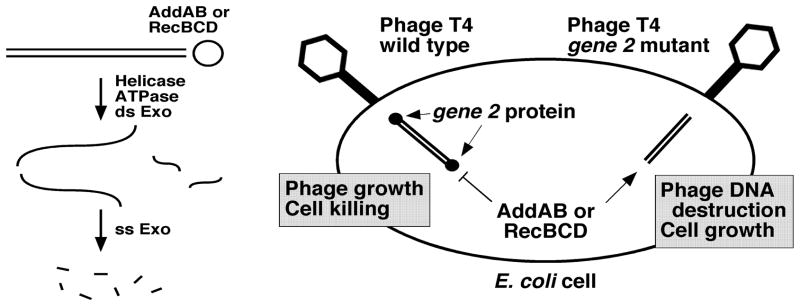
Figure 1
Figure 1
Principle of the cell-based screen for AddAB and RecBCD inihbitors. Left. Activities of RecBCD and AddAB helicase-nucleases. Both enzymes (open circle) are active on linear duplex DNA (double lines). ds exonuclease activity involves a combination of ATP-dependent DNA unwinding and endonucleolytic cuts. ss DNA intermediates are digested to short TCA-soluble oligonucleotides by the ss exonuclease activity. Right. RecBCD or AddAB nuclease activity blocks the growth of phage T4 gene 2 mutants. Upon injection into E. coli cells, wild-type T4 DNA is protected from AddAB and RecBCD nucleases by the gene 2 protein bound to the linear duplex DNA ends in the virion; phages grow and the cells are killed. Unprotected T4 gene 2 mutant DNA is digested by the nucleases; cells grow. Inhibition of AddAB or RecBCD is detected by lack of cell growth after T4 gene 2 mutant infection.
Figure 2
Figure 2
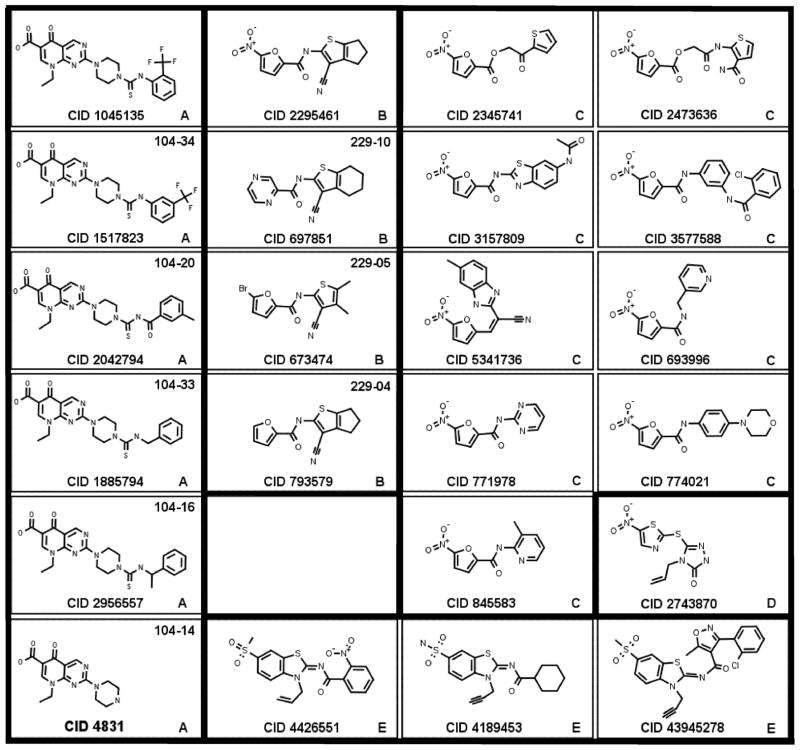
Structures of AddAB and RecBCD inhibitors. Compounds are grouped into “scaffolds” (A, B, C, D, and E in lower right corner or each panel) reflecting related structures. Trivial names, such as 104-34 and 229-10 in the upper right corner of some panels, refer to derivatives of the parent compound (see Figs. S4 and S6, which show additional compounds related to CID 1045135 [A] and CID 2295461 [B]). Heavy outlines separate compounds of different scaffold types (Fig. 2).
Figure 3
Figure 3
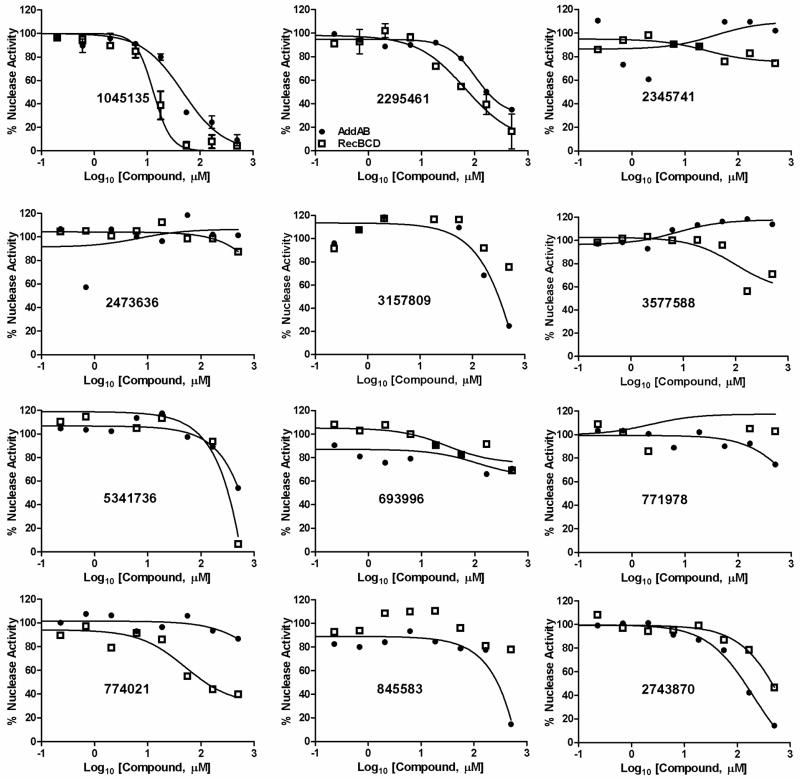
Inhibition of AddAB and RecBCD nuclease activities by the 12 most active compounds identified in the initial screen. ds exonuclease activity of AddAB (filled circles) and RecBCD (open squares) was measured in the presence of the indicated concentration of each compound (identified by CID number) and expressed as a percent of the activity in the absence of compound. Curves were fit by GraphPad software using the four-parameter logistic nonlinear regression model. For CID 1045135 [A] and CID 2295461 [B] data are means +/− SEM; n = 3 or 4; for other compounds data are from one experiment. Structures are in Fig. 2.
Figure 4
Figure 4
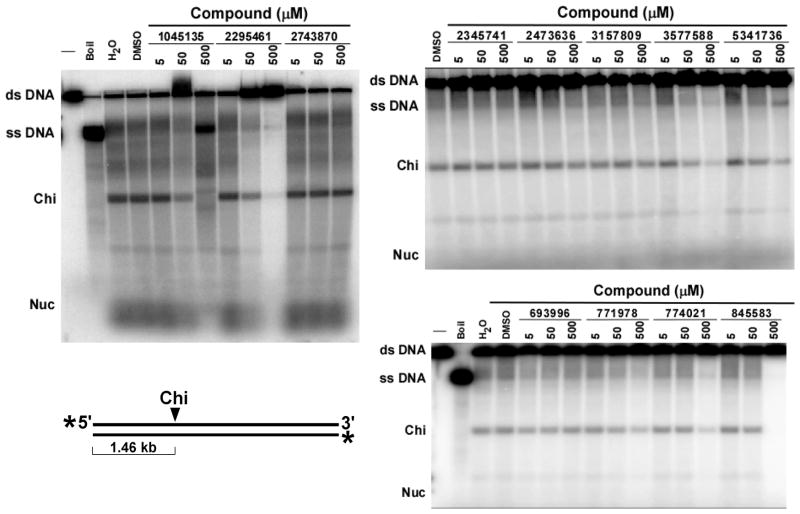
Inhibition of RecBCD unwinding and Chi cutting activities by the 12 most active compounds identified in the initial screen. DNA unwinding and cutting at Chi hotspots by RecBCD enzyme was assayed in the presence of the indicated concentration of each compound (CID number shown). Unwinding is indicated by the amount of ss DNA and Chi cutting by the amount of Chi-dependent 1.46 kb ss DNA fragment (“Chi”) produced from the 4.36 kb ds DNA substrate. Structures are in Fig. 2.
Figure 5
Figure 5
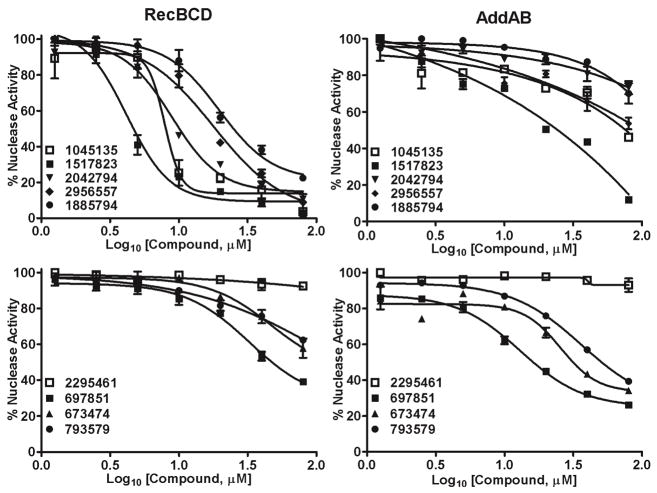
Inhibition of AddAB and RecBCD nuclease activities by derivatives of CID 1045135 [A] and CID 2295461 [B] (dose responses). ds exonuclease activity was measured in the presence of the indicated concentration of each compound and expressed as a percent of the activity in the absence of compound. Structures are in Figs. 2, S4, and S6.
Figure 6
Figure 6
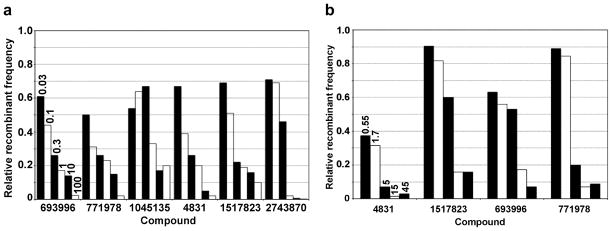
(a) Inhibition of E. coli Hfr recombination by selected compounds. The frequency of His+ StrR recombinants in matings between strains V66 (FrecBCD +hisG4 rpsL +) and V1306 (Hfr PO44 rpsL31 his+) in the presence of compound (concentration in μM as indicated for CID 693996 [C] applies to all compounds) is expressed as a fraction of that in the absence of compound (9.3 % per viable Hfr cell). Structures are in Figs. 2, S4, and S6. Data are from one experiment; similar results were obtained in two others. (b)Inhibition of phage λ recombination by selected compounds. The mean frequency of J+ R+ recombinants in λ crosses (1081 × 1082 and 1083 × 1084) in strain V66 in the presence of the indicated compound (concentration in μM as indicated for CID 4831 [A] applies to all compounds) is expressed as a fraction of that without compound (6.9 ± 0.25 %; n = 4). Structures are in Figs. 2, S4, and S6.
Figure 7
Figure 7
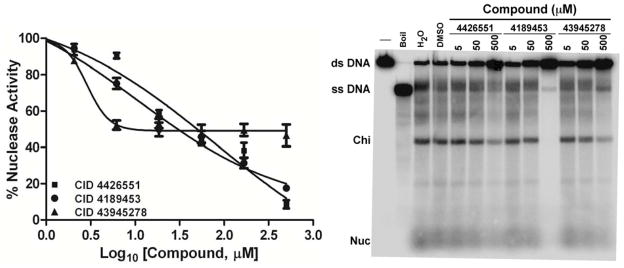
Inhibition of RecBCD nuclease, unwinding, and Chi cutting activities by “iminobenzothiazoles” [group E]. ds exonuclease activity (left panel) and unwinding and Chi cutting activities (right panel) were measured in the presence of the indicated concentration of each compound. ds exonuclease activity is expressed as a percent of the activity in the absence of compound. Unwinding is indicated by the amount of ss DNA, and Chi cutting by the amount of Chi-dependent ss DNA fragment (“Chi”). Structures are in Fig. 2.

References

    1. Tse YC, Kirkegaard K, Wang JC. Covalent bonds between protein and DNA. Formation of phosphotyrosine linkage between certain DNA topoisomerases and DNA. J Biol Chem. 1980;255:5560–5. - PubMed
    1. Gellert M, Mizuuchi K, O’Dea MH, Itoh T, Tomizawa J. Nalidixic acid resistance: A second genetic character involved in DNA gyrase activity. Proc Natl Acad Sci USA. 1977;74:4772–4776. - PMC - PubMed
    1. Smith GR. Homologous recombination near and far from DNA breaks: Alternative roles and contrasting views. Annu Rev Genet. 2001;35:243–274. - PubMed
    1. Dillingham MS, Kowalczykowski SC. RecBCD enzyme and the repair of double-stranded DNA breaks. Microbiol Mol Biol Rev. 2008;72:642–71. - PMC - PubMed
    1. Smith GR. How RecBCD enzyme and Chi promote DNA break repair and recombination– A molecular biologist’s view. Microbiol Mol Biol Rev. in press. - PMC - PubMed

Publication types

MeSH terms