Randomized Controlled Trial
. 2012 Mar 23:344:e1756.
doi: 10.1136/bmj.e1756.

Clinical and cost effectiveness of mobile phone supported self monitoring of asthma: multicentre randomised controlled trial

Affiliations
Randomized Controlled Trial

Clinical and cost effectiveness of mobile phone supported self monitoring of asthma: multicentre randomised controlled trial

Dermot Ryan et al. BMJ. .

Abstract

Objective: To determine whether mobile phone based monitoring improves asthma control compared with standard paper based monitoring strategies.

Design: Multicentre randomised controlled trial with cost effectiveness analysis.

Setting: UK primary care.

Participants: 288 adolescents and adults with poorly controlled asthma (asthma control questionnaire (ACQ) score ≥ 1.5) from 32 practices.

Intervention: Participants were centrally randomised to twice daily recording and mobile phone based transmission of symptoms, drug use, and peak flow with immediate feedback prompting action according to an agreed plan or paper based monitoring.

Main outcome measures: Changes in scores on asthma control questionnaire and self efficacy (knowledge, attitude, and self efficacy asthma questionnaire (KASE-AQ)) at six months after randomisation. Assessment of outcomes was blinded. Analysis was on an intention to treat basis.

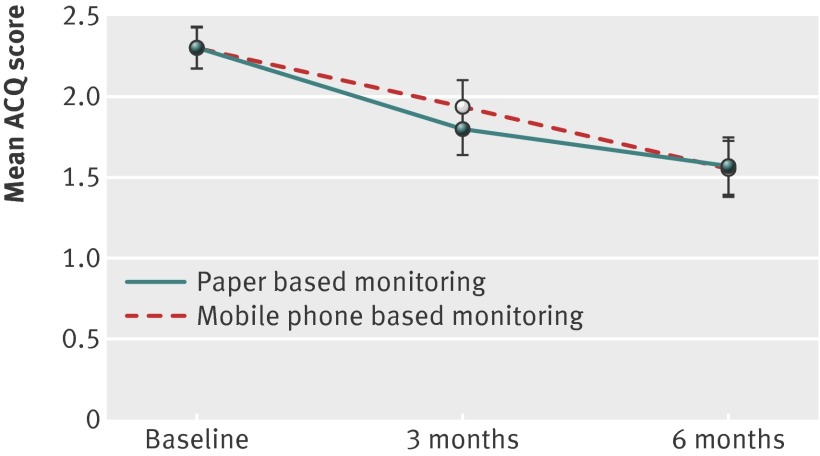
Results: There was no significant difference in the change in asthma control or self efficacy between the two groups (ACQ: mean change 0.75 in mobile group v 0.73 in paper group, mean difference in change -0.02 (95% confidence interval -0.23 to 0.19); KASE-AQ score: mean change -4.4 v -2.4, mean difference 2.0 (-0.3 to 4.2)). The numbers of patients who had acute exacerbations, steroid courses, and unscheduled consultations were similar in both groups, with similar healthcare costs. Overall, the mobile phone service was more expensive because of the expenses of telemonitoring.

Conclusions: Mobile technology does not improve asthma control or increase self efficacy compared with paper based monitoring when both groups received clinical care to guidelines standards. The mobile technology was not cost effective.

Trial registration: Clinical Trials NCT00512837.


Conflict of interest statement

Competing interests: All authors have completed the ICMJE uniform disclosure form at www.icmje.org/coi_disclosure.pdf (available on request from the corresponding author) and declare: DR has spoken on behalf of AstraZeneca, Nycomed, MSD, AlkAbello,Chiesi, Novartis, Pfizer and BoehringerIingelheim. He has undertaken advisory work for Astra Zeneca, MSD, Novartis, Uriach, Mundipharma, Orion, and Napp. DP has consultant arrangements with Boehringer Ingelheim, GlaxoSmithKline, Merck, Mundipharma, Novartis, and Teva. In the past five years, he or his research team have received grants and support for research in respiratory disease from UK National Health Service, Aerocrine, AstraZeneca, Boehringer Ingelheim, GlaxoSmithKline, Merck, Mundipharma, Novartis, Nycomed, Pfizer, and Teva. He has spoken for AstraZeneca, Boehringer Ingelheim, Chiesi, GlaxoSmithKline, Merck, Mundipharma, Pfizer, and Teva. He has shares in AKL, which produces phytopharmaceuticals. He is the sole owner of Research in Real Life. SDM has received institutional grant support from Merck and Co, AKL Technologies, Chiesi, and Mundipharma AS serves on WHO’s mHealth and Information Technology for Patient Safety Expert Working Groups and is an adviser to NHS Connecting for Health’s Evaluation Programme. He is a consultant to ALK and Phadia and has received support from Napp, Pfizer, and Chiesi for research advice. LT is a cofounder of, advisor to, and holds shares in OBS Medical. He contributed to the design of t+ asthma and of the trial, but had no role in the day-to-day conduct of the study or statistical analysis. His work on telehealthcare is funded by the NIHR Biomedical Research Centre Programme. HP has spoken for AstraZeneca, Boehringer Ingelheim, Chiesi, GlaxoSmithKline, Pfizer, and Teva and undertaken advisory group work for Chiesi.

Figures

None
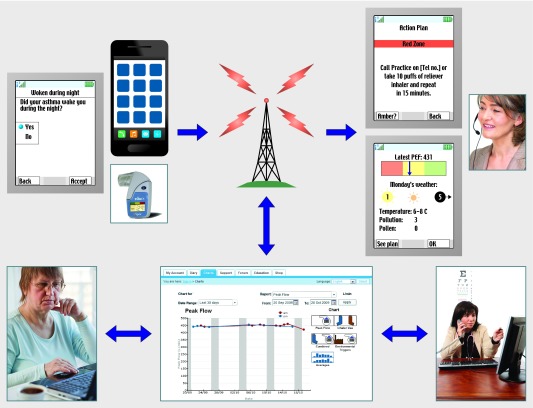
Fig 1 Mobile phone monitoring system. t+ Asthma application, running on web enabled handset, allowed patient to record symptoms, drug use, and peak flow from Piko meter. Automated display plotted peak flow as normal (≥80% green zone), in need of attention (60-79% amber zone), or in need of urgent action (<60% red zone) and prompted patients to follow their agreed action plan. Incursion into red or amber zones also triggered contact by t+ Asthma nurse from OBS Medical on next working day to ascertain what had happened and what learning points had arisen. Data were automatically transmitted to secure website on remote server hosted by OBS Medical, every time application was used by patient. Patient and clinician were able to access patient data record via password protected website, which also provided general information about asthma
None
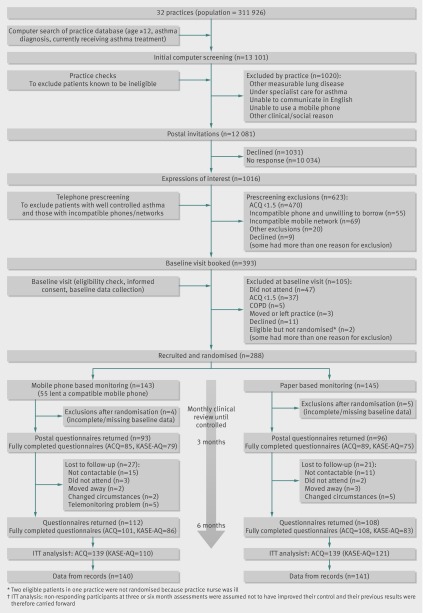
Fig 2 Flow of patients through trial of mobile phone and paper based monitoring of asthma control (ACQ=asthma control questionnaire; KASE-AQ= knowledge, attitude, and self efficacy asthma questionnaire; COPD=chronic obstructive pulmonary disease; ITT=intention to treat)
None
Fig 3 Mean ACQ scores adjusted for age and sex at different time points in people with asthma according to allocated method of monitoring
None
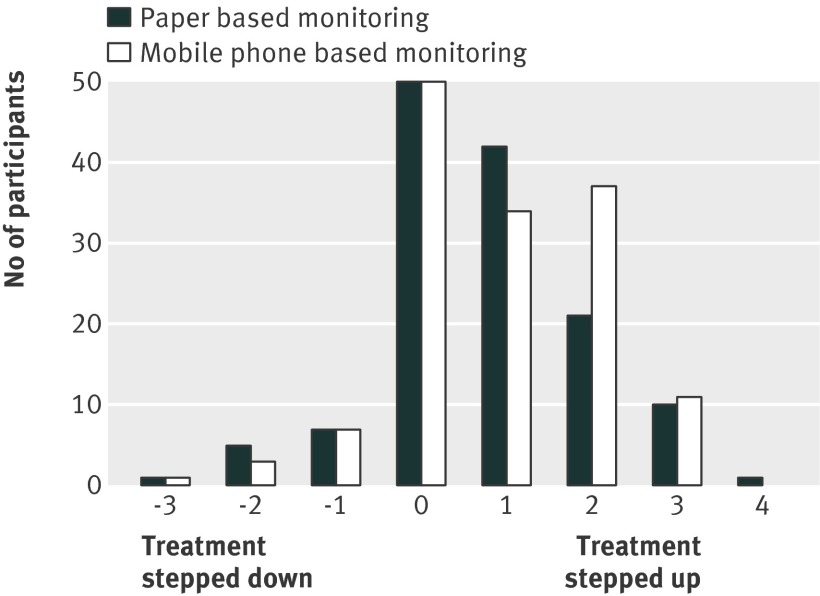
Fig 4 Change in BTS-SIGN step from baseline to six months in people with asthma according to allocated method of monitoring

References

    1. Masoli M, Fabian D, Holt S, Beasley R. The global burden of asthma. Global Initiative for Asthma, 2003. www.ginasthma.com. - PubMed
    1. McIvor RA, Chapman KR. The coming of age of asthma guidelines. Lancet 2008;372:1021-2. - PubMed
    1. Rabe KF, Adachi M, Lai CK, Soriano JB, Vermeire PA, Weiss KB, et al. Worldwide severity and control of asthma in children and adults: the global asthma insights and reality surveys. J Allergy Clin Immunol 2004;114:40-7. - PubMed
    1. Campbell S, Reeves D, Kontopantelis E, Middleton E, Sibbald B, Roland M. Quality of primary care in England with the introduction of pay for performance. N Engl J Med 2007;357:181-90. - PubMed
    1. Gibson PG, Powell H, Wilson A, Abramson MJ, Haywood P, Bauman A, et al. Self-management education and regular practitioner review for adults with asthma. Cochrane Database Syst Rev 2002;3:CD001117. - PubMed

Publication types

MeSH terms

Associated data