. 2012 Sep;37(3):171-80.
doi: 10.1007/s10484-012-9191-4.

The effects of QEEG-informed neurofeedback in ADHD: an open-label pilot study

Affiliations

The effects of QEEG-informed neurofeedback in ADHD: an open-label pilot study

Martijn Arns et al. Appl Psychophysiol Biofeedback. 2012 Sep.

Abstract

In ADHD several EEG biomarkers have been described before, with relevance to treatment outcome to stimulant medication. This pilot-study aimed at personalizing neurofeedback treatment to these specific sub-groups to investigate if such an approach leads to improved clinical outcomes. Furthermore, pre- and post-treatment EEG and ERP changes were investigated in a sub-group to study the neurophysiological effects of neurofeedback. Twenty-one patients with ADHD were treated with QEEG-informed neurofeedback and post-treatment effects on inattention (ATT), hyperactivity/impulsivity (HI) and comorbid depressive symptoms were investigated. There was a significant improvement for both ATT, HI and comorbid depressive complaints after QEEG-informed neurofeedback. The effect size for ATT was 1.78 and for HI was 1.22. Furthermore, anterior individual alpha peak frequency (iAPF) demonstrated a strong relation to improvement on comorbid depressive complaints. Pre- and post-treatment effects for the SMR neurofeedback sub-group exhibited increased N200 and P300 amplitudes and decreased SMR EEG power post-treatment. This pilot study is the first study demonstrating that it is possible to select neurofeedback protocols based on individual EEG biomarkers and suggests this results in improved treatment outcome specifically for ATT, however these results should be replicated in further controlled studies. A slow anterior iAPF at baseline predicts poor treatment response on comorbid depressive complaints in line with studies in depression. The effects of SMR neurofeedback resulted in specific ERP and EEG changes.


Figures
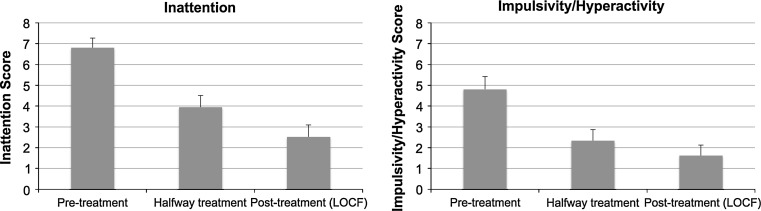
Fig. 1
Fig. 1
Clinical effects over time for the total group of ADHD/ADD patients at pre-treatment, halfway treatment and post-treatment (averages plus SEM) for ATT and HI. All time effects were significant (p ≤ .001)
Fig. 2
Fig. 2
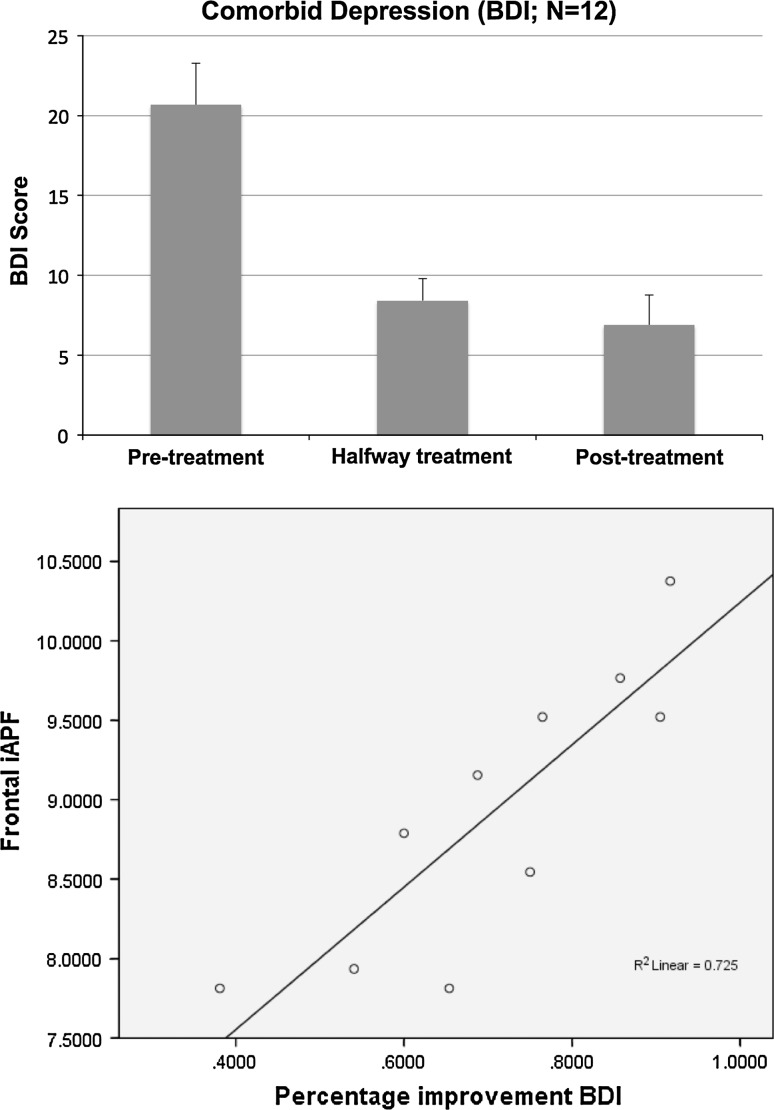
Improvement on comorbid depressive symptoms for the patients across time (time effects: p = .003; Left) and the significant correlation between the frontal iAPF and the percentage improvement in BDI scores (p = .002; r = 0.851; Right)
Fig. 3
Fig. 3
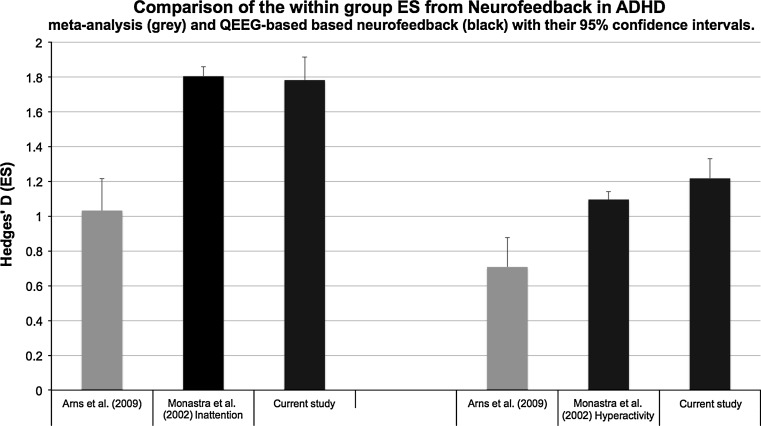
ES for the different studies mentioned in the introduction and the ES obtained from the current study, with on the left ES for ATT and on the right ES for hyperactivity. Note that ES for hyperactivity for this study was based on a combined HI scale
Fig. 4
Fig. 4
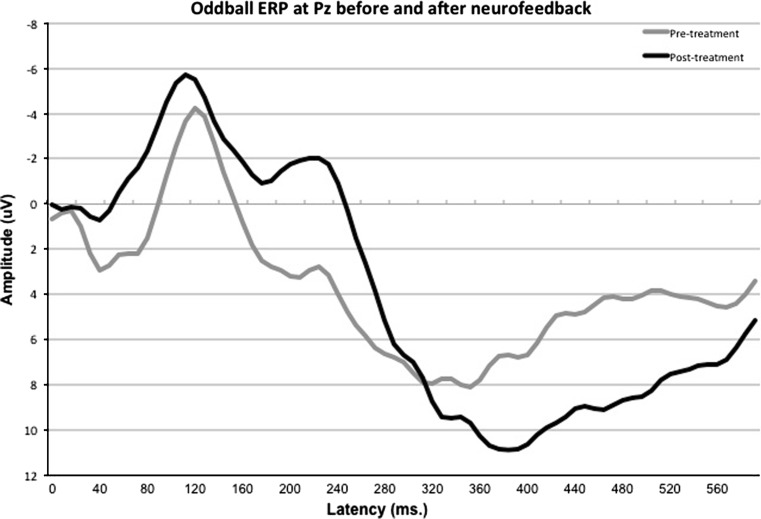
Oddball ERP at Pz before and after treatment for a sub-group of patients who have all been treated with SMR neurofeedback. Note the clear increased N200 and P300 amplitudes after treatment
Fig. 5
Fig. 5
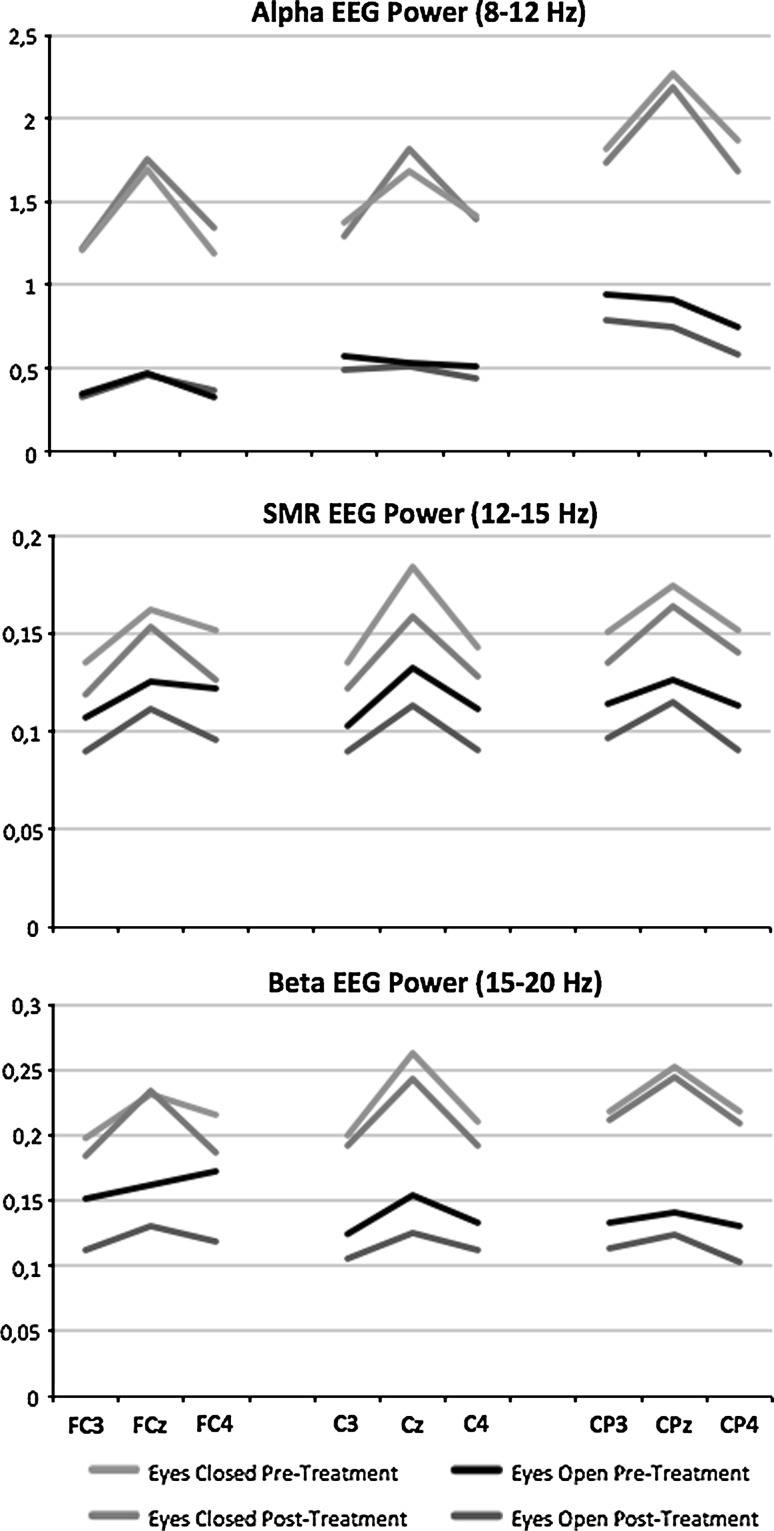
Pre- to post-treatment changes in EEG power for SMR power—which was trained using neurofeedback—and the neighboring frequency bands alpha and beta. Note the specific decrease in SMR power from pre- to post-treatment for both eyes open and eyes closed EEG, which is specific for only the SMR frequency band

References

    1. Arns M, de Ridder S, Strehl U, Breteler M, Coenen A. Efficacy of neurofeedback treatment in ADHD: The effects on inattention, impulsivity and hyperactivity: A meta-analysis. Clinical EEG and Neuroscience. 2009;40:180–189. doi: 10.1177/155005940904000311. - DOI - PubMed
    1. Arns, M., Drinkenburg, W. H. I. M., Fitzgerald, P. B., & Kenemans, J. L. (in press). Neurophysiological predictors of non-response to rTMS in depression. Brain Stimulation. doi:10.1016/j.brs.2011.12.003. - PubMed
    1. Arns M, Gunkelman J, Breteler M, Spronk D. EEG phenotypes predict treatment outcome to stimulants in children with ADHD. Journal of Integrative Neuroscience. 2008;7:421–438. doi: 10.1142/S0219635208001897. - DOI - PubMed
    1. Arns M, Spronk D, Fitzgerald PB. Potential differential effects of 9 Hz rTMS and 10 Hz rTMS in the treatment of depression. Brain Stimulation. 2010;3:124–126. doi: 10.1016/j.brs.2009.07.005. - DOI - PubMed
    1. Barry RJ, Johnstone SJ, Clarke AR. A review of electrophysiology in attention-deficit/hyperactivity disorder: II. Event-Related potentials. Clinical Neurophysiology. 2003;114:184–198. doi: 10.1016/S1388-2457(02)00363-2. - DOI - PubMed