


Mifepristone 2.5 mg versus 5 mg daily in the treatment of leiomyoma before surgery
- PMID: 22448109
- PMCID: PMC3310351
- DOI: 10.2147/IJWH.S28103
Mifepristone 2.5 mg versus 5 mg daily in the treatment of leiomyoma before surgery
Abstract
Objectives: To evaluate the efficacy and safety of 2.5 mg and 5 mg mifepristone during 3 months for the treatment of uterine fibroids before surgery.
Design: Multicenter randomized clinical trial.
Locations: Eusebio Hernández Hospital, Havana, Cuba and the Alemán Hospital, Managua, Nicaragua.
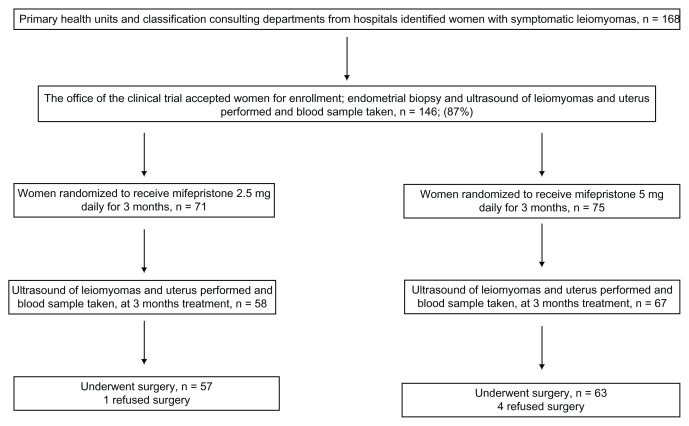
Subjects: Included in the study were 146 women with symptomatic uterine fibroids.
Treatment: GROUP I: half a tablet of 5 mg (2.5 mg) mifepristone taken orally every 24 hours, and Group II: one tablet of 5 mg mifepristone taken orally every 24 hours over a period of 3 months in both groups. Two endometrial biopsies were performed. VARIABLES TO EVALUATE EFFICACY: Increase in average hemoglobin, changes in fibroid and uterine volume, and symptomatic improvement.
Results: The average hemoglobin at the end of treatment was 0.6 g/dL greater in the 5 mg mifepristone group (P = 0.033). In both groups there were similar reductions in fibroid volumes. Clinical improvement was more significant in the 5 mg group.
Conclusion: The dose to be used should be 5 mg.
Keywords: antiprogestins; fibroid; leiomyoma; mifepristone.
References
-
- Day BD, Dunson DB, Hill MC, Coousins D, Schectman JM. High cumulative incidence of uterine leiomyoma in black and white women: ultrasound evidence. Am J Obstet Gynecol. 2003;188(1):100–107. - PubMed
-
- Wegienka G, Baird DD, Hertz-Piccioto I, et al. Self-reported heavy bleeding associated with uterine leiomyomata. Obstet Gynecol. 2003;101(3):431–437. - PubMed
-
- Wilcox LS, Koonin LM, Pokras R, Strauss LT, Xia Z, Peterson HB. Hysterectomy in the United States, 1988–1990. Obstet Gynecol. 1994;83(4):549–555. - PubMed
-
- Wilson EA, Yang F, Reese E. Estradiol and progesterone binding in uterine leiomyomata and in normal uterine tissues. Obstet Gynecol. 1980;55(1):20–24. - PubMed
-
- Andersen J. Factors in fibroid growth. Baillieres Clin Obstet Gynaecol. 1998;12(2):225–243. - PubMed
LinkOut - more resources
Full Text Sources
