


Examining the incidence of human papillomavirus-associated head and neck cancers by race and ethnicity in the U.S., 1995-2005
- PMID: 22448226
- PMCID: PMC3308956
- DOI: 10.1371/journal.pone.0032657
Examining the incidence of human papillomavirus-associated head and neck cancers by race and ethnicity in the U.S., 1995-2005
Abstract
Background: Head and neck cancer (HNC) incidence, mortality and survival rates vary by sex and race, with men and African Americans disproportionately affected. Risk factors for HNC include tobacco and alcohol exposure, with a recent implication of human papillomavirus (HPV) in the pathogenesis of HNC. This study describes the epidemiology of HNC in the United States, examining variation of rates by age, sex, race/ethnicity and potential HPV-association.
Methods: We used the North American Association of Central Cancer Registries (NAACCR) Cancer in North America (CINA) Deluxe Analytic Data to analyze HNC incidence for 1995-2005 from forty population-based cancer registries. We calculated age-adjusted incidence rates and incidence trends using annual percent change by age, sex, race/ethnicity and HPV-association.
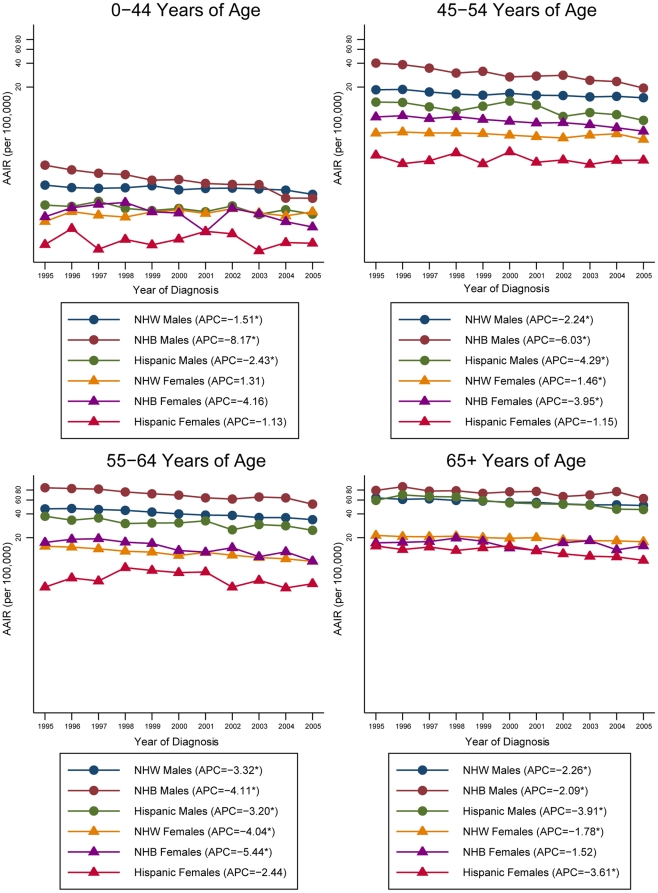
Results: Males and Non-Hispanic Blacks experienced greater HNC incidence compared to women and other race/ethnicity groupings. A significant overall increase in HNC incidence was observed among HPV-associated sites during 1995-2005, while non HPV-associated sites experienced a significant decline in HNC incidence. Overall, younger age groups, Non-Hispanic Whites and Hispanics experienced greater increases in incidence for HPV-associated sites, while HNC incidence declined for Non-Hispanic Blacks independent of HPV-association. In particular, for HPV-associated sites, HNC incidence for Non-Hispanic White males aged 45-54 increased at the greatest rate, with an APC of 6.28% (p<0.05). Among non HPV-associated sites, Non-Hispanic Black males aged 0-44 years experienced the greatest reduction in incidence (APC, -8.17%, p<0.05), while a greater decline among the older, 55-64 year age group (APC, -5.44%, p<0.05) occurred in females.
Conclusions: This study provides evidence that HPV-associated tumors are disproportionately affecting certain age, sex and race/ethnicity groups, representing a different disease process for HPV-associated tumors compared to non HPV-associated tumors. Our study suggests that HPV tumor status should be incorporated into treatment decisions for HNC patients to improve prognosis and survival.
Conflict of interest statement
Figures


References
-
- Jemal A, Siegel R, Xu J, Ward E. Cancer statistics, 2010. CA Cancer J Clin. 2010;60:277–300. - PubMed
-
- American Cancer Society. Cancer Facts and Figures 2010. 2010. Atlanta.
-
- Horner MJ, Ries LAG, Krapcho M, Neyman N, Aminou R, et al. SEER Cancer Statistics Review, 1975–2006. Bethesda, MD: National Cancer Institute; 2009.
-
- Silverman S., Jr Demographics and occurrence of oral and pharyngeal cancers. The outcomes, the trends, the challenge. J Am Dent Assoc. 2001;132(Suppl):7S–11S. - PubMed
Publication types
MeSH terms
Substances
Grants and funding
LinkOut - more resources
Full Text Sources
Medical
