


A review of the invasive mosquitoes in Europe: ecology, public health risks, and control options
- PMID: 22448724
- PMCID: PMC3366101
- DOI: 10.1089/vbz.2011.0814
A review of the invasive mosquitoes in Europe: ecology, public health risks, and control options
Abstract
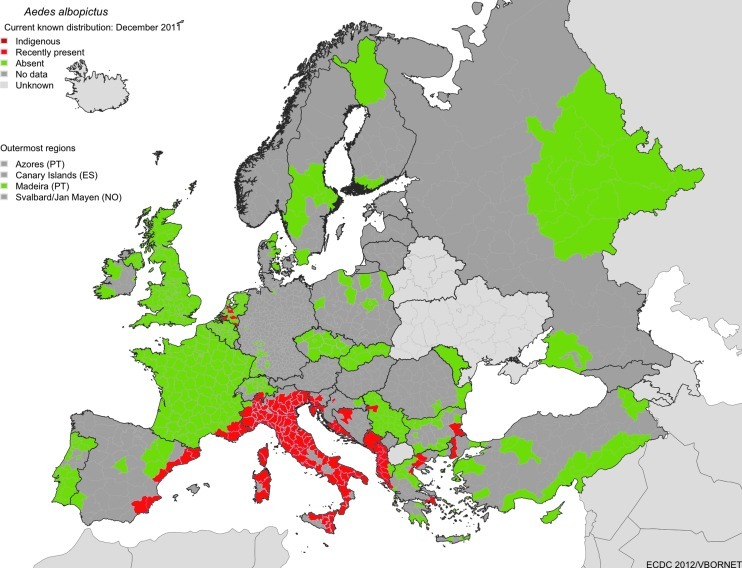
There has been growing interest in Europe in recent years in the establishment and spread of invasive mosquitoes, notably the incursion of Aedes albopictus through the international trade in used tires and lucky bamboo, with onward spread within Europe through ground transport. More recently, five other non-European aedine mosquito species have been found in Europe, and in some cases populations have established locally and are spreading. Concerns have been raised about the involvement of these mosquito species in transmission cycles of pathogens of public health importance, and these concerns were borne out following the outbreak of chikungunya fever in Italy in 2007, and subsequent autochthonous cases of dengue fever in France and Croatia in 2010. This article reviews current understanding of all exotic (five introduced invasive and one intercepted) aedine species in Europe, highlighting the known import pathways, biotic and abiotic constraints for establishment, control strategies, and public health significance, and encourages Europe-wide surveillance for invasive mosquitoes.
Figures
References
-
- Abramides GC. Roiz D. Guitart R, et al. Effectiveness of a multiple intervention strategy for the control of the tiger mosquito (Aedes albopictus) in Spain. Trans R Soc Trop Med Hyg. 2011;105:281–288. - PubMed
-
- Adhami J. Mushkonjat (Diptera: Culicidae) te Shqiperise, tribu Culicini. Revista Mjekësore. 1987;1–2:82–95. [In Albanian].
-
- Almeida APG. Goncalves YM. Novo MT, et al. Vector monitoring of Aedes aegypti in the Autonomous Region of Madeira, Portugal. Euro Surveill. 2007. http://www.eurosurveillance.org/ViewArticle.aspx?ArticleId=3311 p. 12.http://www.eurosurveillance.org/ViewArticle.aspx?ArticleId=3311 - PubMed
-
- Andreadis JF. Anderson JF. Munstermann LE, et al. Discovery, distribution and abundance of the newly introduced mosquito Ochlerotatus japonicus in Connecticut, USA. J Med Entomol. 2001;38:774–749. - PubMed
Publication types
MeSH terms
LinkOut - more resources
Full Text Sources
Medical
