The hierarchical structure of DSM-5 pathological personality traits
- PMID: 22448740
- PMCID: PMC3389150
- DOI: 10.1037/a0027669
The hierarchical structure of DSM-5 pathological personality traits
Abstract
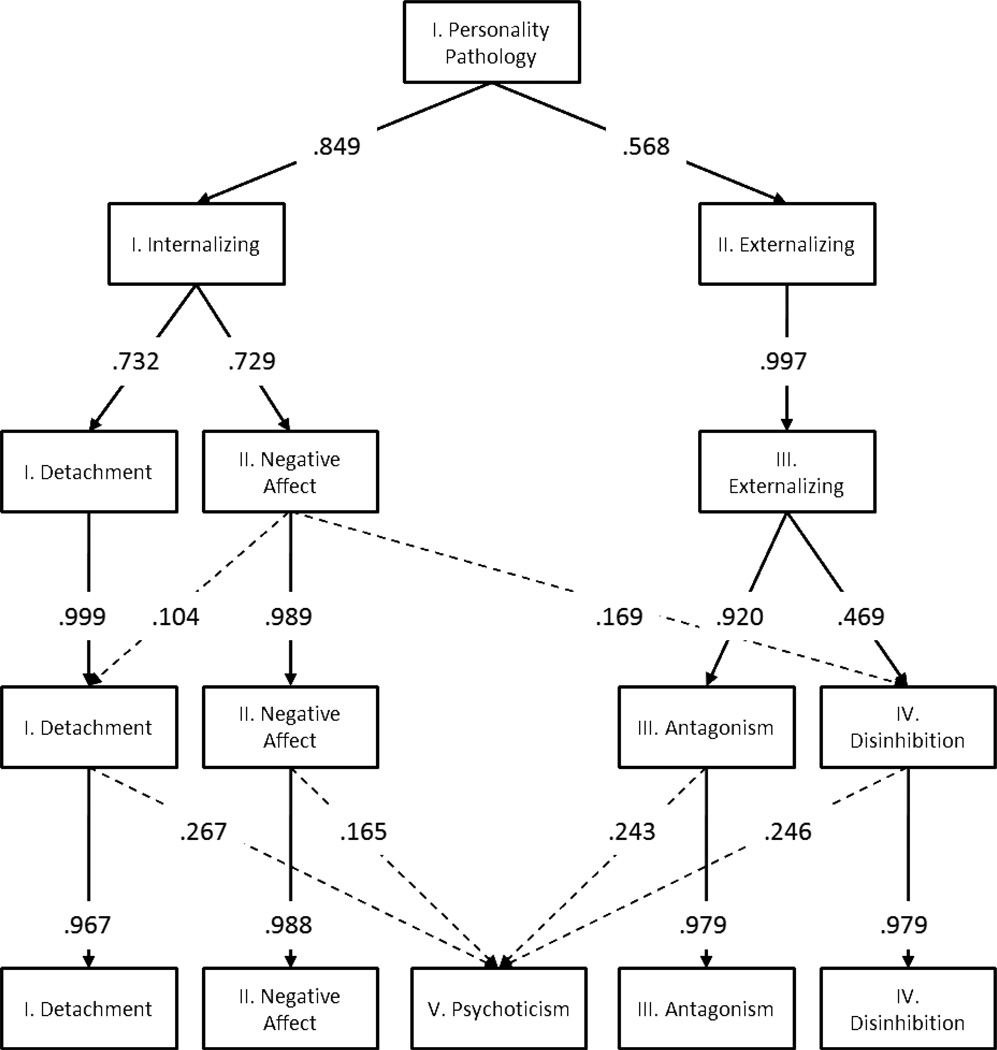
A multidimensional trait system has been proposed for representing personality disorder (PD) features in the fifth edition of the Diagnostic and Statistical Manual of Mental Disorders (DSM-5) to address problematic classification issues such as comorbidity. In this model, which may also assist in providing scaffolding for the underlying structure of major forms of psychopathology more generally, 25 primary traits are organized by 5 higher order dimensions: Negative Affect, Detachment, Antagonism, Disinhibition, and Psychoticism. We examined (a) the generalizability of the structure proposed for DSM-5 PD traits, and (b) the potential for an integrative hierarchy based upon DSM-5 PD traits to represent the dimensions scaffolding psychopathology more generally. A large sample of student participants (N = 2,461) completed the Personality Inventory for DSM-5, which operationalizes the DSM-5 traits. Exploratory factor analysis replicated the initially reported 5-factor structure, as indicated by high factor congruencies. The 2-, 3-, and 4-factor solutions estimated in the hierarchy of the DSM-5 traits bear close resemblance to existing models of common mental disorders, temperament, and personality pathology. Thus, beyond the description of individual differences in personality disorder, the trait dimensions might provide a framework for the metastructure of psychopathology in the DSM-5 and the integration of a number of ostensibly competing models of personality trait covariation.
(PsycINFO Database Record (c) 2012 APA, all rights reserved).
Figures
References
-
- Achenbach TM. The classification of children’s psychiatric symptoms: a factor–analytic study. Psychological Monographs. 1966;80(No. 615) - PubMed
-
- American Psychiatric Association. Diagnostic and statistical manual of mental disorders. 3rd ed. Washington, DC: Author; 1980.
-
- American Psychiatric Association. Diagnostic and statistical manual of mental disorders. 4th ed. Washington, DC: Author; 2000. Text Revision.
-
- Andersen AM, Bienvenu OJ. Personality and psychopathology. International Review of Psychiatry. 2011;23:234–247. - PubMed
-
- Andrews G, Goldberg DP, Krueger RF, Carpenter WT, Hyman SE, Sachdev P, Pine DS. Exploring the feasibility of a meta-structure for DSM-V and ICD-11: could it improve utility and validity? Psychological Medicine. 2009;39:1993–2000. - PubMed