


Investigation of chalcones as selective inhibitors of the breast cancer resistance protein: critical role of methoxylation in both inhibition potency and cytotoxicity
- PMID: 22449016
- PMCID: PMC3983950
- DOI: 10.1021/jm2016528
Investigation of chalcones as selective inhibitors of the breast cancer resistance protein: critical role of methoxylation in both inhibition potency and cytotoxicity
Abstract
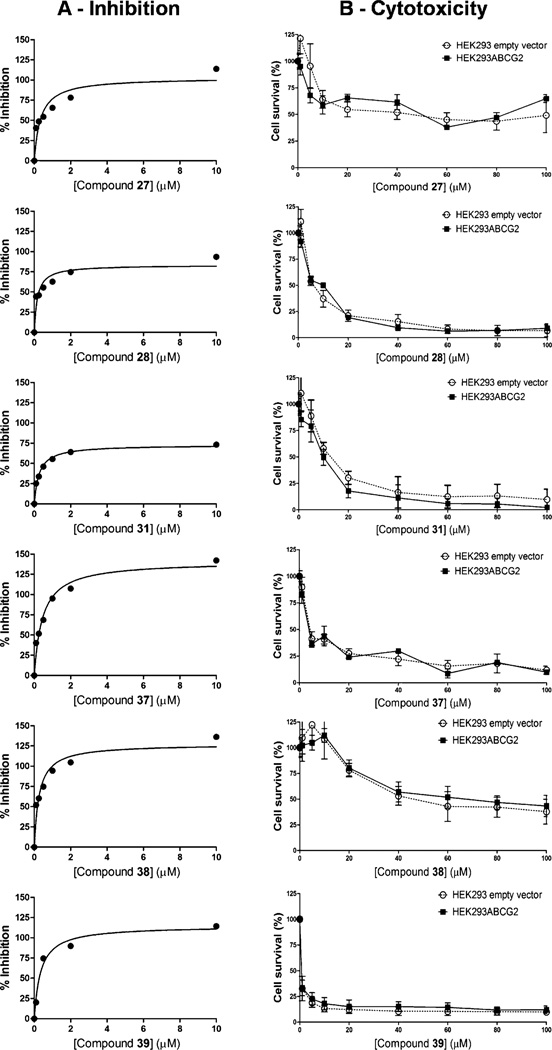
ABCG2 plays a major role in anticancer-drug efflux and related tumor multidrug resistance. Potent and selective ABCG2 inhibitors with low cytotoxicity were investigated among a series of 44 chalcones and analogues (1,3-diarylpropenones), by evaluating their inhibitory effect on the transport of mitoxantrone, a known ABCG2 substrate. Six compounds producing complete inhibition with IC(50) values below 0.5 μM and high selectivity for ABCG2 were identified. The number and position of methoxy substituents appeared to be critical for both inhibition and cytotoxicity. The best compounds, with potent inhibition and low toxicity, contained an N-methyl-1-indolyl (compound 38) or a 6'-hydroxyl-2',4'-dimethoxy-1-phenyl (compound 27) moiety (A-ring) and two methoxy groups at positions 2 and 6 of the 3-phenyl moiety (B-ring). Methoxy substitution contributed to inhibition at positions 3 and 5, but had a negative effect at position 4. Finally, methoxy groups at positions 3, 4, and 5 of the B-ring markedly increased cytotoxicity and, therefore, should be avoided.
© 2012 American Chemical Society
Figures

References
-
- Glavinas H, Krajcsi P, Cserepes J, Sarkadi B. The role of ABC tansporters in drug resistance, metabolism and toxicity. Curr. Drug Deliv. 2004;1:27–42. - PubMed
-
- Allikmets R, Schriml LM, Hutchinson A, Romano-Spica V, Dean M. A human placenta-specific ATP-binding cassette gene (ABCP) on chromosome 4q22 that is involved in multidrug resistance. Cancer Res. 1998;58:5337–5339. - PubMed
-
- Miyake K, Mickley L, Litman T, Zhan Z, Robey R, Cristensen B, Brangi M, Greenberger L, Dean M, Fojo T, Bates SE. Molecular cloning of cDNAs which are highly overexpressed in mitoxantrone-resistant cells: demonstration of homology to ABC transport genes. Cancer Res. 1999;59:8–13. - PubMed
-
- Ahmed-Belkacem A, Pozza A, Macalou S, Perez-Victoria JM, Di Pietro A. Inhibitors of cancer cell multidrug resistance mediated by breast cancer resistance protein (BCRP/ABCG2) Anticancer Drugs. 2006;17:239–243. - PubMed
Publication types
MeSH terms
Substances
Grants and funding
LinkOut - more resources
Full Text Sources
Other Literature Sources
Chemical Information
