


Biological sources and sinks of nitrous oxide and strategies to mitigate emissions
- PMID: 22451101
- PMCID: PMC3306631
- DOI: 10.1098/rstb.2011.0415
Biological sources and sinks of nitrous oxide and strategies to mitigate emissions
Abstract
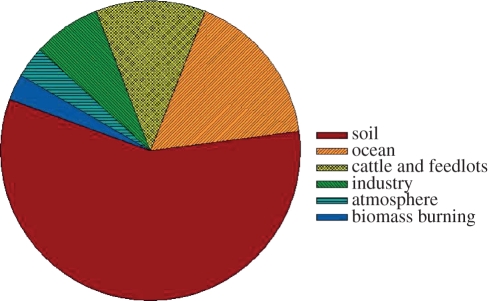
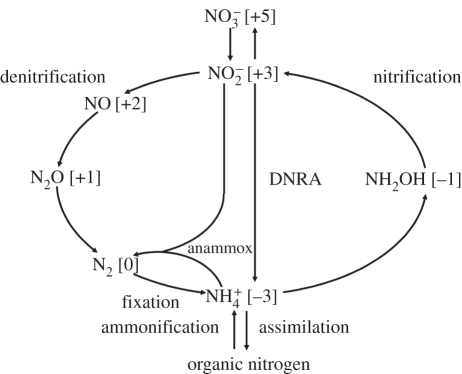
Nitrous oxide (N(2)O) is a powerful atmospheric greenhouse gas and cause of ozone layer depletion. Global emissions continue to rise. More than two-thirds of these emissions arise from bacterial and fungal denitrification and nitrification processes in soils, largely as a result of the application of nitrogenous fertilizers. This article summarizes the outcomes of an interdisciplinary meeting, 'Nitrous oxide (N(2)O) the forgotten greenhouse gas', held at the Kavli Royal Society International Centre, from 23 to 24 May 2011. It provides an introduction and background to the nature of the problem, and summarizes the conclusions reached regarding the biological sources and sinks of N(2)O in oceans, soils and wastewaters, and discusses the genetic regulation and molecular details of the enzymes responsible. Techniques for providing global and local N(2)O budgets are discussed. The findings of the meeting are drawn together in a review of strategies for mitigating N(2)O emissions, under three headings, namely: (i) managing soil chemistry and microbiology, (ii) engineering crop plants to fix nitrogen, and (iii) sustainable agricultural intensification.
Figures
 .
.References
-
- Lassey K., Harvey M. 2007. Nitrous oxide: the serious side of laughing gas. Water Atmos. 15, 1–10
-
- NERC. 2005. Global nitrogen enrichment (GANE): reports and key findings. See www.nerc.ac.uk/research/programmes/gane/results.asp (accessed 15 December 2011)
-
- Kimochi Y., Inamori Y., Mizuochi M., Xu K.-Q., Matsumura M. 1998. Nitrogen removal and N2O emission in a full-scale domestic wastewater treatment plant with intermittent aeration. J. Biosci. Bioeng. 86, 202–206 10.1016/s0922-338x(98)80114-1 (doi:10.1016/s0922-338x(98)80114-1) - DOI
-
- Davidson E. A. 2009. The contribution of manure and fertilizer nitrogen to atmospheric nitrous oxide since 1860. Nat. Geosci. 2, 659–662 10.1038/ngeo608 (doi:10.1038/ngeo608) - DOI
Publication types
MeSH terms
Substances
Grants and funding
LinkOut - more resources
Full Text Sources
