


Age-related increase in food spilling by laboratory mice may lead to significant overestimation of actual food consumption: implications for studies on dietary restriction, metabolism, and dose calculations
- PMID: 22451471
- PMCID: PMC3437968
- DOI: 10.1093/gerona/gls009
Age-related increase in food spilling by laboratory mice may lead to significant overestimation of actual food consumption: implications for studies on dietary restriction, metabolism, and dose calculations
Abstract
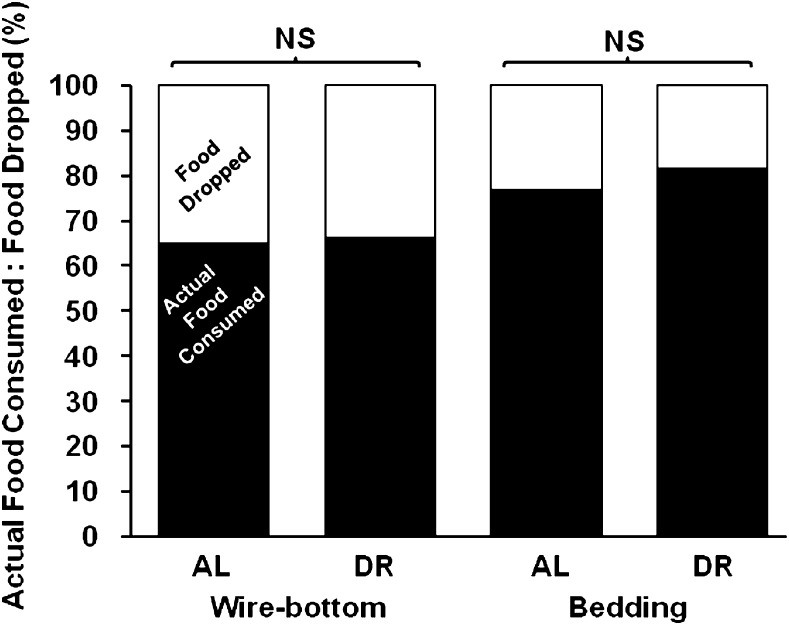
It is widely accepted that food consumption in humans declines with advanced age; however, data from mice remain controversial. Based on our previous observation that mice spill a considerable amount of food while eating, we hypothesized that increased food spillage in old mice masks actual food intake. To investigate whether mice exhibit age-associated declines in food consumption, we evaluated the actual food consumption of C57BL/6 mice at various ages by measuring both the amount of food in the food receptacle and the amount dropped to the cage bottom during feeding. We found that old mice dropped significantly more food (36% ± 8%) than young mice (18% ± 5%), which led to overestimations of food consumption, particularly in old mice. Although actual food consumption decreased in very old mice, food intake per body weight did not significantly change. These findings suggest that caution should be taken to accurately quantify food consumption by aged animals.
Figures
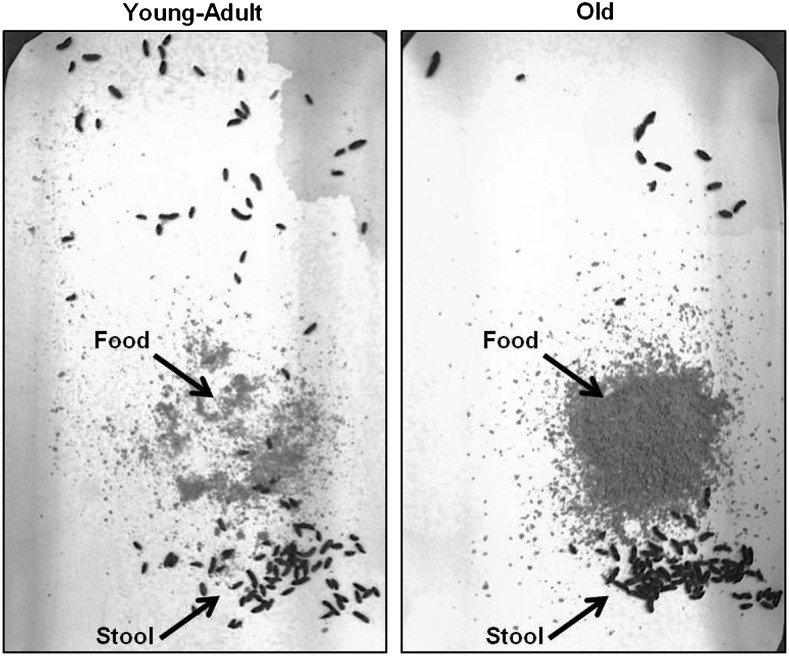
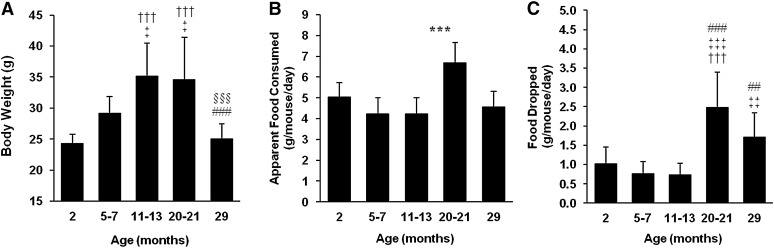
 Indicates statistically significant difference compared with
2-month-old mice.
Indicates statistically significant difference compared with
2-month-old mice.  Indicates statistically
significant difference compared with 5- to 7-month-old mice. #Indicates
statistically significant difference compared with 11- to 13-month-old mice.
§Indicates statistically significant difference compared with 20- to 21-month-old
mice. *Indicates statistically significant difference as compared with all other
groups. One, two, or three symbols indicate p < .05, .01, and
.001, respectively.
Indicates statistically
significant difference compared with 5- to 7-month-old mice. #Indicates
statistically significant difference compared with 11- to 13-month-old mice.
§Indicates statistically significant difference compared with 20- to 21-month-old
mice. *Indicates statistically significant difference as compared with all other
groups. One, two, or three symbols indicate p < .05, .01, and
.001, respectively.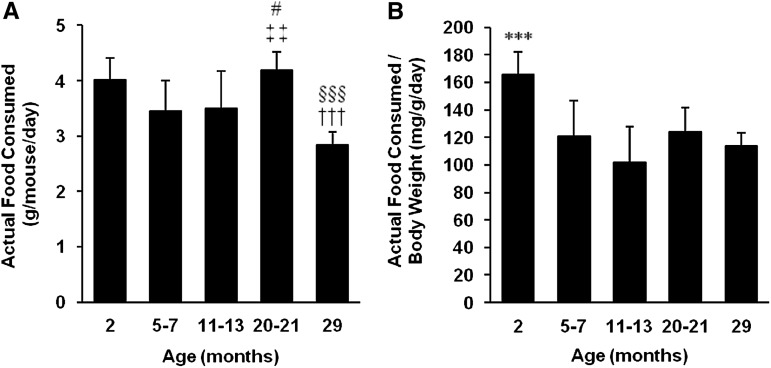 Indicates statistically
significant difference compared with 2-month-old mice. Indicates statistically significant difference compared with 5- to
7-month-old mice. #Indicates statistically significant difference compared with
11- to 13-month-old mice. §Indicates statistically significant difference
compared with 20- to 21-month-old mice. One, two, or three symbols indicate
p < .05, .01, and .001, respectively. (B) Actual
food consumed per body weight per day is the actual food consumed adjusted for body
weight. ***Indicates statistically significant difference as compared with
all other groups (p < .001).
Indicates statistically
significant difference compared with 2-month-old mice. Indicates statistically significant difference compared with 5- to
7-month-old mice. #Indicates statistically significant difference compared with
11- to 13-month-old mice. §Indicates statistically significant difference
compared with 20- to 21-month-old mice. One, two, or three symbols indicate
p < .05, .01, and .001, respectively. (B) Actual
food consumed per body weight per day is the actual food consumed adjusted for body
weight. ***Indicates statistically significant difference as compared with
all other groups (p < .001).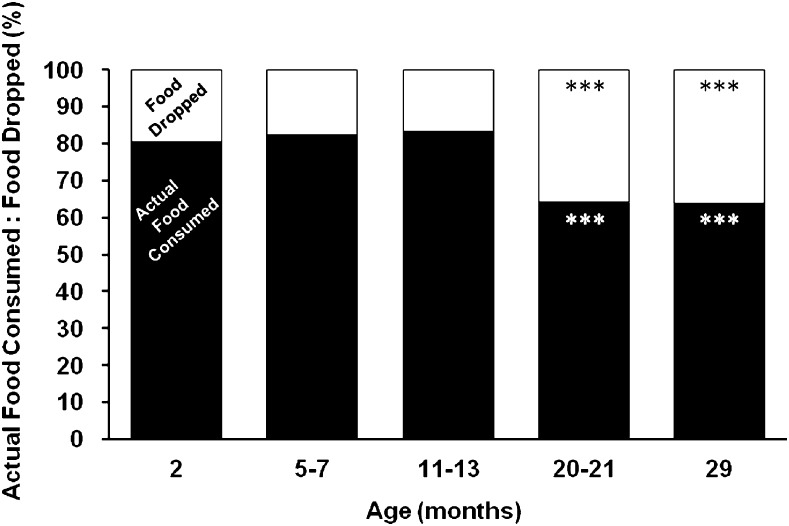
References
-
- Cameron KM, Speakman JR. The extent and function of ‘food grinding’ in the laboratory mouse (Mus musculus) Lab Anim. 2010;44(4):298–304. - PubMed
-
- Koteja P, Carter PA, Swallow JG, Garland T., Jr Food wasting by house mice: variation among individuals, families, and genetic lines. Physiol Behav. 2003;80(2–3):375–383. - PubMed
-
- Ueda J, Saito H, Watanabe H, Evers BM. Novel and quantitative DNA dot-blotting method for assessment of in vivo proliferation. Am J Physiol Gastrointest Liver Physiol. 2005;288(4):G842–G847. - PubMed
-
- Gesing A, Masternak MM, Wang F, et al. Expression of key regulators of mitochondrial biogenesis in growth hormone receptor knockout (GHRKO) mice is enhanced but is not further improved by other potential life-extending interventions. J Gerontol A Biol Sci Med Sci. 2011;66(10):1062–1076. - PMC - PubMed
Publication types
MeSH terms
Grants and funding
LinkOut - more resources
Full Text Sources
Medical
