


Both younger and older adults have difficulty updating emotional memories
- PMID: 22451483
- PMCID: PMC3578257
- DOI: 10.1093/geronb/gbs039
Both younger and older adults have difficulty updating emotional memories
Abstract
Objective: The main purpose of the study was to examine whether emotion impairs associative memory for previously seen items in older adults, as previously observed in younger adults.
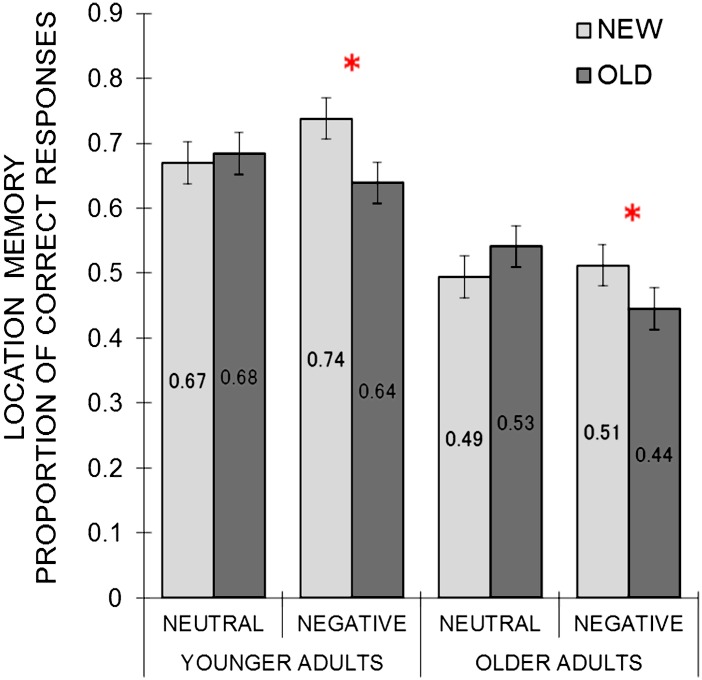
Method: Thirty-two younger adults and 32 older adults participated. The experiment consisted of 2 parts. In Part 1, participants learned picture-object associations for negative and neutral pictures. In Part 2, they learned picture-location associations for negative and neutral pictures; half of these pictures were seen in Part 1 whereas the other half were new. The dependent measure was how many locations of negative versus neutral items in the new versus old categories participants remembered in Part 2.
Results: Both groups had more difficulty learning the locations of old negative pictures than of new negative pictures. However, this pattern was not observed for neutral items.
Discussion: Despite the fact that older adults showed overall decline in associative memory, the impairing effect of emotion on updating associative memory was similar between younger and older adults.
Figures
References
-
- Achim AM, Lepage M. Neural correlates of memory for items and for associations: An event-related functional magnetic resonance imaging study. Journal of Cognitive Neuroscience. 2005;17:652–667. doi:10.1162/0898929053467578. - PubMed
-
- Allen JS, Bruss J, Brown CK, Damasio H. Normal neuroanatomical variation due to age: The major lobes and a parcellation of the temporal region. Neurobiology of Aging. 2005;26:1245–1260. doi:10.1016/j.neurobiolaging.2005.05.023. - PubMed
-
- Chalfonte BL, Johnson MK. Feature memory and binding in young and older adults. Memory & Cognition. 1996;24:403–416. doi:10.3758/BF03200930. - PubMed
-
- Chee MWL, Goh JOS, Venkatraman V, Tan JC, Gutchess A, Sutton B, Hebrank A, Park D. Age-related changes in object processing and contextual binding revealed using fMR adaptation. Journal of Cognitive Neuroscience. 2006;18:495–507. doi:10.1162/jocn.2006.18.4.495. - PubMed
-
- Izquierdo A, Murray EA. Opposing effects of amygdala and orbital prefrontal cortex lesions on the extinction of instrumental responding in macaque monkeys. European Journal of Neuroscience. 2005;22:2341–2346. doi:10.1111/j.1460-9568.2005.04434.x. - PubMed
