


Neural substrates of empathic accuracy in people with schizophrenia
- PMID: 22451493
- PMCID: PMC3627780
- DOI: 10.1093/schbul/sbs042
Neural substrates of empathic accuracy in people with schizophrenia
Abstract
Introduction: Empathic deficits in schizophrenia may lead to social dysfunction, but previous studies of schizophrenia have not modeled empathy through paradigms that (1) present participants with naturalistic social stimuli and (2) link brain activity to "accuracy" about inferring other's emotional states. This study addressed this gap by investigating the neural correlates of empathic accuracy (EA) in schizophrenia.
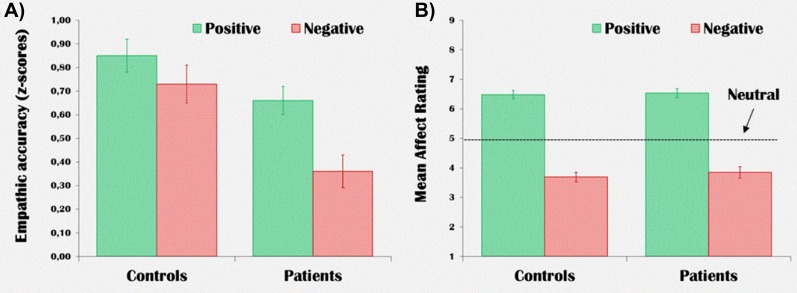
Methods: Fifteen schizophrenia patients and 15 controls were scanned while continuously rating the affective state of another person shown in a series of videos (ie, targets). These ratings were compared with targets' own self-rated affect, and EA was defined as the correlation between participants' ratings and targets' self-ratings. Targets' self-reported emotional expressivity also was measured. We searched for brain regions whose activity tracked parametrically with (1) perceivers' EA and (2) targets' expressivity.
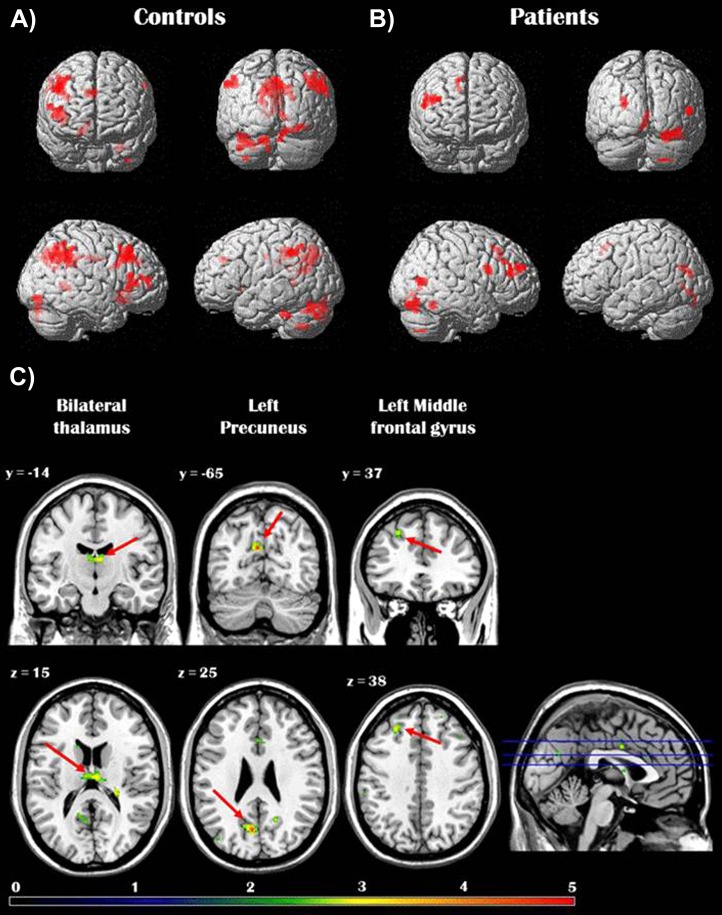
Results: Patients showed reduced EA compared with controls. The left precuneus, left middle frontal gyrus, and bilateral thalamus were significantly more correlated with EA in controls compared with patients. High expressivity in targets was associated with better EA in controls but not in patients. High expressivity was associated with increased brain activity in a large set of regions in controls (eg, fusiform gyrus, medial prefrontal cortex) but not in patients.
Discussion: These results use a naturalistic performance measure to confirm that schizophrenic patients demonstrate impaired ability to understand others' internal states. They provide novel evidence about a potential mechanism for this impairment: schizophrenic patients failed to capitalize on targets' emotional expressivity and also demonstrate reduced neural sensitivity to targets' affective cues.
Figures
References
-
- Eisenberg N, Miller PA. The relation of empathy to prosocial and related behaviors. Psychol Bull. 1987;101:91–119. - PubMed
-
- Blair RJ. Responding to the emotions of others: dissociating forms of empathy through the study of typical and psychiatric populations. Conscious Cogn. 2005;14:698–718. - PubMed
-
- Henry JD, Bailey PE, Rendell PG. Empathy, social functioning and schizotypy. Psychiatry Res. 2008;160:15–22. - PubMed
-
- Fakra E, Salgado-Pineda P, Delaveau P, Hariri AR, Blin O. Neural bases of different cognitive strategies for facial affect processing in schizophrenia. Schizophr Res. 2008;100:191–205. - PubMed
Publication types
MeSH terms
Grants and funding
LinkOut - more resources
Full Text Sources
Medical
Molecular Biology Databases
Miscellaneous
