Review
. 2012 Apr;198(4):737-45.
doi: 10.2214/AJR.11.7483.

Personalized tumor response assessment in the era of molecular medicine: cancer-specific and therapy-specific response criteria to complement pitfalls of RECIST

Affiliations
Review

Personalized tumor response assessment in the era of molecular medicine: cancer-specific and therapy-specific response criteria to complement pitfalls of RECIST

Mizuki Nishino et al. AJR Am J Roentgenol. 2012 Apr.

Abstract

Objective: The purpose of this article is to review cancer- and therapy-specific tumor response assessment criteria used in clinical trials and in practice, with illustrative case examples, and to discuss future directions toward "personalized" tumor response assessment.

Conclusion: Although Response Evaluation Criteria in Solid Tumors will remain as the primary generalized criteria for response assessment, newer cancer- and therapy-specific criteria will play an important role in providing state-of-the-art response assessment of tumor following molecular targeted therapy and will contribute to personalized cancer care in the era of molecular medicine.


Figures
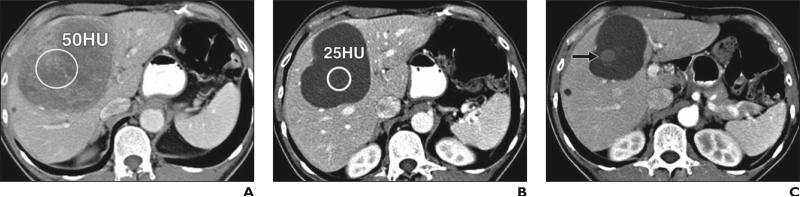
Fig. 1
Fig. 1
58-year-old man with advanced gastrointestinal stromal tumor with liver metastasis, treated with imatinib mesylate. A, Baseline contrast-enhanced CT of abdomen before therapy shows heterogeneously enhancing mass in liver representing metastasis, measuring 10 cm in longest diameter and 50 HU in CT attenuation (circle). B, Follow-up CT scan obtained 8 weeks after initiation of imatinib mesylate therapy shows significant decrease in CT attenuation of tumor (circle; 25 HU), meeting criteria for response by Choi criteria, with minimal decrease in size (9.5 cm in longest diameter). C, Patient continued receiving imatinib mesylate therapy. Follow-up CT scan at 2 years revealed new intratumoral tumor nodule (arrow), meeting criteria for progression by Choi criteria. Note measurement of longest diameter alone by Response Evaluation Criteria in Solid Tumors (7.5 cm) fails to detect progression. Adjacent small lesion in anterior segment of liver remained unchanged since baseline, most likely representing benign lesion.
Fig. 2
Fig. 2
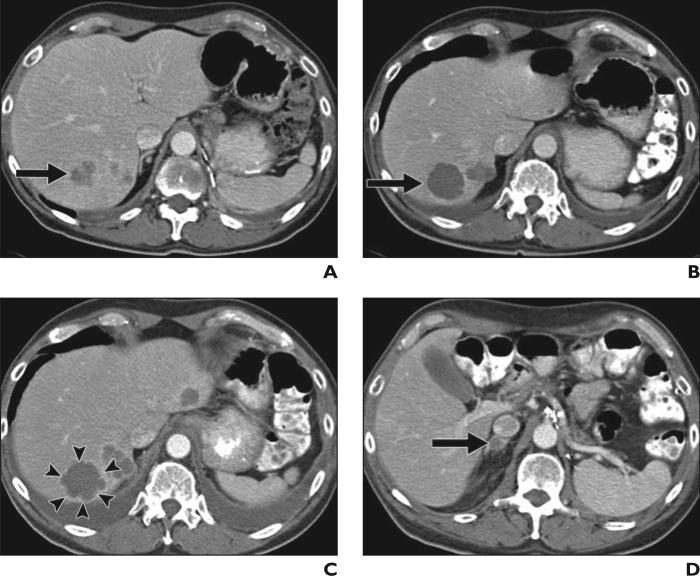
57-year-old man with metastatic renal cell carcinoma treated with antiangiogenic therapy using multitargeted receptor tyrosine kinase inhibitor, sunitinib malate. A, Baseline contrast-enhanced CT of abdomen before therapy shows heterogeneously enhancing mass (arrow) in posterior segment of liver with similar adjacent lesions, representing vascularized metastasis. B, Follow-up CT scan 12 weeks after initiation of sunitinib malate therapy shows significant decrease in CT attenuation of mass (arrow) to near fluid attenuation due to necrosis, showing “marked central necrosis” by morphology, attenuation, size, and structure (MASS) criteria and therefore “favorable response.” C and D, Follow-up CT scans at 20 weeks of sunitinib malate therapy show new enhancement in peripheral rim of mass (arrowheads, C), as well as new adrenal lesion (arrow, D), representing “unfavorable response” by MASS criteria.
Fig. 3
Fig. 3
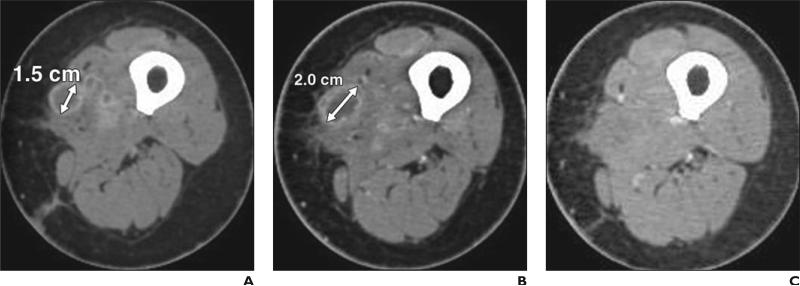
56-year-old woman with metastatic melanoma treated with ipilimumab. A, Baseline contrast-enhanced CT scan before ipilimumab therapy shows metastatic nodule (double-ended arrow) in left upper thigh, measuring 1.5 cm in longest diameter. B, Follow-up CT scan after 12 weeks of ipilimumab therapy reveals increase in size of nodule (double-ended arrow), measuring 2.0 cm in longest diameter. C, Follow-up CT scan after 24 weeks of ipilimumab therapy shows complete disappearance of nodule, representing response pattern C in immune-related response criteria.
Fig. 4
Fig. 4
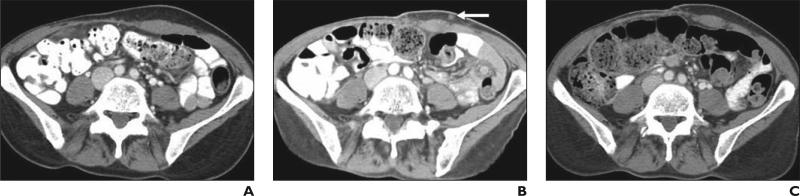
56-year-old woman with metastatic melanoma treated with ipilimumab. A and B, Contrast-enhanced CT scans of abdomen before (A) and 12 weeks after (B) initiation of ipilimumab therapy reveal new subcutaneous nodule (arrow, B) suspicious for new site of metastasis at 12 weeks. C, Follow-up CT scan at 24 weeks reveals resolution of nodule. Overall tumor burden also decreased, showing response pattern D in immune-related response criteria
Fig. 5
Fig. 5
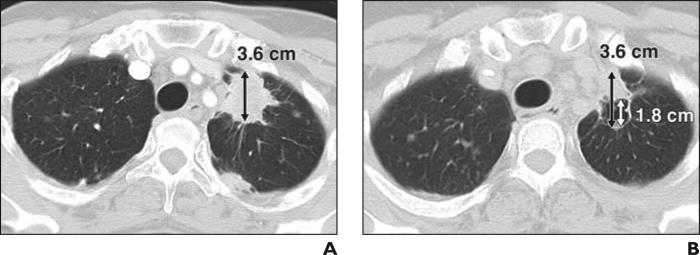
53-year-old woman with stage IV adenocarcinoma of lung treated with paclitaxel, carboplatin, and concurrent vascular epidermal growth factor receptor inhibitor, bevacizumab. A, Baseline CT scan of chest before bevacizumab therapy shows spiculated mass (double-ended arrow) in left upper lobe, which measured 3.6 cm in longest diameter. B, Follow-up CT after 6 weeks of therapy reveals development of tumor cavitation. Measurement of lesion by Response Evaluation Criteria in Solid Tumors would be 3.6 cm (black double-ended arrow), which is not different compared with baseline, even though decrease of tumor volume is evident after bevacizumab therapy. Using alternate method incorporating cavitation, measurement of lesion would be 1.8 cm (white double-ended arrow) because diameter of cavity (1.8 cm) should be extracted from longest diameter of entire lesion (3.6 cm). Measurement by alternate method shows 50% decrease compared with baseline, meeting criteria for partial response.

References

    1. Demetri GD, von Mehren M, Blanke CD, et al. Efficacy and safety of imatinib mesylate in advanced gastrointestinal stromal tumors. N Engl J Med. 2002;347:472–480. - PubMed
    1. Blanke CD, Rankin C, Demetri GD, et al. Phase III randomized, intergroup trial assessing imatinib mesylate at two dose levels in patients with unresectable or metastatic gastrointestinal stromal tumors expressing the kit receptor tyrosine kinase: S0033. J Clin Oncol. 2008;26:626–632. - PubMed
    1. Lynch TJ, Bell DW, Sordella R, et al. Activating mutations in the epidermal growth factor receptor underlying responsiveness of non-small-cell lung cancer to gefitinib. N Engl J Med. 2004;350:2129–2139. - PubMed
    1. Paez JG, Janne PA, Lee JC, et al. EGFR mutations in lung cancer: correlation with clinical response to gefitinib therapy. Science. 2004;304:1497–1500. - PubMed
    1. Pao W, Miller V, Zakowski M, et al. EGF receptor gene mutations are common in lung cancers from “never smokers” and are associated with sensitivity of tumors to gefitinib and erlotinib. Proc Natl Acad Sci USA. 2004;101:13306–13311. - PMC - PubMed

Publication types

MeSH terms

Substances