


Sex, puberty, and the timing of sleep EEG measured adolescent brain maturation
- PMID: 22451933
- PMCID: PMC3326502
- DOI: 10.1073/pnas.1120860109
Sex, puberty, and the timing of sleep EEG measured adolescent brain maturation
Abstract
The steep adolescent decline in the slow wave (delta, 1-4 Hz) electroencephalogram (EEG) of nonrapid eye movement (NREM) sleep is a dramatic maturational change in brain electrophysiology thought to be driven by cortical synaptic pruning. A perennial question is whether this change in brain electrophysiology is related to sexual maturation. Applying Gompertz growth models to longitudinal data spanning ages 9-18 y, we found that the timing of the delta decline was significantly (P < 0.0001) linked to timing of pubertal maturation. This timing relation remained significant when sex differences in the timing of the delta decline were statistically controlled. Sex differences and the relation to the timing of puberty jointly explained 67% of the between-subject variance in the timing of the delta decline. These data provide a demonstration of a temporal relation between puberty and an electrophysiological marker of adolescent brain development. They can guide research into whether the neuroendocrine events of puberty are mechanistically linked to cortical maturation or whether, instead, the two maturational processes are parallel but independent programs of human ontogenesis.
Conflict of interest statement
The authors declare no conflict of interest.
Figures
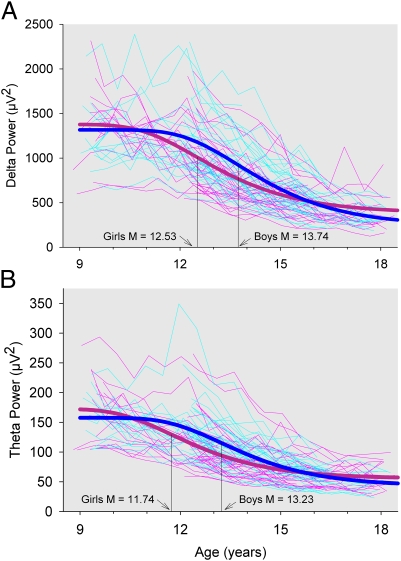
 . The age of steepest decline, M, differed significantly (P < 0.0001) between individual subjects and, on average, occurred earlier in girls (heavy pink) than in boys (heavy blue). (B) Theta power at each semiannual recording is plotted against age using the same format as in Fig. 1A. The age of steepest decline for theta differed significantly (P < 0.0001) between individual subjects, occurred earlier in girls than in boys, and occurred earlier than the age of steepest decline for delta.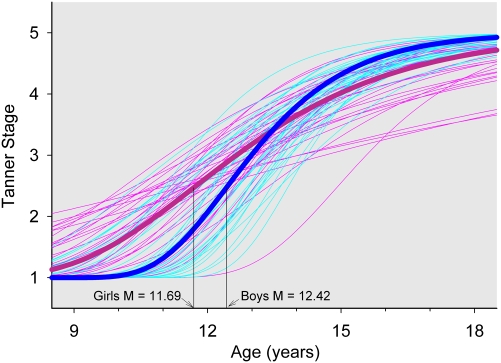
References
-
- Feinberg I. Schizophrenia: Caused by a fault in programmed synaptic elimination during adolescence? J Psychiatr Res. 1982-1983/1983;17:319–334. - PubMed
-
- Jenni OG, Carskadon MA. Spectral analysis of the sleep electroencephalogram during adolescence. Sleep. 2004;27:774–783. - PubMed
-
- Tononi G, Cirelli C. Sleep function and synaptic homeostasis. Sleep Med Rev. 2006;10:49–62. - PubMed
-
- Huttenlocher PR. Synaptic density in human frontal cortex - developmental changes and effects of aging. Brain Res. 1979;163:195–205. - PubMed
Publication types
MeSH terms
Grants and funding
LinkOut - more resources
Full Text Sources
Medical
