. 2012 Mar 28:11:92.
doi: 10.1186/1475-2875-11-92.

Large-scale survey for novel genotypes of Plasmodium falciparum chloroquine-resistance gene pfcrt

Affiliations

Large-scale survey for novel genotypes of Plasmodium falciparum chloroquine-resistance gene pfcrt

Nobuyuki Takahashi et al. Malar J. .

Abstract

Background: In Plasmodium falciparum, resistance to chloroquine (CQ) is conferred by a K to T mutation at amino acid position 76 (K76T) in the P. falciparum CQ transporter (PfCRT). To date, at least 15 pfcrt genotypes, which are represented by combinations of five amino acids at positions 72-76, have been described in field isolates from various endemic regions. To identify novel mutant pfcrt genotypes and to reveal the genetic relatedness of pfcrt genotypes, a large-scale survey over a wide geographic area was performed.

Methods: Sequences for exon 2 in pfcrt, including known polymorphic sites at amino acid positions 72, 74, 75 and 76, were obtained from 256 P. falciparum isolates collected from eight endemic countries in Asia (Bangladesh, Cambodia, Lao P.D.R., the Philippines and Thailand), Melanesia (Papua New Guinea and Vanuatu) and Africa (Ghana). A haplotype network was constructed based on six microsatellite markers located -29 kb to 24 kb from pfcrt in order to examine the genetic relatedness among mutant pfcrt genotypes.

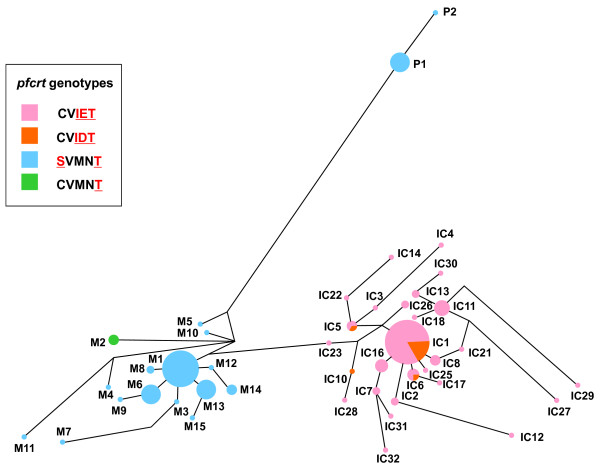
Results: In addition to wild type (CVMNK at positions 72-76), four mutant pfcrt were identified; CVIET, CVIDT, SVMNT and CVMNT (mutated amino acids underlined). Haplotype network revealed that there were only three mutant pfcrt lineages, originating in Indochina, Philippines and Melanesia. Importantly, the Indochina lineage contained two mutant pfcrt genotypes, CVIET (n = 95) and CVIDT (n = 14), indicating that CVIDT shares a common origin with CVIET. Similarly, one major haplotype in the Melanesian lineage contained two pfcrt genotypes; SVMNT (n = 71) and CVMNT (n = 3). In Africa, all mutant pfcrt genotypes were the CVIET of the Indochina lineage, probably resulting from the intercontinental migration of CQ resistance from Southeast Asia.

Conclusions: The number of CQ-mutant lineages observed in this study was identical to that found in previous studies. This supports the hypothesis that the emergence of novel CQ resistance is rare. However, in the mutant pfcrt genotypes, amino acid changes at positions 72, 74 and 75 appear to have recently been generated at least several times, producing distinct pfcrt mutant genotypes. The occurrence of new mutations flanking K76T may yield stronger resistance to CQ and/or a higher fitness than the original pfcrt mutant.


Figures
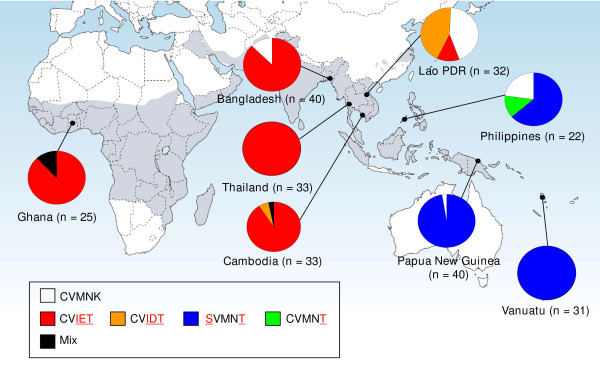
Figure 1
Figure 1
Geographical distribution of pfcrt genotypes in 256 Plasmodium falciparum isolates from eight countries in Asia, Africa and Melanesia. Capital letters in the box denote amino acid residues at positions 72, 73, 74, 75 and 76, with mutations identified in red. Mixed genotypes include combinations of CVIE/DT (n = 1), CVMNK/T (n = 1), CVIN/ET (n = 1) and CVIEK/T (n = 1). Gray colour shows a malaria endemic area.
Figure 2
Figure 2
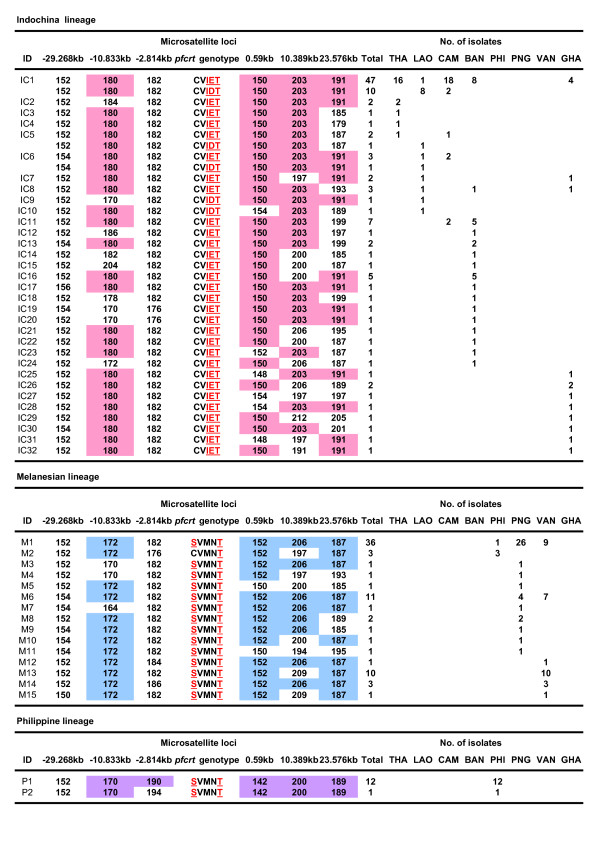
Microsatellite haplotypes found in 196 chloroquine-resistant P. falciparum isolates from eight countries in Asia, Africa and Melanesia. The number of TA repeats at each MS locus is shown. MS alleles in the most frequent haplotype are shown in pink (Indochina lineage), blue (Melanesian lineage) and violet (Philippine lineage). THI; Thailand, LAO; Lao P.D.R., CAM; Cambodia, BAN; Bangladesh, PHI; Philippines, PNG; Papua New Guinea, VAN; Vanuatu, GHA; Ghana.
Figure 3
Figure 3
Haplotype network diagram in Plasmodium falciparum isolates harbouring pfcrt mutation. Network tree is shown according to pfcrt genotypes. The haplotype network was constructed for 196 P. falciparum isolates harbouring pfcrt mutation comprises 49 microsatellite haplotypes, based on allelic variations in six microsatellite loci flanking the pfcrt locus (see text for details). The size of each circle corresponds to the number of samples sharing the same haplotype, and the length of an edge is proportional to a variation in repeat number between two haplotypes. IC; Indochina lineage, M; Melanesian lineage, P; Philippine lineage.
Figure 4
Figure 4
Haplotype network diagram in Plasmodium falciparum isolates harbouring pfcrt mutation. Network tree is shown according to countries where samples were taken. The haplotype network was constructed for 196 P. falciparum isolates harbouring pfcrt mutation comprises 49 microsatellite haplotypes, based on allelic variations in six microsatellite loci flanking the pfcrt locus (see text for details). The size of each circle corresponds to the number of samples sharing the same haplotype, and the length of an edge is proportional to a variation in repeat number between two haplotypes. IC; Indochina lineage, M; Melanesian lineage, P; Philippine lineage.

References

    1. Wootton JC, Feng X, Ferdig MT, Cooper RA, Mu J, Baruch DI, Magill AJ, Su XZ. Genetic diversity and chloroquine selective sweeps in Plasmodium falciparum. Nature. 2002;418:320–323. doi: 10.1038/nature00813. - DOI - PubMed
    1. Nair S, Williams JT, Brockman A, Paiphun L, Mayxay M, Newton PN, Guthmann JP, Smithuis FM, Hien TT, White NJ, Nosten F, Anderson TJ. A selective sweep driven by pyrimethamine treatment in Southeast Asian malaria parasites. Mol Biol Evol. 2003;20:1526–1536. doi: 10.1093/molbev/msg162. - DOI - PubMed
    1. Roper C, Pearce R, Nair S, Sharp B, Nosten F, Anderson T. Intercontinental spread of pyrimethamine-resistant malaria. Science. 2004;305:1124. doi: 10.1126/science.1098876. - DOI - PubMed
    1. Mita T, Tanabe K, Kita K. Spread and evolution of Plasmodium falciparm drug resistance. Parasitol Int. 2009;58:201–209. doi: 10.1016/j.parint.2009.04.004. - DOI - PubMed
    1. Harinasuta T, Suntharasamai P, Viravan C. Chloroquine-resistant falciparum malaria in Thailand. Lancet. 1965;2:657–660. - PubMed

Publication types

LinkOut - more resources