Risk factors for mortality from imported falciparum malaria in the United Kingdom over 20 years: an observational study
- PMID: 22454091
- PMCID: PMC3314185
- DOI: 10.1136/bmj.e2116
Risk factors for mortality from imported falciparum malaria in the United Kingdom over 20 years: an observational study
Abstract
Objectives: To determine which travellers with malaria are at greatest risk of dying, highlighting factors which can be used to target health messages to travellers.
Design: Observational study based on 20 years of UK national data.
Setting: National register of malaria cases.
Participants: 25,054 patients notified with Plasmodium falciparum malaria, of whom 184 died, between 1987 and 2006.
Main outcome measures: Comparison between those with falciparum malaria who died and non-fatal cases, including age, reason for travel, country of birth, time of year diagnosed, malaria prophylaxis used.
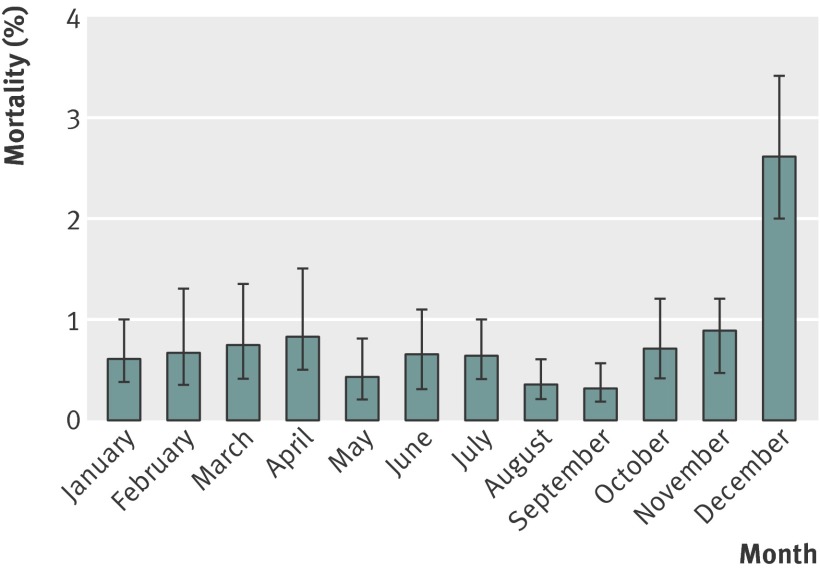
Results: Mortality increased steadily with age, with a case fatality of 25/548 (4.6%) in people aged >65 years, adjusted odds ratio 10.68 (95% confidence interval 6.4 to 17.8), P<0.001 compared with 18-35 year olds. There were no deaths in the ≤ 5 year age group. Case fatality was 3.0% (81/2740 cases) in tourists compared with 0.32% (26/8077) in travellers visiting friends and relatives (adjusted odds ratio 8.2 (5.1 to 13.3), P<0.001). Those born in African countries with endemic malaria had a case fatality of 0.4% (36/8937) compared with 2.4% (142/5849) in others (adjusted odds ratio 4.6 (3.1 to 9.9), P<0.001). Case fatality was particularly high from the Gambia. There was an inverse correlation in mortality between region of presentation and number of cases seen in the region (R(2) = 0.72, P<0.001). Most delay in fatal cases was in seeking care.
Conclusions: Most travellers acquiring malaria are of African heritage visiting friends and relatives. In contrast the risks of dying from malaria once acquired are highest in the elderly, tourists, and those presenting in areas in which malaria is seldom seen. Doctors often do not think of these as high risk groups for malaria; for this reason they are important groups to target in pre-travel advice.
Conflict of interest statement
Competing interests: All authors have completed the Unified Competing Interest form at
Figures



References
-
- World Health Organization. World Malaria Report 2010. 2010. www.who.int/malaria/publications/atoz/9789241564106/en/index.html.
-
- HPA. Press releases, 2011. 2011. www.hpa.org.uk/NewsCentre/NationalPressReleases/2011PressReleases/110425....
-
- Dubos F, Dauriac A, El Mansouf L, Courouble C, Aurel M, Martinot A. Imported malaria in children: incidence and risk factors for severity. Diagn Microbiol Infect Dis 2010;66:169-74. - PubMed
-
- Jensenius M, Ronning EJ, Blystad H, Bjorneklett A, Hellum KB, Bucher A, et al. Low frequency of complications in imported falciparum malaria: a review of 222 cases in south-eastern Norway. Scand J Infect Dis 1999;31:73-8. - PubMed
Publication types
MeSH terms
Substances
LinkOut - more resources
Full Text Sources
Medical