


Reproducibility of tumor uptake heterogeneity characterization through textural feature analysis in 18F-FDG PET
- PMID: 22454484
- PMCID: PMC3779464
- DOI: 10.2967/jnumed.111.099127
Reproducibility of tumor uptake heterogeneity characterization through textural feature analysis in 18F-FDG PET
Abstract
(18)F-FDG PET measurement of standardized uptake value (SUV) is increasingly used for monitoring therapy response and predicting outcome. Alternative parameters computed through textural analysis were recently proposed to quantify the heterogeneity of tracer uptake by tumors as a significant predictor of response. The primary objective of this study was to evaluate the reproducibility of these heterogeneity measurements.
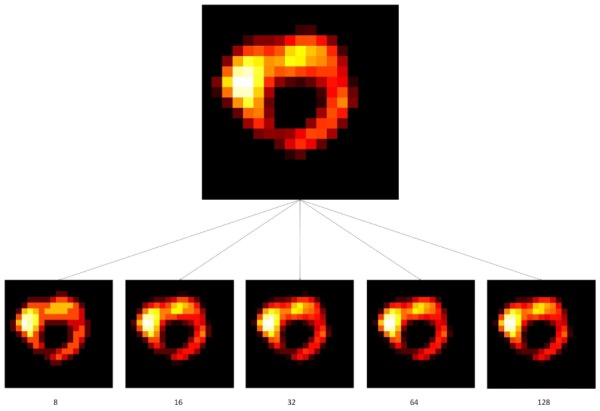
Methods: Double baseline (18)F-FDG PET scans were acquired within 4 d of each other for 16 patients before any treatment was considered. A Bland-Altman analysis was performed on 8 parameters based on histogram measurements and 17 parameters based on textural heterogeneity features after discretization with values between 8 and 128.
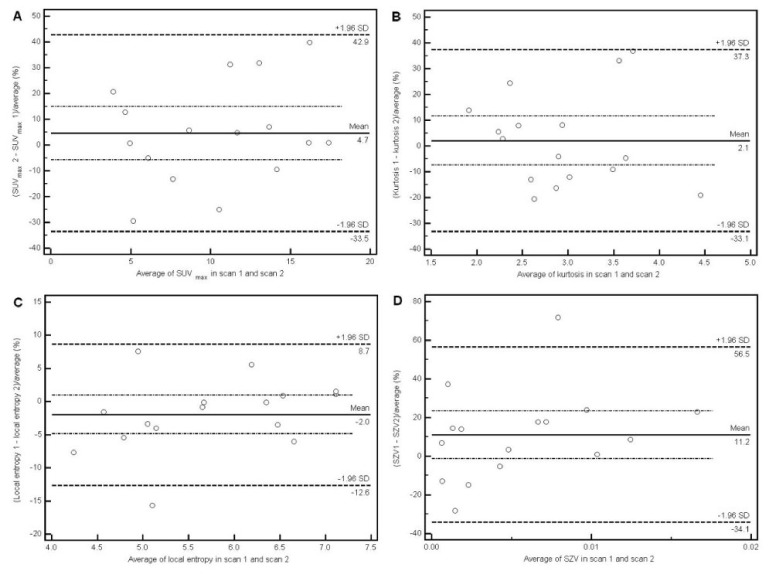
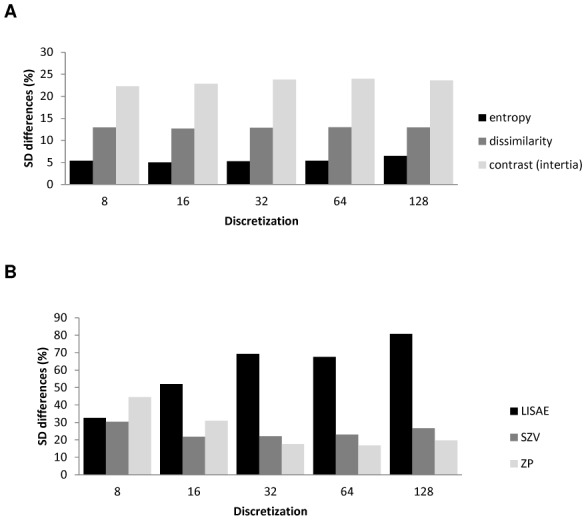
Results: The reproducibility of maximum and mean SUV was similar to that in previously reported studies, with a mean percentage difference of 4.7% ± 19.5% and 5.5% ± 21.2%, respectively. By comparison, better reproducibility was measured for some textural features describing local heterogeneity of tracer uptake, such as entropy and homogeneity, with a mean percentage difference of -2% ± 5.4% and 1.8% ± 11.5%, respectively. Several regional heterogeneity parameters such as variability in the intensity and size of regions of homogeneous activity distribution had reproducibility similar to that of SUV measurements, with 95% confidence intervals of -22.5% to 3.1% and -1.1% to 23.5%, respectively. These parameters were largely insensitive to the discretization range.
Conclusion: Several parameters derived from textural analysis describing heterogeneity of tracer uptake by tumors on local and regional scales had reproducibility similar to or better than that of simple SUV measurements. These reproducibility results suggest that these (18)F-FDG PET-derived parameters, which have already been shown to have predictive and prognostic value in certain cancer models, may be used to monitor therapy response and predict patient outcome.
Figures
Comment in
-
Marker selection based on only reproducibility can be questioned.J Nucl Med. 2012 Dec;53(12):1993; author reply 1993. doi: 10.2967/jnumed.112.108985. Epub 2012 Oct 12. J Nucl Med. 2012. PMID: 23064213 No abstract available.
References
-
- Cazaentre T, Morschhauser F, Vermandel M, et al. Pre-therapy 18F PET quantitative parameters help in predicting the response to radioimmunotherapy in non-Hodgkin lymphoma. Eur J Nucl Med Mol Imaging. 2010;37:494–504. - PubMed
-
- Rizk NP, Tang L, Adusumilli PS, et al. Predictive value of initial PET SUVmax in patients with locally advanced esophageal and gastroesophageal junction adenocarcinoma. J Thoracic Oncol. 2009;4:875–879. - PubMed
-
- Shamim SA, Kumar R, Shandal V, et al. FDG PET/CT evaluation of treatment response in patients with recurrent colorectal cancer. Clin Nucl Med. 2011;36:11–16. - PubMed
Publication types
MeSH terms
Substances
LinkOut - more resources
Full Text Sources
Other Literature Sources
Medical
