


A novel design of grooved fibers for fiber-optic localized plasmon resonance biosensors
- PMID: 22454595
- PMCID: PMC3312454
- DOI: 10.3390/s90806456
A novel design of grooved fibers for fiber-optic localized plasmon resonance biosensors
Abstract
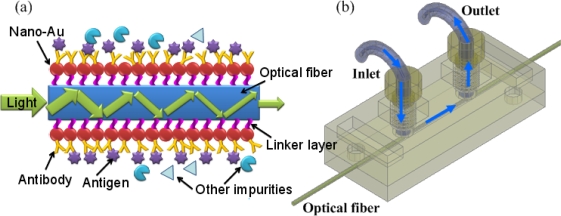
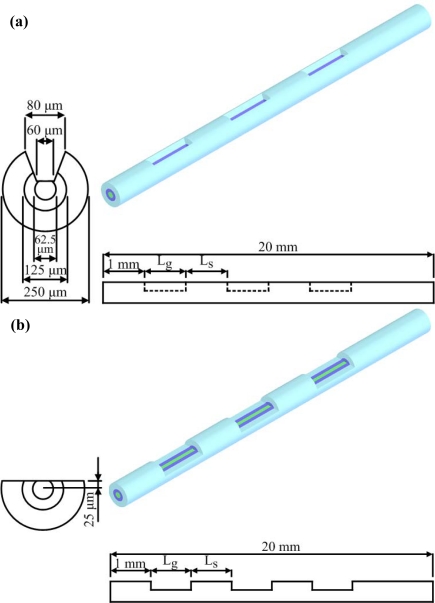
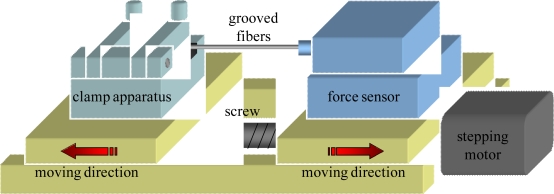
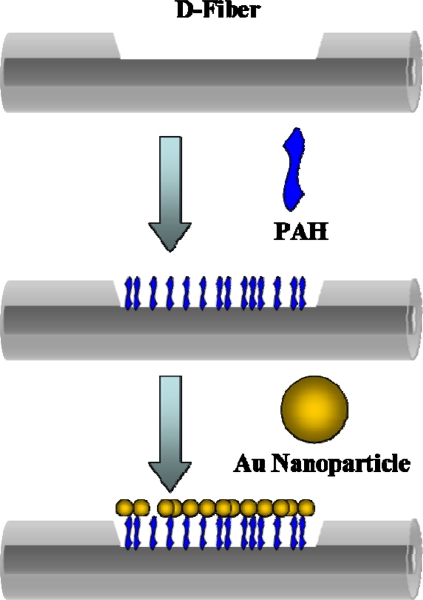
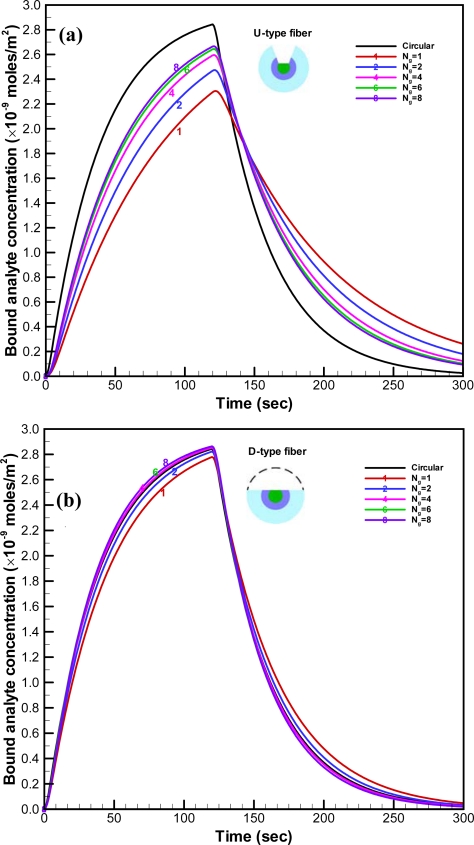
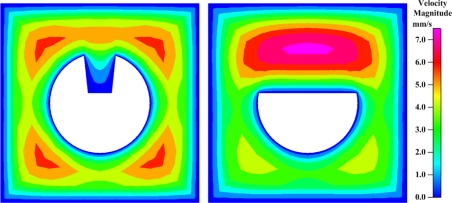
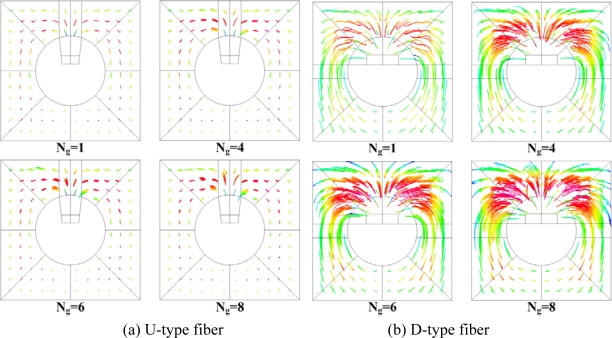
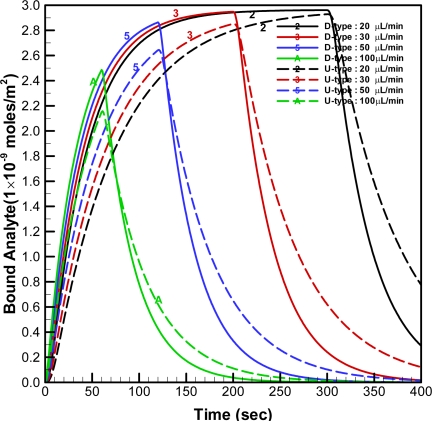
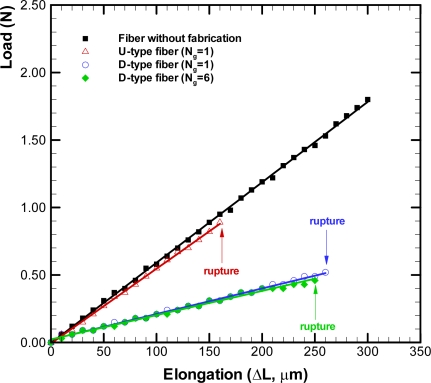
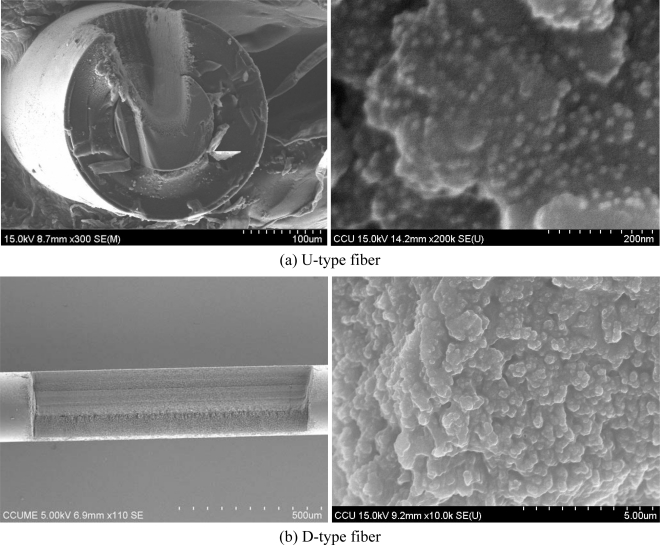
Bio-molecular recognition is detected by the unique optical properties of self-assembled gold nanoparticles on the unclad portions of an optical fiber whose surfaces have been modified with a receptor. To enhance the performance of the sensing platform, the sensing element is integrated with a microfluidic chip to reduce sample and reagent volume, to shorten response time and analysis time, as well as to increase sensitivity. The main purpose of the present study is to design grooves on the optical fiber for the FO-LPR microfluidic chip and investigate the effect of the groove geometry on the biochemical binding kinetics through simulations. The optical fiber is designed and termed as U-type or D-type based on the shape of the grooves. The numerical results indicate that the design of the D-type fiber exhibits efficient performance on biochemical binding. The grooves designed on the optical fiber also induce chaotic advection to enhance the mixing in the microchannel. The mixing patterns indicate that D-type grooves enhance the mixing more effectively than U-type grooves. D-type fiber with six grooves is the optimum design according to the numerical results. The experimental results show that the D-type fiber could sustain larger elongation than the U-type fiber. Furthermore, this study successfully demonstrates the feasibility of fabricating the grooved optical fibers by the femtosecond laser, and making a transmission-based FO-LPR probe for chemical sensing. The sensor resolution of the sensor implementing the D-type fiber modified by gold nanoparticles was 4.1 × 10(-7) RIU, which is much more sensitive than that of U-type optical fiber (1.8 × 10(-3) RIU).
Keywords: biosensor; fiber-optic localized plasmon resonance; microfluidic.
Figures
References
-
- Cheng S.F., Chau L.K. Colloidal gold-modified optical fiber for chemical and biochemical sensing. Anal. Chem. 2003;75:16–21. - PubMed
-
- Chau L.K., Lin Y.F., Cheng S.F., Lin T.J. Fiber-optic chemical and biochemical probes based on localized surface plasmon resonance. Sens. Actuat. B: Chem. 2006;113:100–105.
-
- Lai N.S., Wang CC., Chiang H.L., Chau L.K. Detection of antinuclear antibodies by a colloidal gold modified optical fiber: comparison with ELISA. Anal. Bioanal. Chem. 2007;388:901–907. - PubMed
-
- Nath N., Chikoti A. A colorimetric gold nanoparticle sensor to interrogate biomolecular interactions in real time on a surface. Anal. Chem. 2002;74:504–509. - PubMed
-
- Jen C.P., Huang C.T., Lu Y.H. Simulation of biochemical binding kinetics on the microfluidic biochip of fiber-optic localized plasma resonance (FO-LPR) Microelectron. Eng. 2009 doi: 10.1016/j.mee.2008.12.084. - DOI
LinkOut - more resources
Full Text Sources
Other Literature Sources
