Review
. 2012:2012:912147.
doi: 10.1100/2012/912147. Epub 2012 Feb 2.

Yeast as a tool to study signaling pathways in mitochondrial stress response and cytoprotection

Affiliations
Review

Yeast as a tool to study signaling pathways in mitochondrial stress response and cytoprotection

Maša Zdralević et al. ScientificWorldJournal. 2012.

Abstract

Cell homeostasis results from the balance between cell capability to adapt or succumb to environmental stress. Mitochondria, in addition to supplying cellular energy, are involved in a range of processes deciding about cellular life or death. The crucial role of mitochondria in cell death is well recognized. Mitochondrial dysfunction has been associated with the death process and the onset of numerous diseases. Yet, mitochondrial involvement in cellular adaptation to stress is still largely unexplored. Strong interest exists in pharmacological manipulation of mitochondrial metabolism and signaling. The yeast Saccharomyces cerevisiae has proven a valuable model organism in which several intracellular processes have been characterized in great detail, including the retrograde response to mitochondrial dysfunction and, more recently, programmed cell death. In this paper we review experimental evidences of mitochondrial involvement in cytoprotection and propose yeast as a model system to investigate the role of mitochondria in the cross-talk between prosurvival and prodeath pathways.


Figures
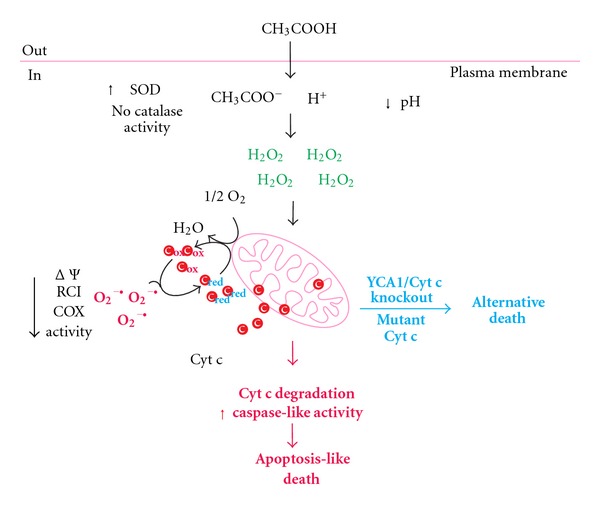
Figure 1
Figure 1
AA-PCD pathways. Acetic acid enters in yeast cells and dissociates into acetate and protons causing intracellular acidification. H2O2 accumulates, SOD activity increases, while catalase activity is undetectable. En route to AA-PCD, cyt c is released and works as an electron donor (cred) to mitochondrial respiratory chain and as superoxide anion (O2 −•) scavenger (cox). In a late phase, cyt c is degraded by unidentified proteases. Mitochondrial functions progressively decline with decrease in mitochondrial membrane potential (ΔΨ), respiratory control index (RCI) and COX activity. Caspase-like activity increases in a late phase (red lines). Alternative programmed cell death is induced by acetic acid in YCA1 and/or cyt c knockout cells or in mutant cyt c cells (blue lines).
Figure 2
Figure 2
Signaling pathways possibly involved in the interplay between cell death and cytoprotection processes in yeast cells in response to acetic acid stress. Acetic acid causes intracellular acidification, mitochondrial dysfunction, and cell death. TOR pathway is involved in the signaling of AA-PCD; rapamycin inhibition of TOR can trigger autophagy and RTG target gene expression. Dotted lines indicate the hypothetical signaling pathways in AA-PCD regulation in response to mitochondrial dysfunction, on the basis of indirect experimental evidence (see text for details). Intracellular acidification stimulates RAS-cAMP signaling pathway, causing mitochondrial dysfunction, which may lead to AA-PCD or activate retrograde response inducing AA-PCD resistance. RAS pathway negatively regulates Mks1p, a negative regulator of RTG pathway. Positive and negative regulators of RTG pathway are shown in blue and red, respectively. TOR signaling is found at the crossroad of RTG, AA-PCD, and autophagy pathways.

References

    1. Kerr JF, Wyllie AH, Currie AR. Apoptosis: a basic biological phenomenon with wide-ranging implications in tissue kinetics. British Journal of Cancer. 1972;26(4):239–257. - PMC - PubMed
    1. Kroemer G, Galluzzi L, Vandenabeele P, et al. Classification of cell death: recommendations of the Nomenclature Committee on Cell Death 2009. Cell Death and Differentiation. 2009;16(1):3–11. - PMC - PubMed
    1. Peter ME. Programmed cell death: apoptosis meets necrosis. Nature. 2011;471(7338):310–312. - PubMed
    1. Yuan J, Kroemer G. Alternative cell death mechanisms in development and beyond. Genes and Development. 2010;24(23):2592–2602. - PMC - PubMed
    1. Fulda S, Gorman AM, Hori O, Samali A. Cellular stress responses: cell survival and cell death. International Journal of Cell Biology. 2010;2010:p. 23. Article ID 214074. - PMC - PubMed

Publication types

LinkOut - more resources
