. 2012 Jul;7(3):405-14.
doi: 10.1007/s12263-012-0293-7. Epub 2012 Mar 29.

Suppressed hepcidin expression correlates with hypotransferrinemia in copper-deficient rat pups but not dams

Affiliations

Suppressed hepcidin expression correlates with hypotransferrinemia in copper-deficient rat pups but not dams

Margaret Broderius et al. Genes Nutr. 2012 Jul.

Abstract

Copper deficiency leads to anemia but the mechanism is unknown. Copper deficiency also leads to hypoferremia, which may limit erythropoiesis. The hypoferremia may be due to limited function of multicopper oxidases (MCO) hephaestin in enterocytes or GPI-ceruloplasmin in macrophages of liver and spleen whose function as a ferroxidase is thought essential for iron transfer out of cells. Iron release may also be limited by ferroportin (Fpn), the iron efflux transporter. Fpn may be lower following copper deficiency because of impaired ferroxidase activity of MCO. Fpn is also dependent on the liver hormone hepcidin as Fpn is degraded when hepcidin binds to Fpn. Anemia and hypoferremia both down regulate hepcidin by separate mechanisms. Current studies confirmed and extended earlier studies with copper-deficient (CuD) rats that suggested low hepicidin resulted in augmented Fpn. However, current studies in CuD dams failed to confirm a correlation that hepcidin expression was associated with low transferrin receptor 2 (TfR2) levels and also challenged the dogma that holotransferrin can explain the correlation with hepcidin. CuD dams exhibited hypoferremia, low liver TfR2, anemia in some rats, yet no depression in Hamp expression, the hepcidin gene. Normal levels of GDF-15, the putative erythroid cytokine that suppresses hepcidin, were detected in plasma of CuD and iron-deficient (FeD) dams. Importantly, FeD dams did display greatly lower Hamp expression. Normal hepcidin in these CuD dams is puzzling since these rats may need extra iron to meet needs of lactation and the impaired iron transfer noted previously.


Figures

Fig. 1
Fig. 1
Relative liver copper (a), liver iron (b), hemoglobin (c), and plasma iron concentrations (d) in P26 female pups and Dams1 fed modified AIN-76A diet or P25 male pups and Dams2 fed modified AIN-93G diets. Values are means ± SEM (n = 4). Cu-deficient means (gray fill) were significantly different than Cu-adequate (open fill), *P < 0.05 (Student’s t test). Dams2 data were analyzed by ANOVA. Means with different letters are significantly different, P < 0.05. Iron-deficient bars (solid fill) are shown
Fig. 2
Fig. 2
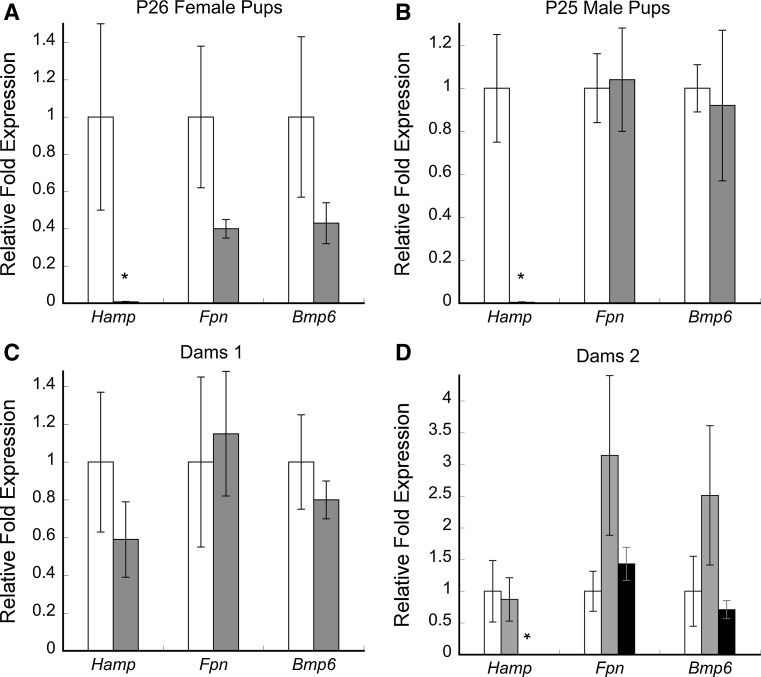
Relative hepatic gene expression in P26 female rat pups (a), P25 male rat pups (b) and their respective dams (c) and (d). Values are means ± SEM (n = 4). Cu-deficient means (gray fill) and iron-deficient means (solid fill) were significantly different than Cu-adequate (open bars), *P < 0.05 (Student’s t test or ANOVA)
Fig. 3
Fig. 3
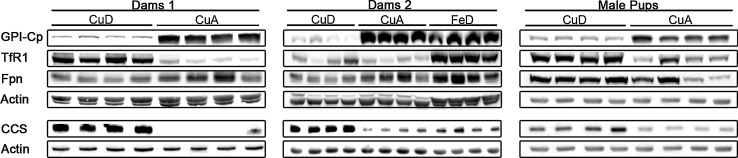
Hepatic protein levels of GPI-ceruloplasmin, transferrin receptor 1, transferrin receptor 2, ferroportin, and scavenger receptor-binding protein 1 following copper deficiency (CuD) or iron deficiency (FeD) in rat Dams1 fed modified AIN-76A diets, or rat Dams2 and P25 male pups fed modified AIN-93G diets. Immunoblots were performed on 10 % SDS–PAGE gels
Fig. 4
Fig. 4
Splenic protein levels of GPI-ceruloplasmin, transferrin receptor 1, ferroportin, and actin in membranes or copper chaperone for superoxide dismutase and actin in cytosol following copper deficiency (CuD) or iron deficiency (FeD) in rat Dams1 fed modified AIN-76A diets, or rat Dams2 and P25 male pups fed modified AIN-93G diets. Immunoblots were performed on 10 % SDS–PAGE gels for membranes and 15 % gels for cytosol
Fig. 5
Fig. 5
Correlation between plasma iron concentration and the natural log of liver Hamp expression in 20 rat dams maintained on either copper-adequate (CuA), copper-deficient (CuD), or iron-deficient (FeD) treatment. A bar separates 8 CuA from 8 CuD values
Fig. 6
Fig. 6
Plasma protein levels of ceruloplasmin, transferrin, and growth differentiation factor 15 following copper deficiency (CuD) or iron deficiency (FeD) in rat dams fed modified AIN-93G diets. Immunoblots were performed on 10 % SDS–PAGE gels

References

    1. Bartnikas TB, Andrews NC, Fleming MD. Transferrin is a major determinant of hepcidin expression in hypotransferrinemic mice. Blood. 2011;117:630–637. doi: 10.1182/blood-2010-05-287359. - DOI - PMC - PubMed
    1. Bastian TW, Prohaska JR, Georgieff MK, Anderson GW. Perinatal iron and copper deficiencies alter neonatal rat circulating and brain thyroid hormone concentrations. Endocrinology. 2010;151:4055–4065. doi: 10.1210/en.2010-0252. - DOI - PMC - PubMed
    1. Bastian TW, Lassi KC, Anderson GW, Prohaska JR. Maternal iron supplementation attenuates the impact of perinatal copper deficiency but does not eliminate hypotriiodothyroninemia nor impaired sensorimotor development. J Nutr Biochem. 2011;22:1084–1090. doi: 10.1016/j.jnutbio.2010.09.007. - DOI - PMC - PubMed
    1. Broderius M, Mostad E, Wendroth K, Prohaska JR. Levels of plasma ceruloplasmin protein are markedly lower following dietary copper deficiency in rodents. Comp Biochem Physiol C. 2010;151:473–479. - PMC - PubMed
    1. Bustin SA, Benes V, Garson JA, Hellemans J, Huggett J, Kubista M, Mueller R, Nolan T, Pfaffl MW, Shipley GL, Vandesompele J, Wittwer CT. The MIQE guidelines: minimum information for publication of quantitative real-time PCR experiments. Clin Chem. 2009;55:611–622. doi: 10.1373/clinchem.2008.112797. - DOI - PubMed

LinkOut - more resources